O’Callaghan hangs on after bruising week
Mike Finnerty 22 Apr 2026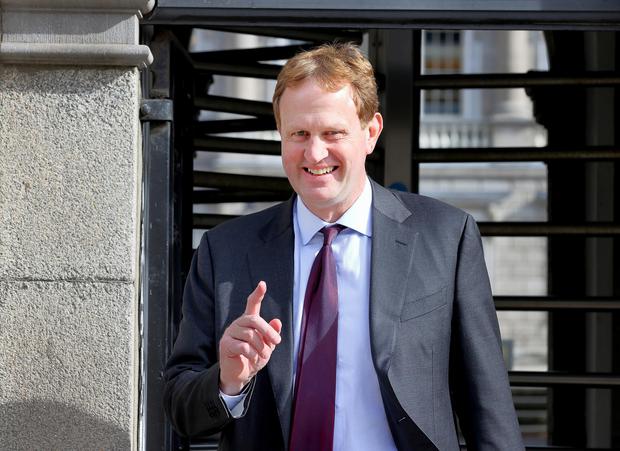
Minister For Justice Jim O’Callaghan has emerged wounded, but not defeated, from the biggest week of his political career.
The Dublin Bay South TD was named as Minister for Justice in January 2025, and the Minister had to make the biggest call of his time as Minister during the fuel protests; he decided to send in the Irish armed forces to disperse protesters.
In a statement on April 9, Minister O’Callaghan stated “the blocking of critical national infrastructure will not be permitted to continue, and the assistance of the Defence Forces has been requested.”
“Large vehicles blocking critical infrastructure will be removed. Owners of those vehicles should remove them immediately this morning and should not complain later about any damage caused to those vehicles during removal.”
“Denying people access to fuel and clean water is an unacceptable interference in the most basic of human rights,” the statement read.
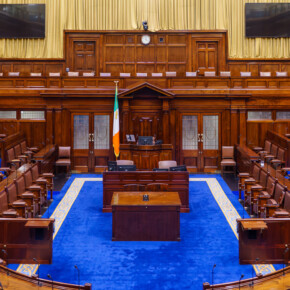
Just under a week later, O’Callaghan had to defend that stance to a tense Dáil chamber.
During the vote of no-confidence on Tuesday, April 14, Minister O’Callaghan stated “let us get one thing straight in this House; the right to protest is not unlimited.”
“Our Constitution states, “The right of the citizens to assemble peaceably” is subject to public order. What we witnessed last week at certain sites, where the blockading of fuel and goods occurred, was not a peaceful assembly in line with public order.”
He explained that in those circumstances, An Garda Síochána were required to restore order.
“That is what they did, and I commend them for doing so. It is a credit to the gardaí that they not only managed to remove the blockades at both ports and fuel depots in a swift manner following a number of days of engagement, but did so without any notable injury to the individuals at the blockades or any member of the force.”
He said that the Gardai have a “proud record and history of defending and securing the people or Ireland and their democratic institutions from harm against those who have tried to undermine them.”
“They did so again on this occasion, and that is to be commended by everyone in this House.”
As to be expected during a vote of no-confidence, tensions ran high in the Dáil.
Sinn Féin TD Pearse Doherty challenged O’Callaghan by saying, “no apologies for threatening the army, Jim? No apologies, no? Do you stand by it?”
O’Callaghan remarked, “you should recognise and respect our army. You respected another army for long enough.”
Social Democrats TD Cian O’Callaghan (no relation), dubbed Jim O’Callaghan “GI Jim O’Callaghan.”
“GI Jim O’Callaghan arrived on the scene thinking that he was Rambo. The last thing the country needed was that approach.”
The Dublin Bay North TD said, “thankfully, a very effective professional policing response from An Garda Síochána brought the country back from the brink.”

Fuel protesters in Dublin
Minister for Health Jennifer Carroll MacNeill said, “as a public representative, I embrace protest. In our democracy, I welcome protest. I will defend it and freedom of expression for all.”
“However,” the Dún Laoghaire TD said, “when protest flips and steps across to become something else – to risking deliveries of chemotherapies in our hospitals, as it did, to risking timely deliveries of refrigerated medicines and blocking people getting to time-sensitive medical appointments like cancer treatments and dialysis, that is not protest that we enable and embrace.”
“That is something I do not believe our very decent people and our very decent society want us to make any part of this state.”
The Fine Gael TD said, “we may now have to face even bigger challenges ahead because of the continuing instability in the Middle East. We have to decide now to protect the strength and the stability we have created together and protect ourselves from the type of crossing over of protest that we saw last week.”
Minister O’Callaghan’s handling of the affair revealed tensions within Fianna Fáil, and within the coalition itself.
Minister for Defence Helen McEntee declined to confirm whether Minister O’Callaghan consulted her before the call was made to deploy the army to break up the fuel protests, hinting at further tension in the governing coalition.
Minister McEntee told RTÉ “I’m not going to get into the details of our process, but what I’ll say is for any type of scenario, we need to review afterwards and make sure that we have seamless engagement and that we have a seamless process at every step and at every level.”
The Minister for Defence implying that the communication process between government colleagues was not “seamless” at a time of major economic shock and global war does not paint a picture of a stable government.
A rumoured heave on Micheál Martin in the aftermath of the Jim Gavin debacle was fended off, with O’Callaghan and John Lahart expressing confidence in Micheál Martin’s position as leader of Fianna Fáil.
Rumblings of a similar heave manifested again this week, with three of the party’s 20-something TDs (James O’Connor, Ryan O’Meara and Albert Dolan) posting an open letter this week saying that something is wrong within the party, and a change in leadership was needed.
The letter said that the “social contract is being strained to breaking point,” and expressed concern that “we are deeply worried that the lesson that many of our age will take from recent events is that our politics is not working.”
The three TDs, born in 1997, 1995 and 1998 respectively, are, by definition, the future of the party, and considering they are from rural constituencies, they are looking over their shoulder as they are concerned they could be dragged down with the ship.
Veteran Limerick TD and former Minister Willie O’Dea put further fuel on the fire, saying that the party has been “badly damaged” by the fuel protests.
O’Dea told RTÉ “I’ve got a series of emails from people who I helped out and people who canvassed for me and voted for me in the past, telling me they’ll never vote for me again because I’m representing the wrong party, a party they’ve totally lost confidence in.”
When a TD with 40 years of experience and three TDs in their 20s express doubts about party leadership, the question then became what would Minister O’Callaghan do?
O’Callaghan, and Dublin South-West TD John Lahart, put paid to any leadership challenge rumblings, with both TDs expressing further confidence in Martin.
A spokesperson for Minister O’Callaghan told The Journal on Thursday that the Minister “backs the Taoiseach and would not support a motion of no confidence in him”.
Lahart told the Irish Times that while he backs Martin, he said that Fianna Fáil “needs to think seriously about planning for the future.”
The Dublin South-West TD said told the newspaper that Martin staying on as Taoiseach “guarantees the country leadership in the immediate period ahead, which is going to be turbulent.”
The rumblings of a heave against Martin in the wake of the Gavin debacle quietened down, as Fianna Fáil sources indicated that O’Callaghan, who was only made Minister for Justice in January 2025, did not have enough time served as a Minister to credibly claim he had the necessary experience to become Taoiseach.
O’Callaghan is regarded by many within Fianna Fáil as a leadership candidate in waiting, but a school of thought within Fianna Fáil is that Martin wishes to lead Ireland through the upcoming EU presidency, bask in the limelight of being a European statesman at a time of a major global crisis, then step down in early 2027 after the EU presidency.
By January 2027, Martin will have served as leader of Fianna Fáil for 16 years and will have been Taoiseach longer than the likes of Leo Varadkar and Liam Cosgrave.
Should Martin remain Taoiseach until December 2027, at which point Simon Harris becomes Taoiseach again, Martin will have overtaken Garret Fitzgerald in terms of time served as Taoiseach.
By January 2027, O’Callaghan will have served as Minister for Justice for two years, enough to have boosted his CV.
Based on the events of the past week however, O’Callaghan may have given opponents within his own party and the opposition itself ample ammunition.
The last word on the debate goes to Dublin Mid-West TD Paul Gogarty.
The independent TD, who voted no confidence in the government parties, said “the Tánaiste and his colleagues are not the devil and the opposition are no angels but, to be clear, the government has not responded quickly enough or gone far enough.
“The programme for government and the groups it did deals with to keep it in power did not inspire any confidence or show any vision.”
“It’s choices during the last budget favoured wealthy developers, left vulnerable people in the lurch, and the government’s lack of urgency on the need to ramp up our energy security has been frustrating.
Related News