Fuelled up: The people who shut down O’Connell Street
Mike Finnerty 15 Apr 2026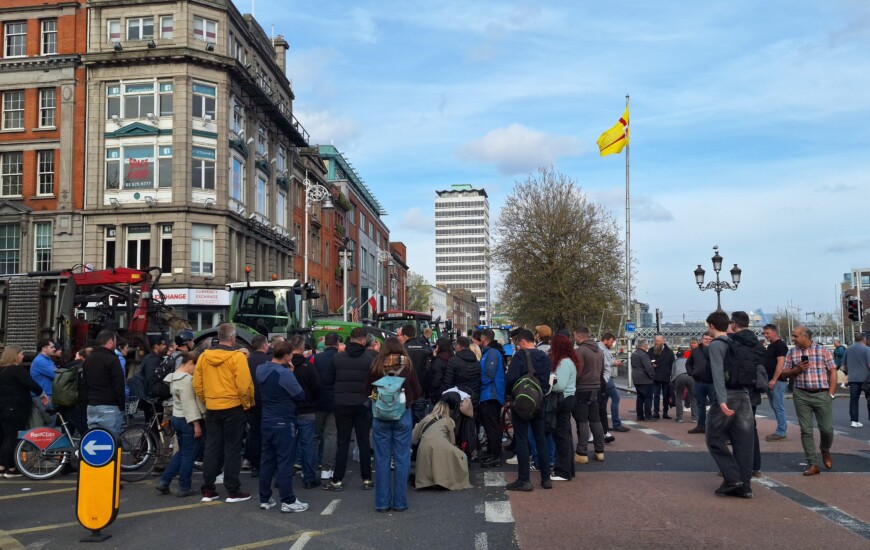
Editor’s note: This article went to press on the afternoon of Friday, April 10th. In the interest of journalistic clarity, we are presenting the article as it initially appeared in print, with no amendments made to the text for the online copy and is not reflective of subsequent events.
Outside the Pale, the joke is that December 8 is the day non-Dubliners come up to Dublin for the day to do their Christmas shopping.
On April 7, outside the Pale came to Dublin a few months early, and set up shop on Dublin’s O’Connell Street.
Despite events nearly 7,000km from Ireland causing the greatest shock to the energy system since the 1970s, farmers from rural Ireland descended onto Dublin’s main thoroughfare this week in an attempt to “force the government’s hand.”
On the afternoon of April 8, as the protest was in the sweet spot between internet novelty and something the government had to urgently address, we headed down to O’Connell Street
The results were less Paris in May 1968 and more Ballinasloe on the first weekend of October.
A protest movement attempting to get the government’s attention in the week when the Dáil was not in session is an indication that the protest organisers were not quite operating on the same level as Abbie Hoffman and Jerry Rubin.
Instead of the American Embassy in Ballsbridge being targeted, a place that has a legitimate connection to the American government, it was the bottom of O’Connell Street that became the focus point of the protest.
Per The Journal, the organisers of the protests are the newly-founded Irish Haulage Farming Construction Contractors Amalgamation, which is operating without the support of the Irish Road Haulage Association or indeed, the Irish Farmers Association.
A Facebook page with over 50,000 followers, The People Of Ireland Against Fuel Prices, is also instrumental in organising the protests.
A protest, by its very nature, is supposed to cause disruption – that much people can agree on – but the method in which the protesters attempted to make themselves heard quickly became a dividing issue.
Green Line Luas services being suspended, along with difficulties for Dublin Buses, has caused a split in public opinion; public transport services are often suspended or delayed during protests, but those protests are flagged in advance, and the Gardaí work with protest organisers to ensure relatively minimal disruption to protesters.
This protest is different, however, as it appears that the protest was organised entirely through social media, and Gardaí were on the back foot.
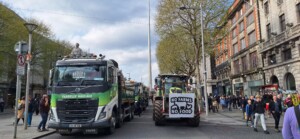
The protest on O’Connell Street on April 8th
The nature of print journalism means that this particular article will either be a relic of the protest movement when it goes to print on the afternoon of April 10, or will be a prelude snapshot of a wider protest movement within Irish society.
The morning of April 9 saw news that Minister for Justice Jim O’Callaghan had announced members of the defence forces were to be deployed to oil depots outside of Dublin in an attempt to end the blockade, while Lord Mayor of Dublin Ray McAdam issued a statement that the city “cannot be held to ransom.”
But before all that, and the subsequent events that followed, we spent three hours at the bottom of O’Connell Street on the evening of April 8 in an attempt to figure out what these people want – and spoke to people who were there for a “gawk.”
The first port of call was to speak to a farmer sitting in the wheel of their tractor.
“Are you media?”, they enquire.
Identification is produced.
“And is your outlet for the people?” was their follow-up line of enquiry.
Within a second, it became strikingly clear what the nature of this protest was.
What started out as farmers pointing out that they are under pressure as a result of the war in Iran and the high fuel prices that followed, the message has been muddled by members of populist movements.
During the three hours at the bottom of O’Connell Street, a man in an Irish football jersey shouted “no to net zero!”, followed by “Ireland for the Irish!”.
The owner of an “alternative media” outlet (with “people on the ground” in Wexford, Roscommon and Westmeath, the owner told us) said he had never “done a TikTok live before” and was amazed by the protest gaining such a positive reaction on TikTok.
“I set out on Tuesday morning on the convoy, and by the end of my livestream, it had 10,000 likes,” we were informed.
TikTok has become a thorn in the side of many world governments – as recently as September last year, the platform was credited for its part in the Gen Z overthrow of the government in Nepal – and the platform proved its potency again in the organisation of the protest.
A common refrain of the afternoon was people not willing to give their names to the media – first names only, at most – but those who were willing to speak to this publication said they found out about the protests through social media.
Two college students, James and Donal (Sligo and Laois men, respectively), said they “weren’t up on the news, but I saw it on TikTok,” and wanted to see what the fuss was about.
James said he is from a farming background in Sligo initially, and he understood the inherent nature of the protest.
When asked if recent government measures to cut excise duty on fuel were enough, James remarked “they might as well have done nothing.”
James said that the mood “back home” was “thick and angry” and that the government needed to do something to alleviate the crisis.
He said that scrapping the carbon tax entirely was the right thing to do in this context.
What was more interesting was Donal’s comment that while he didn’t engage with traditional media, he saw news of the protest on TikTok and wanted to see what all the fuss was about.
In the aftermath of the 2025 presidential election, our analysis discussed how Ireland’s social media landscape has become fragmented in the seven years since the 2018 presidential election.
On that occasion, people of all stripes, backgrounds and views used Facebook and Twitter; those platforms have become increasingly partisan or skewed to suit one viewpoint, while the likes of Reddit, Bluesky, TikTok have become the milieu of people of other persuasions.
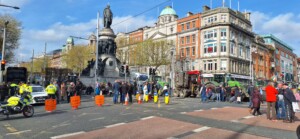
The protest on O’Connell Street on April 8th
Two Dublin 7 students from the Irish Republican Socialist Party were on hand to offer drinks and supplies to the protesters.
Reluctant to give their names, they said the protest movement should be a “cross-societal” issue.
When asked about the appearance of People Before Profit TD Paul Murphy at the protest, they scoffed.
“Too interested in middle-class interests,” they remarked.
On the other side of the spectrum, members of the Tallaght Says No group were there to show support for the protesters.
When asked what fuel prices have to do with the messages of the group, Jane, a member, said that people have “had enough.”
“We are too scared to go outside at night,” she said.
When asked again what that had to do with fuel prices, she said, “we’ve had enough, and enough is enough,” saying that the Covid-19 pandemic was what drove them to protest.
Murphy’s appearance at the protest saw the Dublin South-West TD shouted at, with one woman heard to shout “how are you not embarrassed?”, seemingly forgetting that Murphy is not a TD from a government party and has never been part of a government.
The woman then started to shout, “slavery is taxation.”
Thomas, a farmer from The Liberties, said he had travelled into the city centre not for a political cause, but because he is genuinely concerned about the impact of the war on his livelihood.
He explained that the price of hay to feed his horse has doubled since the war started.
“I can’t feed my horse; imagine how those farmers feel, not being able to feed their animals?” and pointed to a sign on a nearby tractor which read “No Fuel, No Food.”
The ensemble of people from different backgrounds and beliefs made for a great sideshow for a tourist family from Liverpool, Rachel and Jonathan.
They said that they were visiting the GPO on Tuesday when they heard a rumbling noise outside, and saw a wave of tractors parked up on the streets.
“We were meant to get on a tourist bus that afternoon, but it got held up in the traffic – guess we won’t be doing that,” Rachel remarked.
The Liverpool tourists said they had been to Dublin before, but said they weren’t aware of the extent of people’s anger against the Irish government.
“We’ve kind of had the same thing back home,” Jonathan explained, “but not to this extent.”
However, disruption of ambulance and bus services, and suspected far-right involvement, saw Jonathan reveal his true colours.
“Once I twigged that there was possible far-right involvement, my sympathy for the movement went through the floor,” emphatically pointing his hands downwards as if to articulate his point.
Rachel said that they were at the protest to “see if it was still going on,” and said she had never seen such a large-scale protest in any of the major capital cities she had visited.
“I certainly didn’t expect to see tractors here – can they really take time off from farming and travel up 200 miles? If the price of fuel is that bad, how were they able to come up here?” she asked.
A question that is on the minds of many.
Related News