O’Callaghan calls for crackdown on AI scam ads
Mike Finnerty 03 Jun 2026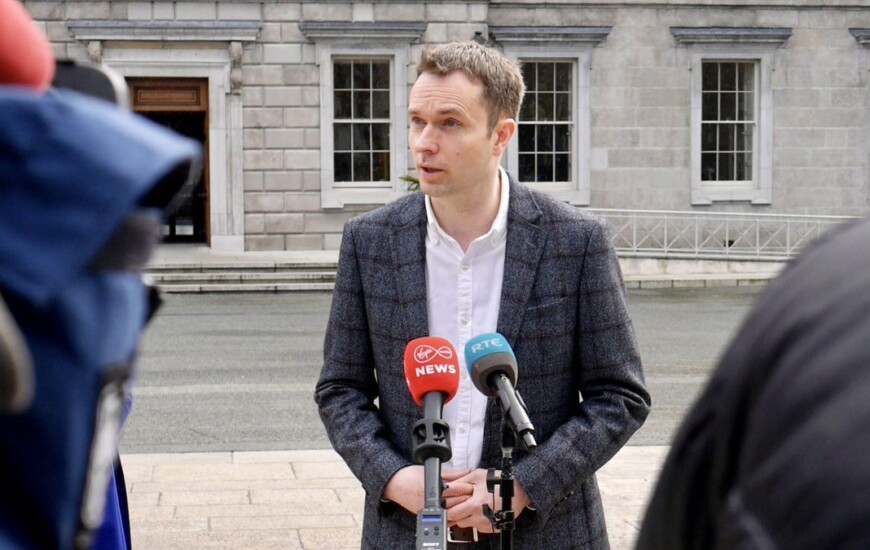
Social Democrats TD Cian O’Callaghan has said that it is “shocking” that AI-generated online adverts are allowed to run on social media.
The Dublin Bay North TD said that it is wrong that social media companies are able to accept payments from criminals to run bogus advertisements, and in turn, “defraud” the Irish public.
O’Callaghan was speaking after FraudSmart, a fraud awareness initiative led by the Banking and Payments Federation of Ireland, reported a surge in AI-generated online ads which promote fake state-backed investment schemes.
Gardaí statistics noted a 20% rise in investment fraud in 2025, with losses exceeding €20 million.
Per O’Callaghan, the AI revolution has “empowered” these scams.
“Last month, research published by the Central Bank showed that more than one in three people have been the victims of fraud, and almost two-thirds have lost money as a result. The weaponisation of AI could cause these dire figures to rise even further,” he warned.
“These fake investment schemes are being advertised on social media platforms. The criminals behind them are paying to have their scams advertised on social media to vulnerable individuals,” the Soc Dems finance spokesperson said.
“Social media giants should not be allowed to make money from hosting fraudulent ads. Research carried out by Revolut in February found that social media companies earned an estimated €32 million last year from scam advertisements targeted at Irish people,” he noted.
O’Callaghan asserted, “social media companies are profiting off people’s misery and the government is doing nothing to stop it.”
The Soc Dems TD pointed to a 2024 proposal by the Department of Finance, which called on tech companies to vet those who can post financial investment ads.
“This is a no-brainer proposal that should be in place already, but has seen zero action from this government,”
“I’m reiterating my call for Minister for Finance Simon Harris to explain why he has failed to act on the proposals put forward by his department in relation to scams and fraud,” he said.
High-profile figures such as economist David McWilliams, singer Daniel O’Donnell and former Taoiseach Leo Varadkar have had their likeness used to promote cryptocurrency scams, leading to them speaking out against the practice.
Speaking to RTÉ last year, McWilliams said “it is a criminal enterprise, it’s a fraud, and people are getting defrauded.”
“Innocent people are getting frauded into this,” he said, and said that his image and likeness were being used to dupe people.
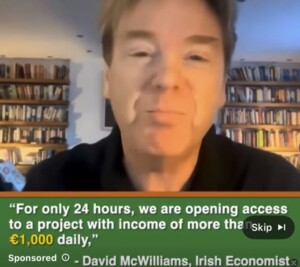
An example of a scam AI ad, featuring Irish economist David McWilliams
Daniel O’Donnell warned fans not to engage with online ads that claimed to be him, with the singer saying that fans had money taken from them in a scam.
The Advertising Standards Authority have said they are considering mandatory labelling of AI ads, as the number of fraud cases rises and social media giants such as Facebook and Twitter appear reluctant to take action against them.
Last week, Sinn Féin TD Mairéad Farrell said that boundaries are being “blurred” between neobanks and cryptocurrency exchanges.
The Dail’s Joint Committee on Finance, Public Expenditure, Public Service Reform and Digitalisation recommended that more resources be delegated to the Gardaí to deal with the increasing volume of suspicious transaction reports, statutory minimum customer service requirements, and a mandatory fraud reimbursement scheme for customers affected by fraud.
“There is a need to protect customers from the risks posed by these risky investments; greater regulation should be introduced to protect consumers from the potential impacts of speculative investment in cryptocurrencies,” Farrell, Committee Cathaoirleach, said.
Related News