Walking through city centre is “grim,” Andrews tells Seanad
Mike Finnerty 25 Nov 2026
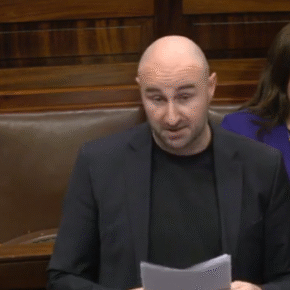
Sinn Féin Senator Chris Andrews has said that walking through much of Dublin city centre is “grim.”
During a Seanad debate on safety in Dublin city centre this week, both government and opposition Senators put pressure on Minister for Justice Jim O’Callaghan to improve policing numbers in Dublin city centre.
As part of Ireland’s EU Council presidency duties (and the massive security operation it entails), Gardaí have been redeployed to Dublin city centre as part of security measures.
While it has the net positive of proving that Dublin can host a major international geopolitical summit with relatively few security concerns, it has had the domino effect of taking Gardaí off city centre streets.
Sinn Féin Senator Chris Andrews, formerly a TD for Dublin Bay South, told the Seanad this week, “my mother is 89, and I always ask, would I want her walking through the city centre from the Southside to the Northside?”
“The answer is I would not, and I do not think anybody in here would want their elderly mother to walk through the city centre because it just is not safe,” he said.
He stated, “we need more Gardaí.”
“Older residents of City Quay and Pearse Street do not feel safe leaving their homes; they always ask for increased CCTV, and that just has not happened.”
“For years, they have been asking for that. It would give them an extra sense of security but that has not happened,” he said.
Senator Andrews noted that early intervention is crucial for stopping people from slipping into crime.
He said that the local youth club Talk About Youth does not have its own 24/7 facility.
“They have to rent out the space from the St. Andrew’s Resource Centre, which is a fantastic facility but a youth club such as Talk about Youth should have their own facility,” he said.
“Those facilities are in place on the Northside and that needs to be replicated on the Southside,” he said.
Senator Andrews warned that Pearse Street residents are “fearful” of drug dealing, theft, and assault.
“I could give countless examples and the Minister would know them as well I do; it needs to be addressed,” he said.
“We need more Gardaí. While the Gardaí who are there are excellent and do a fantastic job, we need more of them. We need more investment in work and education for inner-city communities.”
Independent Senator Lynn Ruane said, “you cannot have public safety without the public.”
The independent Senator noted, “while I always understand the call for extra police, and I understand that is a go-to for people, that is often a perception of safety because people may feel safer because they may see a presence.”
“That does not necessarily mean the people who are most likely to die by violence or experience violence will actual experience real and actual safety,” she told the Seanad.
Senator Ruane noted that the risk factors associated with dying by homicide include being male and being from a certain socioeconomic background.
The independent Senator also pointed to a 1990s study which compared lower-skilled manual jobs with professional occupations and mapped the differences in experience of violence by occupation.
“That is not to say that experiencing poverty or being male determines whether a person will experience, die by or perpetrate violence,” she explained.
She said that sociologists have noted that poverty, social conditions and the amount of power people have in their daily lives, in society and over decisions about their education, children and homes can, when combined and intersecting, increase the likelihood of experiencing violence or dying by violence.
Senator Ruane said that early intervention is a crucial part of crime reduction, and cited research which found that people most likely to die from knife violence when they are in close proximity to it.
“Those carrying a knife are themselves most likely to die from knife violence,” she explained.
“Knife violence often involves a very small percentage of people, and we need to ensure that we include those people in interventions rather than simply designing interventions around them.”
The Seanad was debating a piece of legislation put forward by Fianna Fáil Senator Mary Fitzpatrick.
The Fianna Fáil Senator’s legislation called for more local community safety partnerships to be established across Ireland.
Senator Fitzpatrick said “community safety is about much more than preventing crime, it is shaped by a wide range of social, economic and environmental factors.”
“Community safety is experienced in the small but important moments of everyday life such as whether a parent feels comfortable allowing his or her child walk to school, whether an older person feels confident leaving his or her home or whether young people have positive opportunities to develop and thrive. The conditions that underpin these important moments go far beyond the criminal justice system,” she said.
Senator Fitzpatrick said that Dublin could learn lessons from New York in terms of community safety.
The Fianna Fáil Senator relayed that she lived in New York for eight years in the 1990s, right when the city was grappling with a crack cocaine epdemic.
She said that in response, New York City increased policing numbers, and said that the government were carrying out similar measures here.
“I commend him (the Minister for Justice) on what is now a massive, all-time record number of Gardaí in the force,” with a commitment of 1,000 extra Gardaí in Dublin during the lifetime of this government.
“In New York, the authorities also changed the way they policed the streets. They changed policing in terms of making it proactive. They also recognised – and we need to recognise – that we cannot just police our way out of this problem,” Senator Fitzpatrick warned.
Minister O’Callaghan stated, “in global terms and in general, Ireland is a safe country; it is important as the Minister for Justice that I say that.”
Pointing to the statistics, he noted that Ireland’s homicide rate is “considerably lower than in the vast majority of countries,” and as a whole, crime rates are down relative to other countries.
“It is important to note that in general, Ireland is a safe country,” Minister O’Callaghan told the Seanad.
However, he said that the government was committed to reducing numbers even further.
“If people are victims of crimes, they should report that to An Garda Síochána. We have an effective system in place to investigate that criminal activity. If we can get people coming back or going into cities without fear, cities and towns will respond positively,” he said.
The Minister noted that there are still lingering societal anxieties stemming from the Covid-19 pandemic.
He said, “we do not want to give the impression to the public that there are parts of cities or areas that are unsafe; we want people to go out.”
“It becomes a self-perpetuating prophecy if we say places are unsafe, as people will stop coming in. The reason COVID was such an unpleasant time in our cities is people pulled out of them,” he told the Seanad.
“Regrettably, the only people left were people who had a lot of social, difficult issues to address. It is extremely important that we talk as well about the fact that we want people coming back into our cities, and we want people in our towns and villages,” he said.
Related News