Bacik challenges Taoiseach over SNA chaos
Padraig Conlon 04 Mar 2026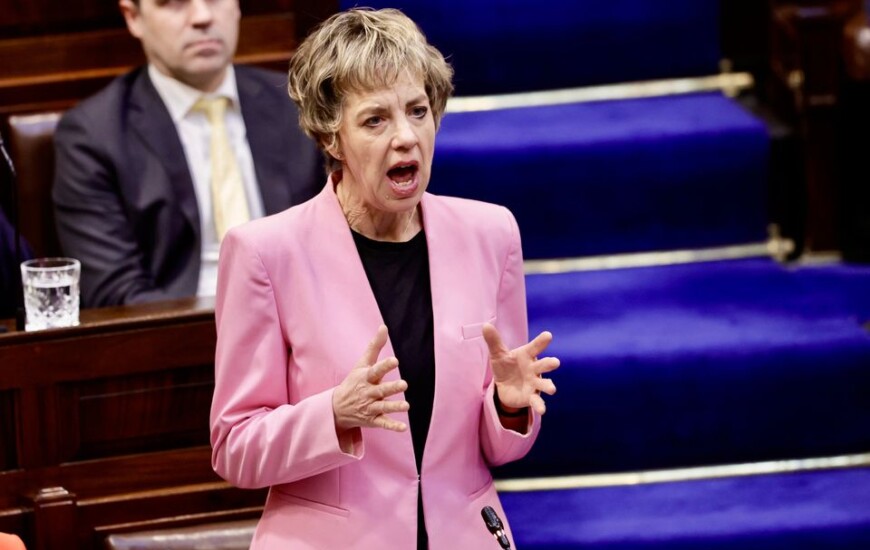
There was some relief felt in school communities across Dublin after the Government confirmed there will be no reductions in Special Needs Assistants this September, but political tensions remain high over how the controversy unfolded.
During Leaders’ Questions in the Dáil on Tuesday, February 24, Labour leader, and Dublin Bay South TD, Ivana Bacik said the decision to halt proposed cuts followed a week of fear and confusion for parents, principals and SNAs who had been told that classroom supports were under review.
“Last night was the latest climbdown in the special education saga,” Deputy Bacik said.
“SNAs, principals, teachers and parents who spent a week in fear now know that their children will at least not lose SNA supports this year.
“That relief is thanks to them and their insistence that the Government must listen to their campaigning and advocacy.
“Unfortunately, our school communities are having to get good at campaigning.
“In a year, they have had to mobilise for their SNAs, caretakers and school secretaries and the Labour Party has supported school communities every step of the way.”
The row centres on a review initiated by the National Council for Special Education, the statutory body responsible for allocating Special Needs Assistants to schools.
SNAs provide care and support to children with additional needs, assisting with tasks such as mobility, personal care and participation in classroom activities.
Schools apply to the NCSE for SNA support based on the needs of their pupils, and allocations are assessed against national criteria.
In recent weeks, schools received correspondence indicating that SNA allocations were being examined as part of a broader review.
Some were informed they faced potential reductions, in certain cases by up to half their existing allocation.
The letters prompted an immediate backlash from parents and staff, who warned that vital classroom lifelines were at risk.
Deputy Bacik told the Dáil that the review was directed by Government and approved at Cabinet level.
“It was the Taoiseach’s Government that directed the National Council for Special Education, NCSE, to carry out this review.
It approved the approach and so, as we know, schools received letters without warning telling them they were losing a classroom lifeline,” she said.
“All were threatened with cuts without warning or consultation and only after a national uproar did the Government reverse course.
“This is not a good look for Fianna Fáil.
“The Taoiseach’s party used to have a good story to tell on education, with Donogh O’Malley’s achievements, for example, which I have always acknowledged.
“Fianna Fáil used to have a vision on education but now when we think of Fianna Fáil, or indeed Fine Gael, we think of prefabs, paused renovations, poor pay for school secretaries and caretakers and now this.”
Under current arrangements, schools outline the number of pupils requiring care and support and submit requests for SNA posts.
These are assessed by the NCSE, which also operates an appeals process.
Over the past two to three years, additional allocations have largely been considered where schools sought increases, rather than through a comprehensive national review.
The recent exercise aimed to examine allocations more broadly, but the issuing of letters before the process was concluded triggered alarm.

Responding in the Dáil, Taoiseach Micheál Martin (pictured above) insisted that no reductions will take place in the coming school year and that any additional SNAs identified as necessary will be provided.
“Any additional SNAs that were identified by the council as being required by a particular school will get this in the context of that review, so they will get that.
“The funding is additional to the education budget and will not be taken from any other part of the education budget,” he said.
He rejected claims that the Government had formally approved the scale of proposed reductions.
“The Government did not sign off on this in terms of the 550, and the scale and the impact of it.
“When the Government saw the impact of this, it considered it and decided not to go ahead with what was being proposed, and that there will be no reductions in the next school year.”
The Taoiseach said a redeployment scheme would form part of future workforce planning.
Under such a scheme, SNAs whose positions are no longer required in one school due to changing enrolments or pupils progressing to second level would be reassigned to other schools rather than made redundant.
“If children with special needs are reduced by a natural process, and move on to second level or whatever, the SNAs, rather than being made redundant, will be redeployed to another school as close as possible to the school where they operate.
“That is a good, positive thing. It is very positive and progressive,” he said.
Workforce planning and redeployment have long been part of teacher arrangements, but applying a similar structure to SNAs raises practical questions for schools.
Many principals point out that SNAs often build close, long term relationships with individual children, and sudden reassignments can be disruptive if not carefully managed.
For schools across south Dublin, the uncertainty came at a critical time.
Planning for September begins months in advance, with staffing decisions, class allocations and timetables typically finalised before the end of the current school year.
Any change in SNA numbers can have knock on effects for special classes, mainstream inclusion and overall classroom organisation.
Southside schools, including those with dedicated autism classes and additional support units, rely on predictable allocations to ensure children with additional needs can participate fully in school life.
Even the possibility of reductions created significant anxiety for families already navigating assessments, transport arrangements and access to therapies.
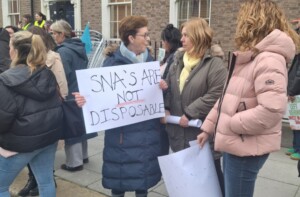
Protesters pictured outside Leinster House last Wednesday (25th) Protests took place all across the country in response to recent moves to cut SNA posts.
Following Leaders’ Questions, Deputy Bacik renewed her call for clarity and guarantees.
“Families of children with additional needs have spent the past week in fear that classroom lifelines would be withdrawn,” she said.
“SNAs have faced anxiety and principals have been left trying to plan for September without basic certainty.
“That fear was real, because schools received letters informing them that SNA allocations would be cut, in some cases by up to half.”
She urged the Government to confirm the source of the €19 million allocation announced to underpin the decision and to set out a clear multi annual workforce plan for special education.
“Inclusion is national policy. Under the Education for Persons with Special Educational Needs Act 2004, the State has a clear obligation to ensure that children with additional needs can access appropriate support in school. Inclusion without adequate and predictable resourcing is not meaningful inclusion,” she said.
The €19 million funding has been described by Government as additional to the education budget, designed to stabilise allocations while broader planning takes place.
However, opposition parties argue that a one year buffer does not address underlying structural issues in how SNA supports are assessed and distributed.
As the debate continues, the immediate threat of cuts has been lifted, but the episode has exposed the fragility many parents feel within the special education system.
For families and school staff across the southside, the coming months will now be watched closely for signs that a longer term plan is forthcoming.
For now, September staffing levels may be secure, but the broader questions about transparency, consultation and certainty in special eeducation remain. unresolved.
Related News