How and why Ireland’s EU Council presidency matters
Mike Finnerty 08 Jul 2026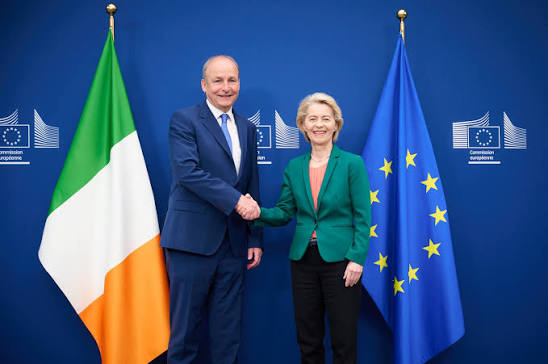
From now until January 1, Ireland has the Presidency of the European Council.
For 6 months, one of the EU’s member states gets the honour of being President of the Council of the European Union, and Ireland’s number came up for the first time since 2013.
In basic terms, the Council President gets to host high-level meetings of European diplomats, is able to set the agenda at the Council of the European Union and will act as an intermediary between the EU’s different institutions.
For the government, the presidency is a chance to bolster its credentials and flex its muscles on an international stage.
The 1984 Presidency saw Portugal and Spain successfully make the pitch for them to join the EU, and the 1990 Presidency saw Ireland at the heart of the EU negotiations to bring East Germany into the fold after the fall of the Berlin Wall.
Ireland’s Presidency of the EU has made good fodder for Reeling In The Years: during the 1996 Presidency, Ireland held the brief during the Mad Cow disease outbreak, leading to the great footage of various agricultural ministers enjoying a burger made of Irish beef in a vote of confidence.
The EU Presidency of 2004 was perhaps the most consequential not only for Ireland, but for Europe itself.
The grand finale of Ireland’s Presidency in 2004 saw 10 nations join the European Union in a ceremony held at Phoenix Park.
On that day, 8 nations that were under communist rule in then-living memory joined the EU: the Czech Republic, Estonia, Hungary, Latvia, Lithuania, Poland, Slovakia and Slovenia were the former communist nations to join the EU, alongside Malta and Cyprus.
That particular occasion was marked by another great Reeling In The Years moment: Seamus Heaney was on hand to deliver a specially-written poem called Bealtaine.
The poem speaks of newcomers appearing and Ireland, metaphorically, acting as a host.
“Move lips, move minds, make new meanings flair, like beacons signalling from peak to peak,” Heaney’s poem read.
Those were great TV moments of the past – but what of now, in 2026? What role will Ireland play as President of the European Council in 2026?
Since Ireland last occupied the hot seat, the European Union has changed quite a bit.
Recent weeks marked the 10-year anniversary of Brexit, which put paid to various efforts to leave the EU in France, Italy and the Netherlands.
The Brexit debacle was the start of a decade from hell for the United Kingdom, with the UK having just ousted its 7th Prime Minister in a decade.
Brexit, it can be argued, opened a Pandora’s Box that no other country is willing to touch.
The likes of Marine Le Pen, once the leading voice of a French exit from the European Union, have sought to work within the system to reform Europe to their liking, instead of angling for an exit.
Far-right Dutch firebrand Geert Wilders has also cooled his calls for The Netherlands to leave the European Union, and instead opting to co-ordinate efforts by the far-right in the European Parliament on issues such as immigration.
While it has gone unremarked upon by the Irish public at large (the European Union still doesn’t quite grab the public interest in Ireland; turnout for the Dublin election in 2024 was 43.4%, down from a 52.9% turnout in 2004), the European Union has shifted to the right in recent times.
The EU Asylum and Migration Pact was at the behest of right-wing parties in the European Parliament, who now command an effective majority.
The results of the 2024 election saw the European People’s Party – home of Fine Gael – move away from its informal coalition with the Socialists and Democrats – home of Labour – and work with the far-right Patriots for Europe and the extreme right Europe of Sovereign Nations to pass tougher immigration laws and water down climate protection measures passed in the last EU Parliament.
Since Ireland last hosted the EU Presidency in 2013, only one other country has joined the EU: Croatia.
Croatia, with a smaller population than Ireland, has become a success story of what the EU can achieve; it brought peace, stability, western-style democracy and the Euro to a country that was at war not even 30 years ago.
There are hopes that Montenegro could be brought into the European Union fold by the time Ireland’s presidency is up in December, with the ideal outcome for Ireland being that Montenegro announces they are joining the EU at a December meeting in Dublin.
As it stands, Montenegro is at the top of the queue, with their government looking to join the EU by 2028.
A recent summit, held in the city of Tivat in June, saw Micheál Martin and a number of other EU heads of state in attendance.
The meeting heard of Montenegro’s progress in joining the EU; to join, nations need to pass 33 specific tests, ranging from anti-corruption measures, harmonisation of domestic laws with European laws, judicial independence, to more big-picture issues such as taxation and energy.
The meeting heard that Montenegro had reached a crucial milestone: they confirmed that freedom of movement for workers in Montenegrin law was compatible with EU law.
Since Brexit, the EU has opened talks with the likes of Ukraine and other Balkan states about potentially joining, while nations that were formerly cool on EU membership, such as Norway and Iceland, are considering joining in the face of the threats posed by Donald Trump.
If the accession of Montenegro was to be rubberstamped while Ireland held the Presidency, it would be a PR win for Micheál Martin at a time when he badly needs one; he would be able to espouse Fianna Fáil’s traditional, pro-EU values at a time when liberalism is not in vogue across the continent.
The most recent opinion poll by the Sunday Business Post has the party within the margin of error of the Social Democrats, a party that didn’t even exist when Ireland last held the Presidency.
Following the Jim Gavin debacle last October and the handling of the fuel protests in April, question marks started to emerge over how long Micheál Martin could hang on as leader of Fianna Fáil.
Having served as leader of the party since January 2011, Martin can claim victory in two general elections after the near-wipeout in 2011.
His reward is that he now gets to enjoy rubbing shoulders with the likes of Emmanuel Macron, Pedro Sánchez, and Ursula von der Leyen while representing Ireland on the global stage.
Within Fianna Fáil, there is a school of thought that Martin should be allowed his big moment on the European stage before announcing a timetable to step down as party leader early next year.
Fianna Fáil still has the Taoiseach job until November 2027, as part of the coalition agreement with Fine Gael and various independents, so the positive PR of representing Ireland at a European level could be a good time for Martin to walk into the sunset as far as the party (and Martin) is concerned.
Of course, Ireland having the EU Presidency has its critics, from both the left and the right.
People Before Profit TD Richard Boyd Barrett has dubbed the EU Presidency a “festival of propaganda,” stating “it’s clear that the Taoiseach and the government are using the presidency as a festival of pro-militarisation propaganda.”
“The Taoiseach talks of promoting EU values, but all this is happening while the EU is annually exporting about €800 million worth of arms and military equipment to Israel, and is therefore deeply complicit in the genocide that Israel is committing against the people of Gaza,” the Dún Laoghaire TD said.
MCC Brussels, a conservative think-tank with links to former Hungarian Prime Minister Viktor Orbán, stated that “Ireland likes to present itself as Europe’s model member state; our analysis argues that the reality is less flattering.”
“Again and again, Ireland’s political establishment has chosen to demonstrate its loyalty to Brussels rather than defend the interests of its own citizens,” and claimed that the EU Presidency is “six months of ideological activism while Europe burns.”
For the Taoiseach, however, he plans to block out the noise.
“Many on the left have opposed the European Union and every treaty to do with it. That is their right and entitlement, but Europe is a far broader story,” he told the Dáil.
Related News