Masters Of The Universe has the power – to bore you
Mike Finnerty 03 Jun 2026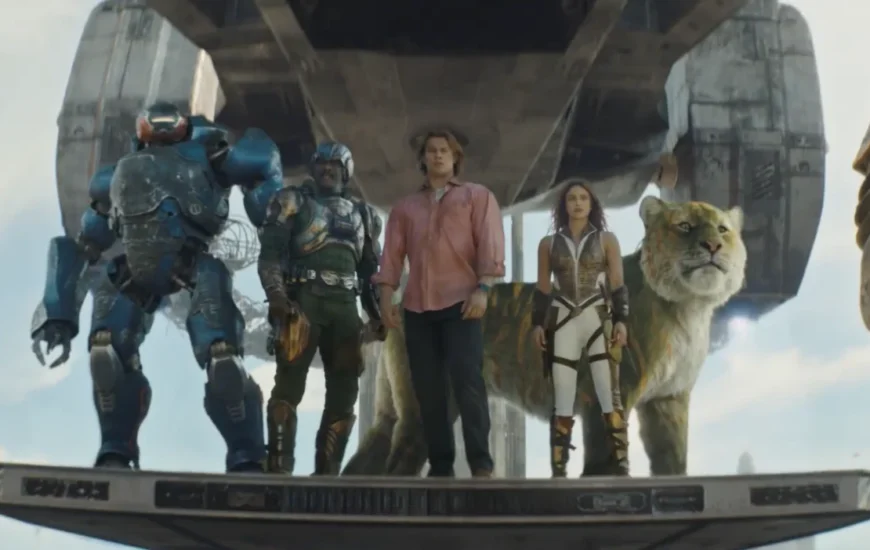
Fear of nuclear war is back in the public zeitgeist, and everyone is worried about the economy, which means it’s time to resurrect another horror from the 1980s: He-Man.
The Stranger Things-ification of modern culture (that is to say, the incessant demand for everything to be about the 1980s), has claimed another victim, with the Masters Of The Universe getting another spin on the big screen.
The first thing that jumps out about Masters Of The Universe and its 2026 big-screen outing? It feels like a movie out of time.
For some movies, feeling like a movie from a different time can be a good thing (for example, Black Bag was a great throwback to the 1990s spy thriller), but Masters Of The Universe has a distinct whiff of the 2016 blockbuster to it.
The film’s colour palette and tone are very clearly aiming for Guardians Of The Galaxy, the writing is peppered with the “Um, he’s right behind me, isn’t he?” cadence (that was insufferable when Joss Whedon did it, too), and the soundtrack is full of route one, obvious choices.
For the purposes of this review, this reviewer was born in the mid-1990s, meaning that the He-Man craze had fully come and gone by the time object permanence was formed in this reviewer’s situation.
This film was the chance to make He-Man relevant to a new generation, and it fails; if you grew up watching the cartoon in the 1980s or had a Castle Greyskull play set, you’ll probably get more enjoyment out of this film than we did.
The most interesting angle the film comes up with (and it’s not a bad one) is that the traditional hero doesn’t need to be a macho action man, and that the societal idea of what makes a hero has changed since the 1980s.
The one interesting quirk about the film, exploring the role of modern masculinity, feels like it was copying Barbie’s homework.
In the case of Barbie, it had the benefit of being directed by Greta Gerwig and co-written by Noah Baumbach, two of the sharpest minds in modern film.
Masters Of The Universe was written by people who worked on the Minecraft movie.
Barbie earned those jokes about the patriarchy and the role of the modern woman because it had done the groundwork; Masters Of The Universe takes a shortcut.
English actor Nicholas Galitzine certainly looks the part as He-Man, and does a decent job of conveying the film’s themes that the modern action hero doesn’t necessarily need to look like Arnold Schwarzenegger anymore.
The film’s message, at its core, is that heart is more important than muscle; a reasonable message that is a good takeaway for younger audience members.
That thesis is a solid, interesting message for the movie to convey.
That same message then gets lost when director Travis Knight, best known for his background in animation, crams the screen with unintelligible action that just becomes visual white noise after a while.
Knight’s previous live-action effort, Bumblebee, did the impossible in making a Transformers movie work as a film and not just a Michael Bay demolition derby.
Bumblebee had heart and intelligence to it, and is one of the better examples of Hollywood’s obsession with trying to capture the 1980s Spielbergian touch.
In this case, Knight is more interested in having lasers, and spaceships zip around and undercut every dramatic moment with a glib one-liner.
This film and the recent Star Wars spin-off feel like a strange inverse of where Hollywood was in the 1960s.
In the 1960s, the big-budget movies of their day were musicals, but youth audiences were more interested in The Graduate, Bonnie and Clyde and Easy Rider.
Of course, the later success of Star Wars was the culmination of the New Hollywood project, but it is ironic that 50 years later, the same fantastical blockbusters feel like the exact kind of movie they replaced.
Nowadays, movies like Masters Of The Universe and The Mandalorian and Grogu feel like the overexpensive, indulgent musicals of the 1960s, and the recent successes of The Drama, Backrooms, and Obsession feel like what cinema-goers are actually interested in.
If one gets the sense that we aren’t talking much about the film and turning it into a broader treatise on the state of modern cinema, you aren’t wrong; the film itself is really that boring and not worth talking about.
The 1987 Masters Of The Universe was a calamity that helped kill Cannon Films, but it had the basic decency to be done in 100 minutes.
For 2026, and in an attempt to get people off their couches and into a cinema seat, the new Masters Of The Universe is 140 minutes.
There is no world where a He-Man movie should be as long as The Shawshank Redemption; a great movie earns its run time, you are hooked and intrigued and want to see Andy Dufrense crawl to freedom.
By the midway point of this movie, you will be left checking your watch and asking yourself if the popcorn stand is still open.
We mention the recent box office smashes of Obsession and Backrooms, because the success of those films feels like the dawning of a new era for the film industry, while He-Man and Star Wars feel like old news.
Obsession and Backrooms are two horror films (one is more high-brow, about a weird liminal space, the other is a classic monkey’s paw situation about a wish gone wrong), directed by filmmakers in their 20s, and attracted a large following online by the time Hollywood came calling.
In the case of Obsession, director Curry Barker came from the world of YouTube sketch comedy (and got his million-plus subscribers to turn out for his movie), and in Backrooms’ instance, director Kane Parsons, created a web series with the premise of “aren’t empty rooms scary?”
The kicker for Hollywood? Barker was born in September 1999, and Parsons was born in June 2005.
In this case, we have two young filmmakers who don’t remember a world without smartphones, showing the film industry how it’s done.
Backrooms and Obsession’s combined budget wouldn’t pay for Skeletor’s special effects, but you are going to remember what happened in those two films quicker than you’d remember Skeletor is monologuing about in this movie.
Backrooms and Obsession have become runaway box office hits, and coupled with other big hits like The Devil Wears Prada 2, Project Hail Mary and Michael, there is a healthy variety for cinema-goers these days.
That leaves Masters Of The Universe in an awkward situation – who is this for, exactly?
If you grew up watching He-Man in the 1980s, pop culture is already built around you; the 1980s aesthetic and trappings haven’t gone anywhere.
There is no decade more over-represented in pop culture than the 1980s (but of course, the people running Hollywood now grew up during that decade, making it our problem in the process).
The moment for this film was a decade ago, when the A-Team, 21 Jump Street, The Karate Kid, Ghostbusters and The Equalizer got big-screen outings.
In the context of 2026, this film sticks out like a sore thumb.
Early on in the film, an interesting action sequence is brought to a halt after an otherworldly creature is hit by an Amazon Prime van.
That scene is a perfect microcosm of where the film went wrong; Amazon signed the cheques, but forgot to deliver a good movie in the process.
Related News