Michael fails to interrogate the man behind the music
Mike Finnerty 22 Apr 2026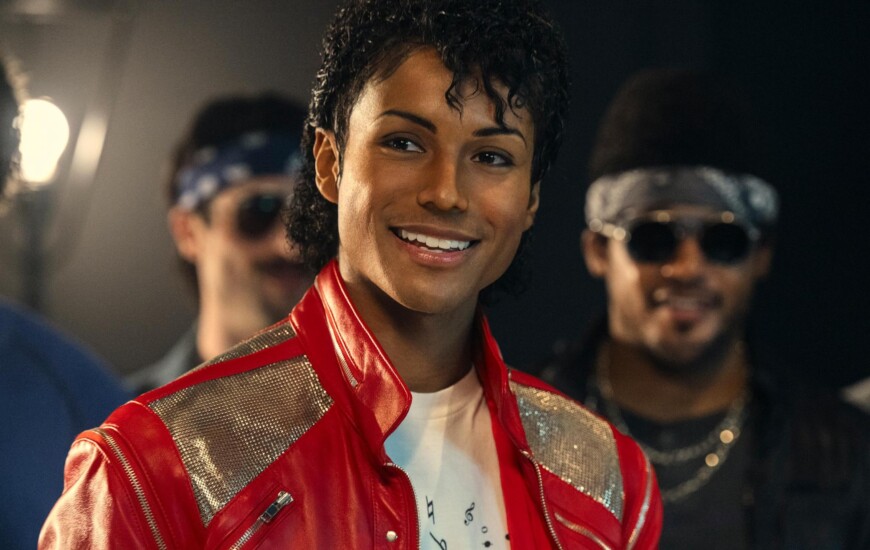
The best scene in the Michael Jackson biopic has very little to do with the man himself.
In an uncredited role, Mike Myers appears as Walter Yetnikoff, the head of Columbia Records.
His top client, Michael Jackson, wants to get the music video for Billie Jean played on MTV, but says it is difficult for a black artist to get airplay.
Wanting to keep his golden boy happy, Yetnikoff makes a call to the head of the network, demanding that the video be played in the next 10 minutes or he will pull the entire Columbia roster off the airwaves.
We only see one end of the phone call, but you can picture the music industry machinery operating on the other end of the line, scrambling to keep the talent happy.
You’d much rather be watching that kind of process-driven movie about pop music infrastructure.
That scene is the only time that the movie approaches anything resembling interesting or has something to say.
The interesting part of Michael Jackson’s life – specifically, his very public fall from grace in the 1990s – is not hinted at; the movie ends in 1987 with a title card informing us “the legend lives on,” with no mention of the Neverland ranch, no mention of the tabloid rumours about buying Joseph Merrick’s bones, and certainly no mention of the allegations.
Strangely, for a film that is so focused on beatifying Michael Jackson, there is zero mention of We Are The World; for a movie that is such a cynical PR exercise, it feels odd that the film leaves out the one thing that would present the man in unambiguous, heroic terms.
In recent years, music biopics have decided to focus on one specific aspect of an artist’s life (as seen in the recent Bob Dylan or Bruce Springsteen biopics) or do the traditional cradle to fame biopics (like Elvis or Robbie Williams).
Michael is following the Bohemian Rhapsody template, hoping that the music is enough to smooth over John and Jane Public; if you like the sound of jingling keys for two hours, Michael is the movie for you.
Bohemian Rhapsody made a lot of money in 2018 despite being awful, and Michael will repeat the same trick.
Remember when Michael Jackson bought a monkey, got plastic surgery and burned his hair? All the greatest hits are in there, don’t worry, audience, the film is going to hold your hand and spell everything out in capital letters.
Michael is flat-out boring; for a person who was larger than life, the film doesn’t even have the intelligence to probe why the music and the legacy have endured.
If Michael had any smacht to it, it would have honed in on one specific album or time in Michael Jackson’s life; instead, we are “treated” to the highs and lows of his early career, with no dramatic tension.
Worst of all, the film is a hagiographical whitewash that fails to address the elephant in the room.
Of course, a Michael Jackson movie that even hints at the elephant in the room doesn’t get the Jackson estate to hand over the songs, and a studio like Universal doesn’t spend 200 million to advertise it on the side of a bus.
In the end credits, all the members of the Jackson 5 are listed as executive producers, as are Michael Jackson’s children; that is a clear hint of who is controlling the narrative here.
2015’s Straight Outta Compton fell into the same trap; Ice Cube and Dr Dre were listed as producers, but that film, at the bare minimum, was a good exploration of why that group imploded; there is no such honesty to be found with Michael.
An actually honest movie about Michael Jackson would be treated the same way Paolo Larrain treated Jackie Kennedy or Princess Diana; it would focus on a specific time in their life, using the iconography of their public figure to psychologically analyse them when they are away from the spotlight.
Films like Jackie and Spencer deconstruct the myth around some of history’s most famous people, and you come away with having viewed portraits that operate as cinematic Mona Lisa smiles.
After you come away from watching Michael, it feels like you’ve just browsed a Wikipedia article.
With Michael Jackson, there is ample opportunity to put the man under the microscope, and the film does not take it; it just assumes the audience will show up for the songs, like trained circus seals.
Depending on how old you are, Michael Jackson was either the greatest celebrity of all time and a crucial part of the 1980s’ iconography, or was a washed-up punchline coasting on past glories.
Michael hopes you are in the former camp.
The thing is, an honest depiction of a famous musician has been done before.
2019’s Rocketman was an excellent example of how the artist involved was happy to have a warts-and-all depiction of their life shown to the public, while still also following the conventional biopic tricks.
Rocketman explores how Elton John’s drug use and gay relationships informed the music, and it wasn’t afraid to delve into the man behind the music; crucially, the man himself was happy to be involved with the project, which lent it gravitas.
There is no world where the Jackson estate hands over the music rights to the Sunset Boulevard-esque movie where a wilderness-era Michael Jackson walks around Neverland, ruminating on his career and what drove him to his point.
Director Antoine Fuqua is best known for his work with Denzel Washington, directing him to an Oscar in Training Day and turning him into an action hero with the Equalizer movies.
Prior to his work in film, Fuqua was a music video director; his most famous work is the video for Gangsta’s Paradise where Michelle Pfeiffer sits on a chair while Coolio sweats for 4 minutes.
When Fuqua remembers he used to be a music video director and not a hagiographer, the film briefly works.
The marketing hook of Michael is that his nephew, Jaafar Jackson, looks and dances just like the man himself.
To give the film some credit, it is uncanny; the speech patterns, the dance moves and even the face are a near 1:1 match of the real thing.
Rami Malek won an Oscar for Bohemian Rhapsody because he had a basic resemblance to Freddie Mercury; Jackson may end up following suit by doing the bare minimum.
Jaafar Jackson is quite a remarkable match for his famous uncle and lives up to what is an impossible task; the next question is whether he has any more tricks up his sleeve as an actor.
Fuqua and Jackson’s finest moment is when the film re-enacts the famous performance, to celebrate 25 years of Motown Records, where the Moonwalk is debuted for the first time.
Fuqua uses all of his music video training for that one sequence; the camera pans in and out, even capturing how Jackson’s socks and shoes operated as one.
For five minutes, Fuqua disengages the autopilot and sells the promise of the movie; you are going to see Michael Jackson brought back to life.
In that scene, you forget all about everything that came after, all the tabloid jokes, the rumours; you are watching a talented man change the modern face of pop music.
A scene of this quality is like if someone spliced five minutes of an episode of The Wire into an episode of The Big Bang Theory; you would take notice because all of a sudden you are watching something good.
The sequence is a genuine stand-out and is likely to be the film’s defining image.
Action and movement have always been Fuqua’s strong suit – god knows The Equalizer movies are best enjoyed while hitting fast forward through the talky bits – and Fuqua locking in, using his 90s rap video chops in a big movie like this is a treat.
Of course, you could also just stay at home and watch the real thing on YouTube – five good minutes in an otherwise bad movie isn’t worth the price of a ticket and snacks.
The moonwalk scene and the aforementioned scene at the record label hint at a film with actual conviction and imagination; it’s a shame the rest of it is so bland and anonymous.
Michael is likely to make a lot of money and is the kind of film that will get people out to the cinemas; on those grounds, we can’t complain too much.
A film like Michael being a big hit means that cinemas can afford to keep the lights on, so people can see matinees of sad Finnish dramas with six other people in the crowd.
A film like Michael not even bothering to interrogate the man at the centre? Now, that is Bad.
Related News