Northside TDs mixed on lifting passenger cap
Mike Finnerty 02 Jul 2026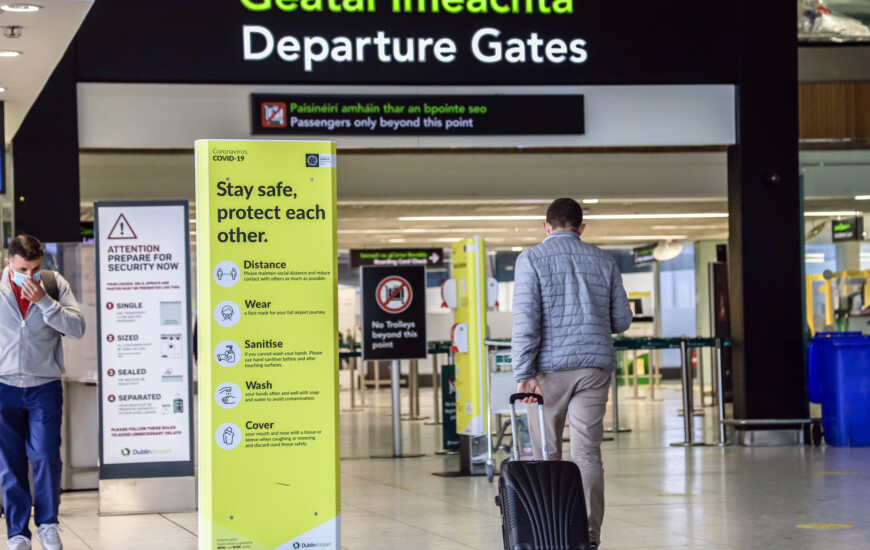
Dublin politicians have reacted with trepidation to the lifting of the Dublin Airport passenger cap.
In June, the government announced it would be moving forward with legislation to resolve the long-standing row.
At present, a maximum of 32 million passengers are allowed to fly in and out of Dublin Airport by legislation that was drawn up in 2007.
Since then, the government has attempted, unsuccessfully, to raise the cap owing to pressure from the Green Party in the last government and various legal challenges.
The government has made the consistent argument that lifting the passenger cap would help boost Ireland’s economy, but has dodged questions about whether lifting the passenger cap would damage Ireland’s climate change protection measures.
In a week where climate change became climate reality, the decision to increase the number of flights in and out of Dublin Airport has irked local TDs.
Green Party leader and Dublin West TD Roderic O’Gorman was chief among the critics.
While acknowledging that Ireland’s status as an island nation meant that air travel was “unavoidable,” he said that the lifting of the passenger gap was “robbing Peter to pay Paul.”
Speaking in the Dáil, O’Gorman said “Ireland is an island nation, and we all recognise the necessity of airport connectivity for our people and our economy; we already have good air links, and they will continue.”
“The question before us is whether this legislation is a proportionate and appropriate way to balance our commitment to a connected island with our obligations to meet climate targets, protect local communities and care for our environment.”
O’Gorman said he had concerns that the new legislation “does not even make an attempt at balancing those competing needs.”
“Instead, we have legislation that is one-sided in its focus, was constructed entirely with the desires of one set of stakeholders in mind, ignoring all others, and creates a set of real risks,” he warned.
O’Gorman took specific umbrage at the environmental impact of the passenger cap being lifted.
In May, the Environmental Protection Agency reported that Ireland is on track to blow past its 2030 climate limits.
O’Gorman noted that raising the passenger cap by just 8 million is likely to increase flight emissions by about 24%.
“Yet, the Minister has indicated in remarks he has made over the past year that he wants to double the numbers currently going through Dublin Airport; this is not about saying people should not fly. It is inevitable that people will fly out of and into Ireland. The question is whether it makes sense to have absolutely no upper limit on flight numbers going through Dublin Airport, with all the connected climate, environmental and community impacts of that approach,” he said.
Ireland stands to face billions in European Union fines if it does not meet legally binding climate change mitigation targets by 2030.
The government are willing to bet that the increased passenger numbers in and out of Dublin Airport are worth the economic (and environmental) risks.
O’Gorman said the risk of EU fines isn’t abstract; it could hurt Ireland’s coffers.
“We know there is a cost to non-compliance that is in a range somewhere between €8 billion and €26 billion. The removal of the obligation to adhere to section 15 of the Climate Action Act in relation to the passenger cap does not remove the government’s wider obligations under national law, international law or, indeed, under the European Convention on Human Rights.”
“A legal opinion that was sought on the Bill found the lifting of the cap without introducing any other protections will expose the government to a credible claim that it is in breach of Article 8 of the convention, which concerns the right to protection of private and family life, by failing to shield its citizens from the health impacts of the climate crisis. The same opinion also found the state had a procedural obligation to conduct an environmental impact assessment, EIA, including of all CO2 and non-CO2 emissions from arriving and departing flights, or face significant risk of being challenged in the courts,” he noted.
O’Gorman cited the long-running saga of a proposed third runway at Heathrow Airport in London.
A political issue for the best part of a decade in the UK (at one stage, forcing a by-election), a recent report by the UK Department for Transport found that the economic implications from the expansion of Heathrow Airport found that the “positive gains were outweighed by the social and environmental impact, which for that airport was estimated at between £58 billion and £82 billion.”
O’Gorman said the government should commission a similar report and draw their own conclusions.
“Deputy O’Brien is the Minister for Transport but he is also the Minister with responsibility for the environment and climate. Yet, he seems allergic to meeting organisations representing those particular interests,” O’Gorman remarked.
O’Gorman criticises American lobbyist “scaremongering” over passenger cap
Minister O’Brien said that lifting the passenger cap was an issue of national importance.
“We are an island nation and we cannot ignore the strategic importance of Dublin Airport to our economy and the serious harm that would be caused to the economy, our people, our international connectivity and the international reputation of the state by failing to be in a position to facilitate not only future growth, but the current level of passengers and cargo at our main international gateway,” he told the Dáil.
The Minister said that the issue at hand was a “legacy” one, as the legislation was drawn up in 2007.
He argues that the 2007 economic realities are different to the ones facing Ireland in 2026.
“The Dublin Airport passenger cap does not serve this state or the people of the region well,” he claimed.
“I want the airport to grow on a sustainable basis and to operate as a good neighbour. I grew up beside the airport and have lived in the area my whole life. I know that tens of thousands of people derive income and good salaries from Dublin Airport.”
He said, “Dublin Airport is a critical part of infrastructure in this country and critical to our international connectivity. We have tens of thousands of people working there who not only derive an income there, as I said, but are at the leading edge of aviation, not just in Ireland but across Europe and the globe.”
Sinn Féin TD and Dublin spokesperson Mark Ward said that while he and his party are supportive of lifting the passenger cap, it should also coincide with improved public transport to and from the airport.
The Dublin Mid-West TD said, “the government must be mindful that any increase in the passenger cap at Dublin Airport will put pressure on existing services.”
Ward remarked, “it does not take a rocket scientist to work out that lifting the passenger cap will mean more staff. More staff will mean more driving and more driving will mean that we will need more parking. I am calling on the government to plan for this certain outcome when lifting any passenger cap.”
Northside Fine Gael TD Naoise Ó Muirí took a different tact, and supported calls by Fianna Fáil TD Paul McAuliffe to support a tourist tax.
In recent weeks, McAuliffe has received support from the Fianna Fáil parliamentary party to introduce a tourist tax for Dublin, similar to what is seen in other European capitals.
The Dublin North-West TD said that the tourist tax could be used to fund local government services.
Discussing the policy, McAuliffe said, “this legislation would empower local authorities to make the decision to impose a levy, and it could provide for funding in areas that are frequented daily by tourists on excursions from the city centre.”
He explained, “the levy would be ring-fenced for the revitalisation of Dublin and the amenities used by residents and visitors. It would offer a much-needed funding boost at a time of rapid expansion in our capital and would support local authorities’ investment in the public realm. It would also bring Dublin in line with many capital cities of our European neighbours.”
Ó Muirí implied that the government could make lemons out of lemonade with the increased number of passengers going to and from Dublin Airport.
The Dublin Bay North TD noted that in 2024, over 4 million tourists visited Dublin.
“As visitor numbers go up, so do pressures on local services and I reiterate my support that we look at that tourism levy again as a government. If we are to get greater numbers in through the airport coming to Dublin and beyond, the tourism levy is a key element of making sure that Dublin has a good offering and is well maintained, open and welcoming to our visitors,” he said.
Related News