Deposit Return Scheme contributing to city centre littering, council hears
Mike Finnerty 12 Aug 2026
Sinn Féin councillor Edel Moran has said that measures should be taken to prevent people, who pick through bins to retain bottles and cans, from causing littering issues.
Ever since the Deposit Return Scheme launched in early 2024, the scheme has seen tens of millions of euros returned to consumers, and litter from cans and bottles has been drastically reduced.
However, at a recent meeting of the Climate Action and Urban Resilience SPC on Dublin City Council, the Sinn Féin councillor said that people rifling through bins is causing issues in the city centre and her local area.
The Artane-Whitehall councillor said it is “horrific” that people are resorting to having to dig through bins.
“As much as the scheme is a great thing, it’s stopping people from dumping bottles and cans, there are people opening black bins in my local area, and leaving everything all over the place.”
Councillor Moran said, “I have seen people pull bins apart, take stuff out, climbing in, no matter how small or big it is,” she told the meeting.
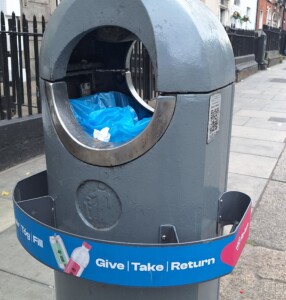
To combat this, Dublin City Council introduced a specific kind of bin which put a rim around over 100 bins in the city centre.
The idea behind the rim was so that people could leave bottles or cans for other people to collect, but Moran said that specific plan has “failed.”
“I know it’s a major thing all over the city; I think it’s a major issue that has been ignored,” she said.
Derek Kelly, director of services with Dublin City Council, said that while “bona-fides” of the scheme are “clear”, he says the scheme is having a “huge impact” on the council’s ability to keep Dublin city centre clean.
“There are bins being scavenged 24 hours a day,” he told the meeting.
“We’ve kept the bins surrounds in a lot of places, but we are seeing coffee cups, banana skins, even half a pizza left on them,” he noted.
Kelly said that the council were looking to introduce more “big belly” bins in the city centre; he explained that those bins have digital locks, preventing people from accessing the contents.
He said that some people are “clean” when they go through bins with the hopes of retrieving a can or bottle from bins, but he said that other people aren’t, and those are the ones causing a mess.
“Some people will just pull the bag out through the opening, and we have problems then,” he noted.
He expanded on Moran’s point that people are going through bins in private settings, outside of the city centre and in the suburbs.
“People’s wheelie bins are being upturned, a lot of eurobins are being upturned by commercial premises in the hopes of finding a 15 cent bottle. We then have a 500 or 600 euro operational fee and are sending a group of lads down to clean up the mess,” he told the meeting.
Kelly said he didn’t have a “silver bullet” to solve the issue, but he hoped to reduce the operational costs of cleaning by introducing bins that cannot be tampered with.
He said that other local authorities are having “similar issues,” with people going through bins hoping to retrieve cans or bottles, and noted that DRS, the operators of the scheme, are carrying out behavioural research as to why people feel compelled to dive through bins.
Denmark and Austria were among the first European nations to introduce a form of a deposit return scheme (in 1981 and 1990 respectively), while Germany’s model, implemented in 2003, has become the most widespread version of a deposit return scheme.
When Ireland introduced the scheme in 2024, it was noted that it would require the greatest change in consumer behaviour since the smoking ban was introduced in 2004.
Figures released this week revealed that just over €60 million has been left unclaimed by consumers who returned bottles and cans.
While the scheme has largely been successful (2.5 billion bottles and cans were returned in the first two years of the scheme and litter has been cut by up to 55% per the DRS’ data), the question then becomes why exactly people feel compelled to go through bins.
Kelly claimed that people are making “good money” on going through bins, and said “as long as it’s commoditised, there’s going to be people doing it.”
Moran said, “if someone is looking for a bottle and they need the money for it, that’s fair enough; maybe there could be a way for them to get easier access to them.”
“The people I’ve seen look like they need it (the money), they are carrying bags around, spending their day doing it (collecting cans and bottles).”
The Sinn Féin councillor suggested that bins are set up in such a way that bottles and cans are easily identifiable so people are aware that a bottle or can is present within them.
Kelly noted that people are putting in half-full bottles of fizzy drinks with the intent of allowing people to spill the drink out so that people can claim the deposit, a consumer psychology insight that the DRS would no doubt be interested to hear about.
Clontarf councillor Clodagh Ní Mhuirí said that further along the Northside, there have been complaints about bins being removed from the Clontarf area.
The Fine Gael councillor told the meeting that there are concerns from local residents about bins being taken out of the local area, and not being replaced.
“Last year I put in a request for a big belly bin near the DART station; then about two weeks ago, I was told the bin has been removed,” she informed the meeting.
“I’m not convinced that removing bins for people using bins the proper way is the right solution,” she said.
“It’s very hard to justify to people when we don’t have the full information why bins are being removed and not replaced,” she said, implying that councillors are being left in the dark on decisions being made by the Dublin City Council executive.
Kelly said that bins are only removed if they are prone to illegal dumping, and said that bins are taken out across the city for that reason.
“If the dumping keeps happening, we know we have an issue; in areas where there are shops, the shops should all follow by-laws about providing bins,” he said.
“All across the city we have bins in inappropriate locations; if they were just put in historically or for any reason, take them out. If bins are needed and it’s a green space, put in a big belly bin,” he said of the Council policy.
“We only take out bins when there are issues,” he said.
Related News