Met Éireann announces new list of storm names for 2026/27
Padraig Conlon 28 Aug 2026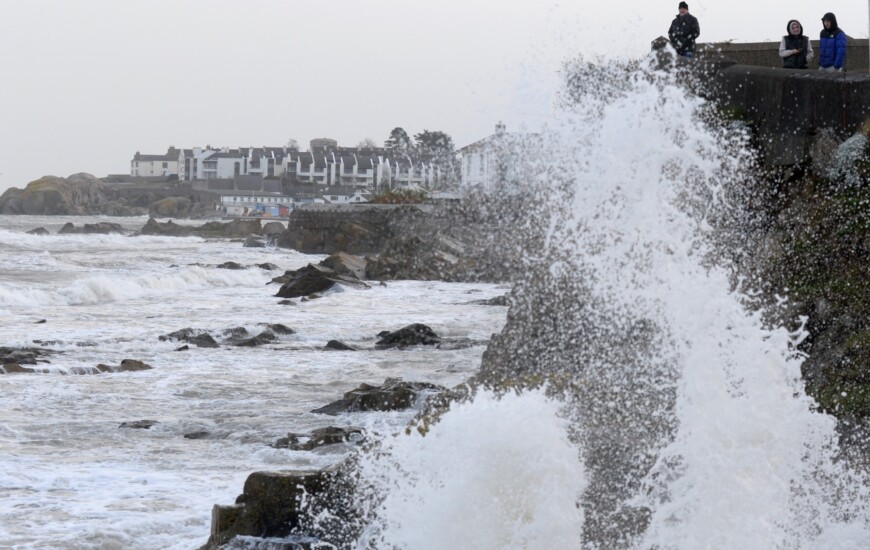
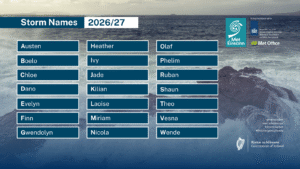
Met Éireann, in partnership with the National Meteorological Services of the UK (Met Office) and the Netherlands (KNMI), has launched the new list of names for the 2026/27 storm ‘season’, which starts today and runs until 31st August 2027.
Of the list of 21 names, each of the national partners has contributed seven names.
Met Éireann’s selection features four historically significant names in Austen, Evelyn, Kilian and Miriam, with three derived from a longlist of nominations proposed through a public campaign run last year in Heather, Laoise and Phelim.
The full 2026/27 list is Austen, Boelo, Chloe, Dano, Evelyn, Finn, Gwendolyn, Heather, Ivy, Jade, Kilian, Laoise, Miriam, Nicola, Olaf, Phelim, Ruban, Shaun, Theo, Vesna, Wende.
(The names chosen by Met Éireann are in bold. Letters Q, U, X, Y, Z are not included, which is in line with the US National Hurricane Center naming convention).
Commenting on the launch, Eoin Sherlock, Head of Forecasting Division in Met Éireann, said:
“Naming storms helps Met Éireann in our mission to protect life and property through the provision of world-class weather, climate, and flood services.
“Using consistent names and communications allows us and other public safety organisations to increase awareness of severe and impactful weather alongside our weather warnings.
“We know that naming storms makes it easier for people to track important and up to date forecast and safety-related information as we can see from the levels of traffic and activity through our website and across social media platforms during storm events.
“2026 marks the 90th anniversary of the establishment of the Irish Meteorological Service and we are proud to be able to recognise some of the significant contributors to our history in the list of storm names this year, such as the first director of the Service in 1936, Austen Nagle, and the first woman to hold an operational role as a meteorological officer, Miriam Lyons.
“As we approach the start of the new storm season, we take the opportunity to encourage to the public to engage with relevant forecasts and safety information during storms and all other extreme weather events.”
A storm is named when it could result in ‘medium’ or ‘high’ impacts in one of the three partner countries. Naming storms allows for authoritative and consistent communications with the public to enable them to prepare for, and stay safe, during potentially severe weather events.
When a storm is forecast, the national weather service that expects the biggest impact from the severe weather or is likely to be affected first, names the storm. As well as naming a storm, relevant warnings may be issued for wind, rain, or snow, or a combination of these conditions. Any warnings issued are based on a combination of numerical criteria and the potential impacts foreseen. Up to date information on all Irish weather forecasts and warnings can be found on the Met Éireann website and app.
Since 2015, Met Éireann and the UK Met Office have been working together on the naming programme, and they were joined by the Netherland’s KNMI in 2019.
Holly Clements, Head of Warnings and Guidance at the UK Met Office explained:
“For more than a decade, storm naming has helped us communicate the risks from severe weather more effectively. A named storm provides a clear focus for forecasts and warnings, helping more people understand the potential impacts and take action to protect themselves, their families and their property.”
Other National Meteorological Service groups in the US and Europe also name storms.
When any National Met Service names a weather system, all others keep that name, including ex-hurricanes named by the US National Hurricane Center such as Charley (25th August 1986) and Ophelia (16th October 2017), which had major impacts in Ireland when they crossed the Atlantic.
Related News