RTÉ hit hard by €20m broken promise
Padraig Conlon 14 Oct 2026
RTÉ has been left €20 million short after making spending commitments based on funding the Government had promised.
The broadcaster warned that the unexpected shortfall would affect its five-year strategy.
It had already entered into agreements with programme makers, staff and other stakeholders based on a written three-year funding deal.
Budget 2027 allocated RTÉ €240 million for next year, rather than the agreed €260 million.
The allocation maintains funding at its 2026 level.

Minister for Culture, Communications and Sport Patrick O’Donovan (pictured above) met RTÉ’s senior management on Thursday (8th).
They agreed to continue discussions, but there was no announcement that the money would be restored.

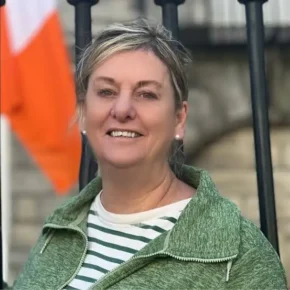
Social Democrats media spokesperson, and Dublin Rathdown TD Sinéad Gibney (pictured above), accused the Government of offering contradictory explanations for the decision.
Oireachtas committee members have also demanded clarity on whether the €20 million has been delayed or withdrawn completely.
The dispute centres on a €725 million public funding package agreed in 2024 for the three years from 2025 to 2027.
Under that arrangement, RTÉ expected €260 million in public funding next year. Budget 2027 instead provided €240
million, maintaining the allocation for 2026 but leaving the broadcaster €20 million below the amount it had planned around.
RTÉ says it has already entered into agreements with programme makers, staff and other stakeholders on the strength of the written commitment.
Director general Kevin Bakhurst warned that the reduction would inevitably affect the broadcaster’s ability to deliver its five-year strategy.
“The Government’s decision to reduce this public funding agreement by €20 million at this late stage, when we have already made important commitments to our audiences, to the independent sector, to other important stakeholders and to RTÉ staff, is one we had not anticipated,” he said.
“If the three-year multi-annual agreement will no longer be honoured – we now have some important decisions to make.”
The broadcaster has also rejected suggestions that reform has been too slow, setting up a dispute over both the funding decision and the Government’s assessment of progress within the organisation.
At a press conference on Wednesday (7th) , Mr O’Donovan referred to budgetary constraints within his department following spending curbs imposed by Minister for Public Expenditure Jack Chambers.
Deputy Gibney said this explanation was difficult to reconcile with the minister’s criticism of the pace of change at RTÉ.
“On the one hand, Minister Patrick O’Donovan says the national broadcaster is being punished because of the slow pace of reform within the organisation. However, in the next breath, he blames budgetary constraints within his own department for the shortfall,” she said.
“So which is it?”
She described the situation as “Schrodinger’s Cuts”, accusing the minister of contradicting his own rationale while Government colleagues failed to clarify the position.
Deputy Gibney said Kevin Bakhurst had received just three hours’ notice of the decision before Tuesday’s Budget announcement and had not been told that the shortfall was linked to the pace of reform.
“It’s hard to believe that the first step taken by the minister to solving a performance issue would be to slash funding that was supposed to be guaranteed,” she said.
She also questioned the handling of additional funding for the department, saying Minister O’Donovan had written to Minister Chambers the previous week warning that the RTÉ agreement would be “reneged on” without more money.
According to Deputy Gibney, the letter resulted in an additional €21 million allocation which senior Government figures reportedly believed would avert difficulties with RTÉ’s funding.
“If that’s not the case, where did the €21 million from Jack Chambers go?” she asked.
Her criticism extended to the absence of clear conditions under which the broadcaster could recover the money.
“If this is a performance issue, can anyone from this Government explain what RTÉ can do to get their previously guaranteed funding restored?” she said.
Deputy Gibney said the decision raised fears about compulsory redundancies and cast doubt over plans for a new studio in Cork.
She also raised concerns about editorial independence, arguing that the Government’s control of funding made its treatment of the broadcaster particularly significant.
RTÉ, meanwhile, insists that substantial reform has already taken place.
Kevin Bakhurst said the leadership team had implemented around 90 per cent of the recommendations in the Expert Advisory Committee report.
He said almost 100 people had already left the organisation, despite what he described as the late approval of the voluntary exit programme and the short period available for departures.
“We completely reject the assertion that the pace of reform and transformation within RTÉ has been slow,” he said.
Bakhurst said the certainty provided by the 2024 agreement had allowed RTÉ to plan investment in news, original Irish drama, live sport and digital services, including podcasts, apps and the RTÉ Player.
It had also supported efforts to stabilise the broadcaster’s finances and develop its digital commercial strategy.
He pointed out that the Taoiseach and Tánaiste had themselves emphasised the importance of predictable multi-annual funding when the arrangement was announced.
The Public Accounts Committee is now seeking to examine the agreement and establish whether the €20 million has been withheld temporarily or withdrawn altogether.
Paul McAuliffe, the Dublin North West TD and committee vice-chair, welcomed the decision to call officials from the Department of Culture, Communications and Sport before the committee.
“The PAC now want to see that agreement, examine its enforcement and understand the mechanisms that may or not be there to withhold funding,” he said.
Deputy McAuliffe said the department should be able to withhold funding if it believed RTÉ needed to improve delivery of reforms. However, he stressed that withholding, delaying and withdrawing funding were different actions with different implications.
“The PAC needs clarity on what the exposure to the state is at present and in future years,” he said.
He called on the department to explain the agreement’s terms and any enforcement mechanisms linking funding to reform benchmarks.
Labour TD Alan Kelly, chair of the Oireachtas Committee on Media, also called for urgent intervention after receiving a letter from Mr Bakhurst following the Budget.
“Government agreed funding with RTÉ, yet has now cut €20 million at a point when the broadcaster has already made significant commitments,” he said.
“The Minister must explain why Government has changed course and what it expects RTÉ to sacrifice.”
Deputy Kelly warned that the consequences could reach viewers and listeners, RTÉ employees and independent producers whose work depends on commissioning decisions.
“A head-on collision between RTÉ and Government is now looming,” he said.
“The Minister must engage immediately, explain this decision publicly and honour the funding commitment.”
Thursday’s meeting brought Mr O’Donovan together with RTÉ chair Terence O’Rourke and Kevin Bakhurst to discuss implementation of the broadcaster’s strategy.
A department spokesperson described the meeting as positive and said the minister had listened to concerns about funding and support for the strategy.
“The Chair and DG provided assurances on the delivery of reforms and their timing,” the spokesperson said.
“The Department and RTÉ will continue to engage constructively on all the issues discussed over the next few weeks.”
Speaking afterwards, Mr Bakhurst said:
“We’ve agreed that we’re going to carry on working with his officials to try to find a resolution to this.”
Those discussions leave the central question unresolved.
Will RTÉ receive the funding it says it was promised, or will it have to revise commitments already made on the strength of that agreement?
Related News