St Vincent’s Hospital launches Parkinson’s medication pilot
Padraig Conlon 12 Mar 2026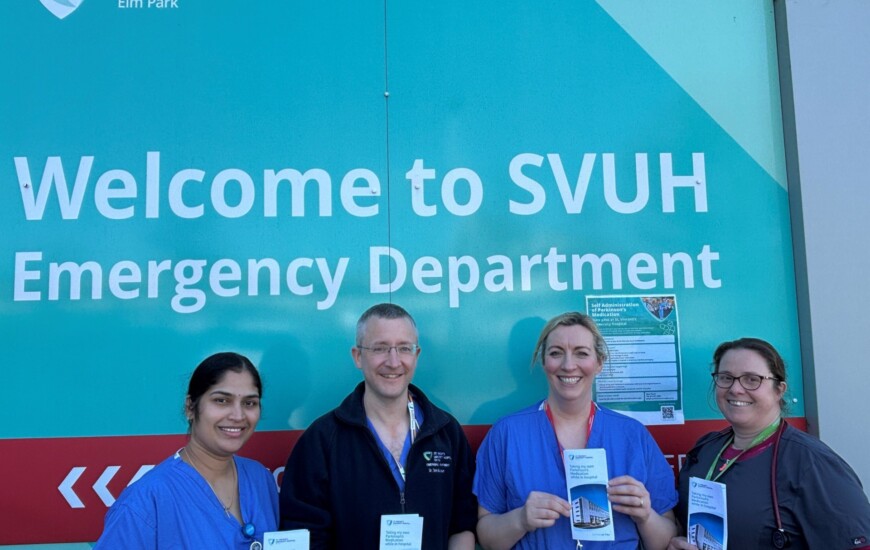
For people living with Parkinson’s disease, timing is everything.
A delayed dose of medication can quickly lead to worsening symptoms, leaving patients struggling with movement, stiffness and severe discomfort.
Now a local hospital is trialling a new approach designed to prevent that from happening.
St. Vincent’s University Hospital (SVUH) has launched what is believed to be the first hospital pilot programme in Ireland allowing eligible patients with Parkinson’s to self administer certain time critical medication while in hospital.
The initiative, which has begun in the hospital’s Emergency Department and on an inpatient Care of the Older Persons’ ward, aims to address a long recognised challenge in Parkinson’s care, delays in medication administration during hospital stays.
For many people living with Parkinson’s, medication must be taken at carefully timed intervals throughout the day.
These medicines help control the symptoms of the progressive neurological condition, which can include tremors, muscle stiffness, slow movement and balance problems.
If doses are delayed, even by a short period, patients can experience a sudden deterioration in symptoms.
Mobility can become significantly more difficult, speech may be affected and everyday tasks can become challenging.
For some patients, missing or delaying medication can also lead to anxiety and distress, particularly when they are already dealing with the stress of being admitted to hospital.
In busy hospital environments, however, standard medication rounds do not always align perfectly with the strict schedules required for Parkinson’s medication.
While clinical teams work hard to ensure patients receive their medicines as promptly as possible, the demands of acute hospital care can sometimes make precise timing difficult.
The new pilot programme aims to reduce that risk by allowing suitable patients to continue managing certain Parkinson’s medicines themselves while in hospital, replicating the routine they follow at home.
Under the programme, patients who normally manage their own Parkinson’s medication outside hospital may be permitted to self administer specific time critical medicines during their stay, provided they are assessed as suitable by the clinical team.
This assessment considers factors such as the patient’s usual medication routine, their ability to manage the medicines safely and their overall clinical condition.
All other medicines prescribed during the hospital stay will continue to be administered by nursing staff in the usual way, ensuring appropriate clinical oversight remains in place.
Dr Tom MacMahon, Consultant in Emergency Medicine at SVUH, said the programme represents a practical step forward in improving patient centred care for people living with Parkinson’s.
“We know that timing is critical for people living with Parkinson’s.
Even small delays can have a real impact on symptoms.
This pilot allows suitable patients to maintain their established routine in a safe, structured way, while remaining under full clinical oversight.
It improves safety and enhances the patient experience in a busy hospital environment.”
Advocacy groups and healthcare professionals have long highlighted the difficulties Parkinson’s patients can face when admitted to hospital, particularly when medication schedules are disrupted.
Maintaining consistent timing of medication is widely recognised as one of the most important aspects of managing the condition.
Hospital staff involved in the initiative say the pilot has been designed to balance patient independence with robust medication safety measures.
The programme was developed through collaboration between several hospital departments and specialist teams, including Emergency Medicine, the Care of the Older Person service, Nursing, Pharmacy and specialist Parkinson’s services.
Hospital leaders say the approach also aligns with national guidance on time critical medicines, which emphasises the importance of ensuring certain drugs are administered exactly when required in order to maintain their effectiveness.
Niamh O’Hanlon, Chief II Pharmacist at SVUH, said the pilot has been carefully developed with medication safety at its core.
“This is about reducing the risk of omitted or delayed doses while maintaining strong clinical governance.
“Only certain time critical Parkinson’s medicines are included, and every patient is individually assessed.
“Supporting appropriate self administration can make a meaningful difference to patients’ comfort and outcomes.”
Phase one of the pilot is now underway in the Emergency Department and on Our Lady’s Ward, where staff will monitor how the programme operates in practice, including its impact on patient experience and medication timing.
If the pilot proves successful, the hospital plans to expand the model to additional wards in the future, with the hope that it could eventually inform wider changes in how Parkinson’s medication is managed during hospital stays across Ireland
Related News