Project seeks to uncover secrets of the Hellfire Club
Dublin People 21 Oct 2016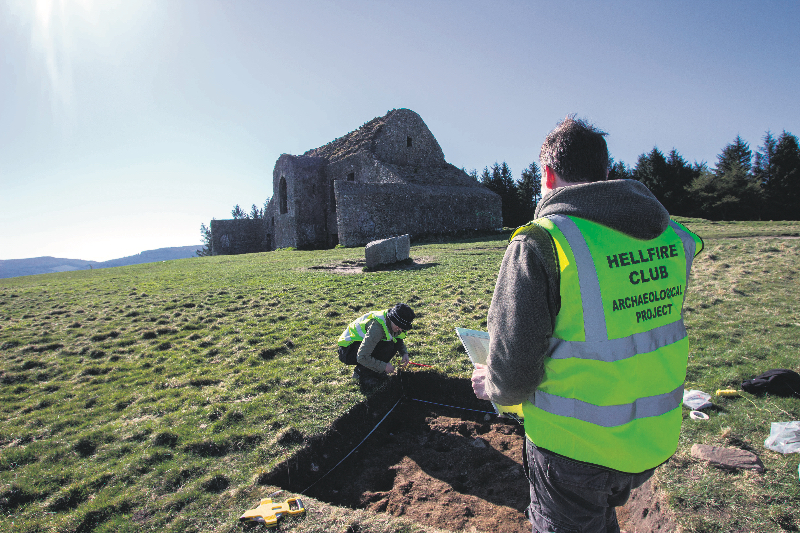
AN EXCITING archaeological excavation at one of the Southside’s scariest locations has been taking place throughout October.
The project aims to help uncover the story of Mountpelier Hill, where you will find the famous ruins known as the Hellfire Club. The excavation is being led by Neil Jackman of Abarta Heritage, with an experienced team of archaeologists alongside volunteers from University College Dublin.
The project is being backed by South Dublin County Council, Coillte and Abarta Heritage, with support from University College Dublin, the Discovery Programme, the National Monuments Service and National Museum of Ireland.
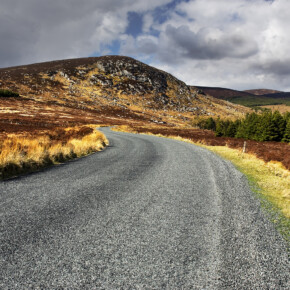
Montpelier Hill, near Tallaght in the Dublin Mountains, is a popular place for locals and visitors to enjoy spectacular views over the city. It is synonymous today with the ruins of an 18th century building known locally as the Hellfire Club.
It was built as a shooting lodge for the famous politician William Conolly in around 1725. To build the lodge, his workmen destroyed two large tombs, and utilised their stone as building material.
The destruction of the tombs marks the beginning of the association of the building with the supernatural. Legend has it that a devil was so enraged by the desecration that he blew off the original wooden roof of the new building.
As one of the richest and most powerful men in Britain or Ireland, William Conolly was not to be deterred by a mere phantom, so had the roof reconstructed in stone, giving the lodge its unique appearance. Conolly did not live long to enjoy his new lodge, as he died just a few years after its construction.
The building is thought to have been idle until 1735, when it is said that his widow, Katherine, leased it to Richard Parsons, the Earl of Rosse. Parsons was one of the leading figures in what was known as ‘Dublin’s Hellfire Club’, ‘The Blasters’ or the ‘Young Bucks of Dublin’. This was a group of aristocrats, described at the time by the famous Jonathan Swift as “a brace of Monsters, Blasphemers and Bacchanalians”.
The Earl of Rosse in particular was infamous for obscenity, blasphemy and for his habit of receiving guests in the nude.
The main meeting place for the Hellfire Club appears to have been The Eagle Tavern on Cork Street. Though no direct records explicitly state that they met on Mountpelier Hill, it was certainly a plausible meeting place given that it was leased to their leader, the Earl of Rosse, and that it was far enough outside the city for their debauches to go unnoticed.
This is the third phase of a project to help uncover the stories of Mountpelier Hill. Phase one was largely research based; during phase two they carried out a geophysical survey with Earthsound Geophysics to discover the archaeological potential of the site. This was augmented by targeted test excavations to establish the nature of the archaeology.
This third and current phase involves the archaeological excavation of a portion of the large tomb. It is believed that this was once a large passage tomb, similar in some respects to Newgrange.
Before it was largely destroyed, archaeologists believe it would have once been a large circular mound with a stone lined passageway that led to a burial chamber. This type of tomb generally dates to the Neolithic period, around 5,000 years ago. It is thought to be part of an extended cemetery of tombs that top a number of the mountains of South Dublin and Wicklow.
With the excavation of a portion of the tomb, it is hoped to discover that the 18th century workmen did not destroy the lower levels of the tomb, and some of the original features might be found intact. They also hope to find bone or charcoal to obtain a radiocarbon date that will tell precisely how old the tomb is. This will allow it be compared with other similar tombs in Ireland.
After the excavation is complete, the site will be returned to its original condition.
The excavation has been carried out Monday to Friday throughout October. You can keep up with the work on www.abartaheritage.ie where you can view site diaries and video blogs to show the progress of the excavation.
Related News