Special education crisis becomes by-election focus
Mike Finnerty 13 May 2026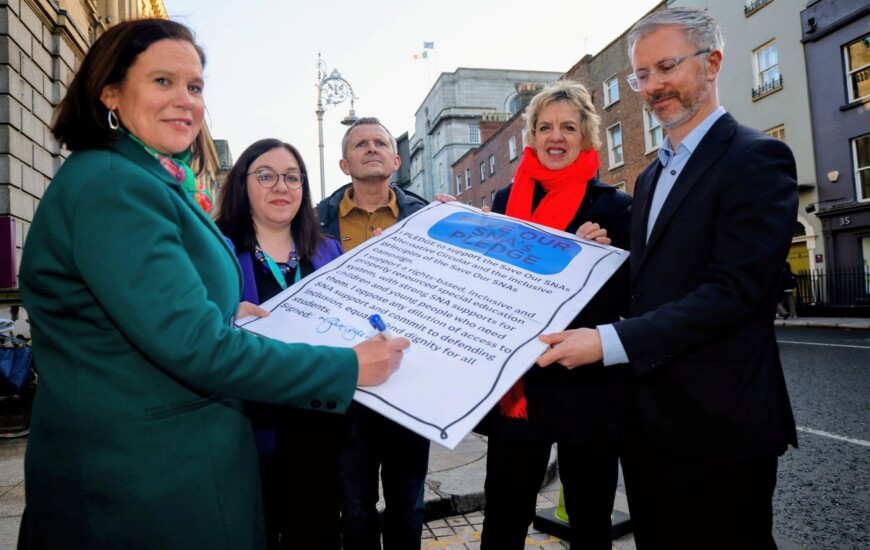
The crisis in special education continues to be a thorn in the side of the government parties.
Across the Northside last week, the crisis in special education came into view in two disparate areas; Croke Park and Dublin 15.
On Wednesday evening (6th), the various candidates in the Dublin Central by-election met with campaigners and parents from the Save Our SNAs campaign.
The meeting, which took place at the National Handball Alley, saw both government and opposition candidates in attendance, with the opposition enjoying a lopsided advantage on the issue.
As reported in an April edition of the Northside People, government parties were warned that they are “sleepwalking” into the worst special education crisis ever when schools return in September.
That attitude was to the forefront of Wednesday evening’s meeting, with the Save Our SNAs group telling elected representatives that the current special education system in Ireland is stuck in the 2010s.
The current “circular” was established in 2014 and is the legal framework in which special needs assistants enter the system.
The “circular” was established in the context of the then-ongoing austerity measures, which severely limited the numbers involved and the hours afforded to special needs assistants in the Irish education system.
With the Irish economy recently reporting a GDP surplus of between €5.1 billion and €9.2 billion for 2026, the penny pinching in a time of plenty attitude dominated the meeting.
Niamh McDonald, co-founder of the Save Our SNAs campaign, said “the current system is based on an outdated 2014 circular that fails to reflect what SNAs actually do every day; supporting communication, emotional regulation and participation in the classroom.”
“Our alternative circular recognises the real role of SNAs and we are building political support to make that a reality. This by-election is an opportunity for candidates to commit to that change.”
Rachel Kane, parent and member of the North Inner City Side-by-Side Support Group said that “special needs assistants are an essential part of our education system, not only in special schools and special classes, but across mainstream schools.”
“SNAs help children with additional needs to manage personal care, communication, emotional regulation, mobility, safety, and access to learning throughout the school day. Without that support, many children would struggle to remain in class, engage with their peers, or even attend a full school day.”
Kane said, “for families, SNAs provide reassurance that their child is safe, included, and given the same opportunity to learn as every other child. Any cuts to SNA numbers or failures in proper deployment will have serious consequences: children may lose vital support, schools will come under greater pressure, teachers will be stretched beyond capacity, and some students could face reduced hours, exclusion, or falling behind academically and socially.”
She stated that “investing in SNAs is not an extra cost—it is an investment in inclusion, equality, and every child’s right to education.”
For by-election candidate Janice Boylan, the government’s seeming inaction in the face of a special education crisis is personal to hear.
The North Inner City councillor said that her nine-year-old son, Brody, is neurodivergent, and she has first-hand experience of the dysfunctional Irish special education system.
“I have been fighting for him every single day for five years to try to get him this diagnosis of ADHD, autism, dyspraxia, and rejection sensitivity dysphoria.”
“No child, no parent and no family should have to wait that long. My family is still learning as we go along, but it is a hard struggle – a struggle we could not cope with if it were not for the support Bródy receives from his SNA.
There was disconcertation at the meeting that Fianna Fáil by-election candidate John Stephens failed to show up to the meeting, while Fine Gael candidate, Lord Mayor Ray McAdam, declined to sign a pledge which calls for a reversal of the current “circular” in the special education system.
Furthermore, the meeting received word that Minister for Education Hildegaarde Naughton was in the area, on a canvass for McAdam, but did not attend the meeting.
Boylan said, “the government must realise that our SNAs are the backbone of an inclusive educational and societal system.”
The Sinn Féin councillor said, “we are facing a crisis that is both unacceptable and inexcusable: Hundreds of children across this state being refused special class and special school places that they need to survive and thrive.”
Minister Naughton’s no-show at the meeting, despite the meeting being publicised and having a member of the government parties in attendance, did not go down well with locals.
Vicky Kelly, a parent and co-founder of Save Our SNAs, said that Minister Naughton’s absence was a “snub” to the campaign and to all the families who gathered.
“It would have been very easy for Minister Naughton to attend the meeting, listen to parents, SNAs and teachers, and engage with the reality facing children with additional needs. She didn’t, and we are disappointed but not surprised.”
“Minister after minister, parents of children with additional needs, SNAs and teachers have been ignored. We saw that most clearly when the government announced plans to reduce SNA allocations to many schools across the country.”
February saw a 500-strong protest outside the Dáil; members of the opposition formed a united front on that occasion, and thanks to their collective pressure (as well as a public backlash led by SNAs), planned cuts were reversed.
“Thankfully, through our work and the grassroots protests that emerged all over Ireland, we were able to force government to pause those plans. People learned a very important lesson through this – people power works,” Kelly said.
Despite the seeming snub from the government parties, McDonald said the event went well.
In particular, she said she was pleased with the level of engagement from by-election candidates.
“Families are demanding action and they are no longer willing to accept being sidelined,” McDonald said.
“We succeeded in pushing special education and inclusion of our children front and centre in this election and we will continue our work until we see progress towards truly inclusive education in Dublin Central,” she said.
Further west, Labour councillor John Walsh, who made special education a key part of his 2024 local election campaign and Dáil bid, has welcomed the government’s report on special education in Dublin 15.
A task force dedicated to improving special education in Dublin 15 was published this week after being presented to the previous Minister for Education, Helen McEntee, last June.
Nearly a year later, Walsh said more urgency was needed on improving special education in Dublin 15, and that the findings of the report can’t be left to gather dust on a shelf.
The Castleknock councillor said that the publication of the report is “long overdue,” and the onus was now on the government to implement the recommendations in full.
The report, which saw input from parents and educators across Dublin 15, has said that an autism school is needed for Dublin 15
Walsh noted that Dublin 15 has a larger population than Limerick City, yet there is only one special school in the area.
Earlier this year, and to great fanfare from government TDs, a number of new special education classes were announced across Dublin and Ireland; despite the presence of a Dublin 15 TD at the Cabinet table, the area was left out entirely.
“The government has a moral obligation to deliver the necessary resources for key recommendations so that every child has an appropriate school place and has an equal opportunity to fulfil their potential,” Walsh said.
The report noted that 40% of referrals to children’s disability network teams in the Dublin 15 area are currently on waiting lists.
Walsh called that statistic a “scandal”, because, in the context of special needs education, early intervention is crucial.
In this case, the early intervention simply never happens, and Walsh says this creates a system where children are “neglected.”
Walsh said that primary care and CDNT services “must now be resourced adequately to provide timely assessment and intervention to children with additional needs in early learning and care providers and schools.”
He said that the government has to commit to additional special school provision for the Dublin 15 area through the establishment of a new special school.
“This is a report that reflects seven years of work, activism and campaigning by parents – it is long past time that the government gave the most vulnerable children in our society the priority they deserve,” Walsh stated.
Related News