Minister invited to visit Finglas to see level of dereliction
Padraig Conlon 29 Jan 2026
A Northside TD has challenged the Housing Minister to walk through Finglas Village and explain why buildings are being left to rot while the housing crisis deepens.
Social Democrats TD Rory Hearne has invited Minister for Housing James Browne to Finglas Village to “see the level of dereliction” locally, arguing that communities are being forced to live beside empty and dangerous buildings while families remain without secure homes.
Hearne, the TD for Dublin North West, made the remarks during a recent Dáil debate on the Derelict Sites (Amendment) Bill 2022, where he criticised Government policy on vacant and derelict buildings.

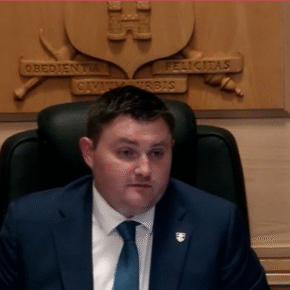
“We have tens of thousands of vacant and derelict homes up and down the country,” Hearne (pictured above) said.
“It is one of the biggest scandals and failures of Fianna Fáil and Fine Gael Governments. Government after Government has failed to tackle this issue.”
He said dereliction is visible in towns and villages nationwide, with buildings left to rot while children and families remain in emergency accommodation.
“Buildings up and down the country are rotting, falling apart, dangerous and left vacant while we have thousands of children and families in homelessness,” he said.
In Finglas, Hearne pointed to the Drake Inn as an example of what he described as years of inaction, despite the housing emergency.
“These are communities where people feel excluded and left behind,” he said.
“They go into their village centre and see derelict building after derelict building.
“What does it tell them about what the Government thinks about them and how it cares for them? They feel completely abandoned.
“I have proposed that Dublin City Council should be compulsory-purchasing buildings like the
Drake Inn and converting them into affordable housing like that proposal being done, but it does not have the funding.”
Hearne said derelict properties hit hardest in communities already feeling under pressure, and argued the daily reality of passing buildings that could be homes makes the crisis even more difficult to bear.
“How hard must it be for these children and families, and for a generation locked out of a home, to walk past these empty derelict buildings?” he asked.
“They have no home and here are these buildings that could be homes left idle because of policy failure.”
He challenged repeated Government claims that the State is now “going to war on dereliction”, arguing that promised measures are too slow and too weak to deliver results.
“The Minister says he is going to war on dereliction,” Hearne said.
“I have to say that from my perspective, the only war he is waging on dereliction is one in his own head.”
A central focus of Hearne’s criticism was the planned derelict sites tax, which he said will not come into effect until 2028. He questioned why it cannot be introduced sooner.
“The new dereliction sites tax will not come into place until 2028,” he said.
“Why will the Minister not implement the tax this year?”
Hearne also criticised the design of the proposed tax, claiming it will mirror flaws in the existing vacant homes tax because it relies on self-assessment.
“There is a fundamental flaw in his derelict sites tax,” he said.
“It is designed to fail, just like the vacant homes tax. It is a self-assessment tax.”
He cited Central Statistics Office figures, saying 166,000 vacant homes have been identified nationally, but only a small number of owners have declared themselves liable for the vacant homes tax.
“We have 166,000 vacant homes identified by the CSO,” Hearne said.
“It is a self-assessment tax but how many of those liable self-declared for the tax? The figure is 2,300. Less than 2% of the total vacant homes are liable for the vacant homes tax. It will be the same for the derelict sites tax.”
Hearne said the challenge is compounded by the difficulty of identifying and registering derelict sites, arguing local authorities are expected to do the work without adequate resources.
Hearne referenced Dublin City Council efforts to address dereliction, including plans to establish an arms-length company to purchase and renovate derelict properties, describing it as “an excellent idea”. However, he argued it cannot work at the scale required without greater support.
“I mentioned my constituency of Finglas,” he said.
“I invite the Minister to Finglas Village to see the level of dereliction there.
“These are communities where people feel excluded and left behind.
“They go into their village centre and see derelict building after derelict building.
“What does it tell them about what the Government thinks about them and how it cares for them?
“They feel completely abandoned.”
While Hearne attacked the Government’s approach and timeline, Browne said during the debate that he shares the broader aim of tackling dereliction, but believes responsibility does not rest solely with central government.

Browne (pictured above) said: “As far as I am concerned, rent seekers are responsible for what is happening because they are leaving their properties derelict.”
He argued the issue crosses political ideology and said stronger pressure should be put on owners sitting on buildings while communities are crying out for homes.
“Regardless of whether you are a socialist or a capitalist, I am of the view that those properties should not be in the hands of the people to whom I refer,” he said.
“I am sure the socialist view would be that the properties should be taken from them. From a capitalist perspective, they should be forced to bloody sell them to people who would actually make proper use of them.”
Browne told TDs he has “been very strong and clear” on the issue and insisted dereliction is not something that can be defended under any ideology.
“Dereliction does not meet any ideology, and I have been very strong and clear in my comments on the matter,” he said.
However, he said this was why he was opposing the Bill, despite backing the intention behind it.
“That is why I am opposing the Bill,” he said.
“I understand the intent behind the Deputy’s Bill. I agree with that intent, but I think he is taking the wrong mark in pointing at me or the Government, because it is the local authorities that have failed to use the existing legislation, which is strong enough but which is not being used.”
Browne said the Government would bring in further measures, describing dereliction and vacancy as a priority.
“We are going to bring in new legislation to tackle this problem,” he said.
He insisted action is already underway, including strengthening how derelict properties are charged and pushing owners to either renovate or sell.
“We are doing an awful lot to tackle dereliction,” he said.
“One aspect of that involves strengthening the rules around how we charge people for dereliction and effectively try to compel them to do something with their properties.”
Browne said the preferred outcome is for owners to either restore buildings themselves or sell them on to somebody who will.
“Ideally, they should fix up their properties or sell them to those who will actually use them,” he said.
He said the State is also using taxation and incentives, describing a mix of penalties and supports to get properties back into use.
“We are also taxing them in relation to their properties. We are also using a lot of carrots. We are supporting people to be able to acquire properties,” he said.
Browne said tackling dereliction and vacancy in village centres and towns must be part of the solution alongside other housing supply measures.
“Tackling dereliction and vacancy, whether in our villages, provincial towns or cities, is the other side of the coin, and it is so important that we tackle both,” he said.
Related News