No government mandate to remove Triple Lock, Dáil hears
Mike Finnerty 28 Oct 2026
Northside opposition TDs have said that the government had no mandate to remove the Triple Lock.
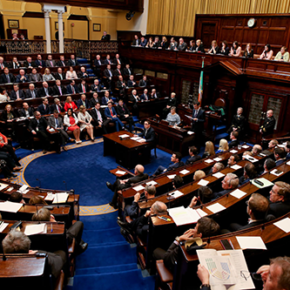
Last Wednesday (October 21st), the Dáil heard contributions from both government and opposition parties on the contentious issue.
Despite removing the Triple Lock not being featured in either Fianna Fáil’s or Fine Gael’s 2024 general election manifestos, the coalition voted 79 to 71 to remove the Triple Lock.
Local independent TD Barry Heneghan, who agreed to prop up the coalition, was not present for the vote but later clarified he was in Denmark on Dáil business and stated that the Triple Lock should go to a referendum.
A stormy three-and-a-half-hour debate saw leader of the opposition Mary Lou McDonald state that Ireland was being “dragged into EU military structures, dangerous alliances and further alignment with NATO.”
The Dublin Central TD stated that the government not putting the issue to a referendum was a “profound betrayal.”
Addressing Taoiseach Micheál Martin, McDonald stated “it is not for you, for Fianna Fáil, for Fine Gael or your government to decide the future of Irish neutrality; that is for the people to decide.”
In 2013, when Martin was serving as leader of the opposition, Martin told the Dáil that removing the Triple Lock was an “out-of-touch ideological obsession on the part of Fine Gael which ignores the facts of Ireland’s international standing.”
Martin claimed in June 2013 that “there is no reason whatsoever to change it (Ireland’s relationship to neutrality”) and further stated, “such a change will impress no one in Europe and it will contribute nothing to international peace.”
Martin’s change of heart on the issue has been spurred by Russia’s aggression since 2013.
Responding to McDonald’s charges, he claimed that the Sinn Féin leader “wants Russia, the United States and China to have the power of veto over whether Ireland ever again in the future participates in a peacekeeping mission.”
“That is the essential difference; she has created false narrative after false narrative, but the essential difference here is how we develop a capacity. We need to be honest with our military about this as well, including with soldiers and their families.
McDonald said that the Taoiseach’s approach to the debate was “to downplay, dismiss and trivialise your shameful manoeuvring; the dishonesty is staggering.”
Sinn Féin MEP Lynn Boylan stated, “scrapping the triple lock is an incredibly reckless move.”
“Every poll shows repeatedly that Irish people value our neutrality, and the triple lock is a key part of protecting it.”
“We know that our government can’t be trusted to stand up to international pressure on global issues, so it’s vital that we don’t leave decisions around deployment of our troops solely in their hand,” she said.
Defending the government’s position, Northside Fianna Fáil TD Paul McAuliffe said, “I cannot understand how parties that mistrust the British government on so many issues are willing to give Britain a veto over where we send our troops.”
He said that the opposition parties mistrust the American government on so many issues, and claimed that the opposition parties were “willing to give Donald Trump a veto on us sending troops to Lebanon.”
“Ultimately, the opposition does not trust this government on lots of issues. We have political differences. However, if the Deputies opposite were elected to govern in the morning, while they might make different decisions than we would, I would trust in their right and mandate from the Irish people to make those decisions, because I abide by the Constitution,” the Dublin North-West TD said.
Labour TD and foreign affairs spokesperson Duncan Smith warned that Ireland was in danger of aligning with right-wing governments in mainland Europe.
The Dublin Fingal East TD stated, “the European Union can change; the UK is not in it any more. Spain could have a change of government. Germany is currently being run by a centre-right or a right-wing government, if you ask me, that could move to AfD. France could be ruled by Le Pen.”
“These are not fantastical ideas; they are things that could definitely happen. What does the EU look like in a security, defence and peace enforcement scenario when its two biggest powers are being run by the far-right? These are genuine questions and concerns that cannot be dismissed,” he said.
Smith warned that “tricky times are ahead” and expressed concern that the government were rushing into resolving the issue.
“We do not have the depth of discussion and policy required. I do not think we have the robustness and honesty in government to be able to enter that world at this time, because we have not had the discussions.”
“I am frustrated by others with regard to how neutrality is discussed. I do not think it is discussed well in this Chamber. It is far more complex than is indicated in this Chamber and in others. We need to have proper discussions about defence and security,” he said.
The Northside Labour TD said that Ireland was in danger of untethering itself from the United Nations’ traditional peacekeeping process.
“By untethering us from the United Nations and from having that guardrail, this bill means that we are operating within the milieu of an EU that is evolving rapidly and will be faced with tough security and defence questions,” he stated.
Smith said that the government has yet to develop a national security strategy, but now it wants to undertake a fundamental shift in Ireland’s foreign policy.
“It is hard to trust a government on this issue when it is not being open and honest about the true nature of why this is being removed,” the Labour TD stated.
Minister for Defence Helen McEntee repeated a favourite line of the government; that the opposition wants Russia to have a veto on where Ireland sends peacekeeping troops.
“The opposition are basically saying that China, the UK, France, the US and Russia – a country that is murdering citizens every single day in Ukraine and attacking members of the EU – should have a say in where we send our peacekeeping troops. They are saying that on one hand we should make our decisions and yet they are saying here this evening that they want those five permanent members of the UN Security Council to continue to have a say in where we send our troops.
Minister McEntee insisted, “this legislation will mean that we can continue our proud tradition of peacekeeping.”
“Due to the triple lock, there are missions that we cannot choose. As an independent country, we cannot decide to be part of them. That is the crux of what we are trying to achieve here,” she said.
Related News