“Concern” as Metrolink project boss quits
Mike Finnerty 08 Apr 2026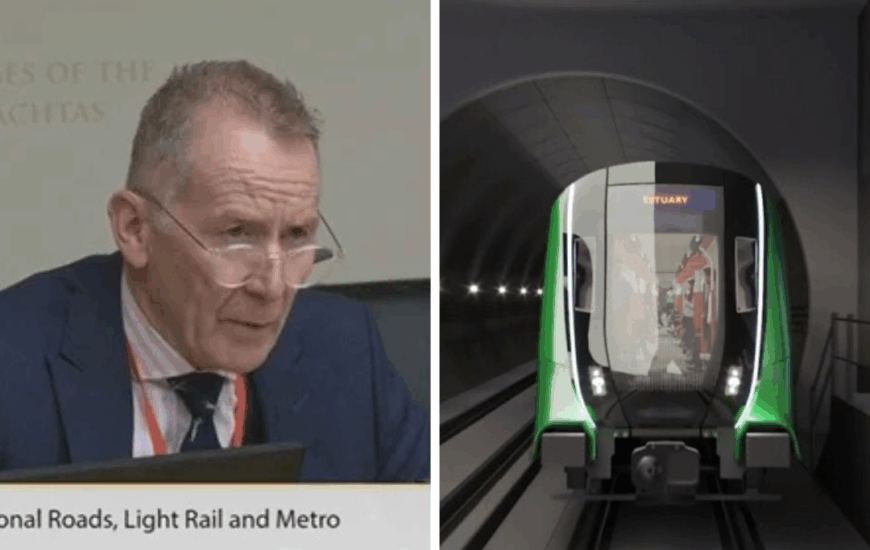
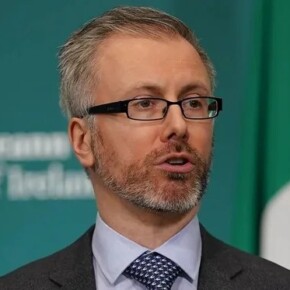
The stop-start nature of the MetroLink project has hit another speedbump in the form of project boss Seán Sweeney departing the project last week.
Sweeney, who was hired to lead the MetroLink project in June 2024, announced his departure from the project on Thursday (April 2).
Sweeney informed Minister for Transport Darragh O’Brien of his decision on Tuesday, and will now work a three-month notice period.
The New Zealander said that the “sacrifice” of being away from his family was “unsustainable.”
In a statement, Sweeney said, “leading the MetroLink programme has been one of the greatest professional privileges of my career.”
“However, after several years away from home, the sacrifice of being separated from my partner, children, and grandchildren, who are over 10,000 miles away, has become unsustainable. It is with deep regret that I leave Metroink; however, I know it is the right thing to do for everyone,” the New Zealander said.
Sweeney was quick to downplay fears that the project was in trouble, and indeed, the project is in “up and running” as a result of the work carried out by him and his team.
Sweeney, who helped deliver a similar project for the New Zealand capital of Auckland, said that he is leaving the project “with a highly committed and experienced executive team,” along with “full government support.”
He stated, “a programme like MetroLink will have many parents, and I always believed my role was to get the programme up and running.”
During his time as project boss, Sweeney said that the MetroLink was no longer an abstract proposed plan, and has now moved to a live delivery project.
He said, “the market appetite is huge, the political support is firm, and the team I leave behind is the best I have ever worked with. I want to thank Minister O’Brien, the TII Board, and the people of Dublin for their trust. I look forward to seeing the first tunnel boring machines start their work, knowing the foundation is rock solid.”
Lorcan O’Connor, CEO of Transport Infrastructure Ireland, said, “Seán joined us at a critical juncture when MetroLink was in need of a steady hand to build a strong team, generate market interest, secure planning, and steer the programme into the procurement phase. During his time, the project has secured its most significant milestone to date: securing the Operational Railway Order in January 2026.”
O’Connor said, “Seán has assembled an executive team with over 250 years of collective experience in delivering global mega-projects. Under his watch, MetroLink now has a completed reference design, a live procurement process, comprehensive political support and a level of international market confidence Ireland has never seen before.”
O’Connor added, “while we are sad to see him leave, we wish him well with the next chapter of his life. We will begin an open competition for his successor immediately.”
Sweeney’s deputy on the program, Michael Flynn, will now be entrusted to pick up from where Sweeney left off.
O’Connor said that Flynn has a lot on his in-tray, such as issuing a contract notice, issuing invitations to tender, and carrying out 21 separate contracts to clear a path for the main infrastructure works.
Local politicians weighed in on Sweeney’s departure, such as Minister O’Brien and Labour TD Duncan Smith.
With both TDs representing Dublin Fingal East, an area that stands to benefit from the MetroLink project getting off the ground, there was a tone of ambivalence.
Minister O’Brien said that Sweeney has made a “great contribution to the progress of MetroLink, and I wish him the very best for the future.”
He said that Sweeney’s expertise helped establish a “highly experienced, highly skilled and high-performing senior leadership team”.
“It is this team who will continue to keep MetroLink on course for its scheduled milestones,” the Minister predicted.
Smith took a more glass-half-empty approach, telling RTÉ that Sweeney’s departure was “deeply concerning.”
Speaking to RTÉ, Smith said that Sweeney’s departure was emblematic of the will-they-won’t-they nature of the MetroLink project, which was first proposed six governments ago.
He said that the MetroLink project “always had an element of doubt,” but that conception changed when Sweeney came on board in 2024.
While the project still does not have shovels in the ground, the consensus agreement is that more progress has been made on the MetroLink since 2024 than at any other stage of the protracted development.
The Labour TD said that Sweeney’s experience was a key reason that the project has gained momentum and is on the cusp of starting.
“To hear now that someone of his experience and renown is now leaving the project, it can’t help but fill me with a sense of huge concern in relation to how speedily this project can get up and running,” Smith noted.
Aside from Sweeney’s departure, the MetroLink project is also causing a stir at the local level.
Local Sinn Féin councillor John Smyth has said that local GAA clubs will lose their pitches as part of the MetroLink project, and accused Transport Infrastructure Ireland of leaving the plan until the last minute.
Smyth said it was a “complete and utter insult” that the Fingallians GAA Club stand to lose two pitches to make way for the project and that the club, as a whole, stands to lose out.
“The Minister for Transport has a lot to answer for here,” the Swords councillor said.
He said that as compensation, the club are only being offered one pitch, and that the female club members would not be able to use it.
“Loads of state agencies are diluting responsibility,” and said that they should answer to the Department of Transport.
“It should not be the case that such a club is going to be suffering so badly in the next few months.”
The push-and-pull between local communities and the government is likely to become the overarching narrative of the MetroLink project as it looks to make tangible progress.
Transport Infrastructure Ireland told oral hearings in February 2024 that traffic congestion will cost Ireland €2 billion per year over the next decade if the MetroLink is not built and that over time, the MetroLink will pay for itself and help Ireland meet its legally binding climate targets.
The proposed route will start at the Estuary station in Swords before taking in Seatown, Swords Central and Fosterstown before serving Dublin Airport itself.
Following on from Dublin Airport, the line will travel down to Northwood, Ballymun, Griffith Avenue, Glasnevin, the Mater and onto O’Connell Street before heading Southside.
It is estimated that the MetroLink will be able to carry 21,000 passengers per hour, helping significantly reduce congestion in Dublin.
After planning permission was granted for the project last year, Dublin Chamber said, “this is a once-in-a-generation project that will transform connectivity across the capital, reduce congestion, support climate targets and underpin Dublin’s competitiveness as a leading European city for business and investment. This project will also unlock vast swathes of housing development in the North County.”
“Dublin has waited far too long for this critical piece of infrastructure. Every further postponement would undermine the city’s growth, sustainability and international reputation,” it said.
The Star Trek maxim of “the needs of the many outweigh the needs of the few” is likely to be a common refrain heard across the Northside – and beyond – if the MetroLink project is to make any form of tangible progress during this government’s term.
Related News