Homeless crisis at “breaking point,” councillors say
Mike Finnerty 18 Mar 2026
Fingal County Council members have written to Minister for Housing James Browne, calling for an end to cuts to the tenant-in-situ scheme and to restore funding to 2024 levels.
Since Browne succeeded Darragh O’Brien as the Minister for Housing in January 2025, Browne has undertaken an aggressive campaign against local authorities, taking measures such as cutting their funding or making decisions on housing without the input of elected representatives.
Last July, Fingal County Council announced it had to pause applications for the tenant-in-situ scheme after its allocated budget of €20 million ran dry, and the government refused to allocate more funding.
Since Browne took office as Minister for Housing in January 2025, 14,864 people were in homeless accommodation in Ireland, with the most recent figures breaking over 17,000 for the first time in the nation’s history.
In January 2025, 10,925 people were in homeless accommodation across Dublin, and the most recent wave of figures placed the same figure at 12,198.
Members of the opposition have asserted that the government’s policies are only making the issue worse (TDs and housing spokespeople from Sinn Féin, Social Democrats and Labour have all argued to that effect), but this week, it was the turn of Fingal County Council members to express frustration with Minister Browne and his one-man war on local authorities.
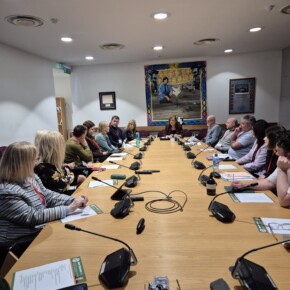
At this month’s meeting of Fingal County Council, a proposal by Sinn Féin councillor Malachy Quinn was passed, which will see the council write to the Minister and ask for the cuts to the tenant-in-situ scheme to be reversed.
Quinn’s motion noted that Fingal County Council spent €51.1 million on acquiring 155 properties in 2024 and 2025 as part of the tenant-in-situ scheme, and warned that if the same level of funding wasn’t restored, there was a risk of exacerbating the homeless crisis.
The Balbriggan councillor said, “the greatest failure of our successive governments has been the reliance of private constructions of homes and the reduction of building in social housing.”
“The first major decision made by Minister Browne was to slash funding for vital homeless supports; while the Minister has denied that he was cutting the funding, figures provided to Sinn Féin show that not only has funding been cut, but the cuts range from 72% up to 96% compared to 2024 levels.”
Quinn explained that the tenant-in-situ scheme is a crucial tool that local authorities have to keep people out of homelessness, and said “the scheme was working,” but it required increased funding to continue to be effective.
“The consequences of the cuts are plain to see and obvious to all,” he said.
Quinn warned that “the tsunami of homelessness” will continue if the funding cuts continue.
“I am currently working with a mother of two, who is a victim of domestic abuse, and has received a notice to quit; the landlord is looking to provide an opportunity for the mother to remain in the home under the tenant-in-situ scheme, but no funding is available.”
Quinn’s Sinn Féin colleague, Swords councillor John Smyth, noted that government and opposition parties were united on this issue, welcoming the fact that Fine Gael councillors were also opposed to the issue.
Smyth noted that in Berlin, the local government has brought apartment blocks in an attempt to prevent them from falling into the hands of private developers.
The actions of the local Berlin government has been used as an example by opposition parties in Ireland as an example of a proactive, well-funded local government using the apparatus of the state to tackle the housing crisis (in that context, the Berlin state government, who carried out the action in 2021, consisted of SPD, the German version of Labour, the German Green Party, and The Left).
“I think we can take a few more leaves out of the German book,” Smyth remarked, saying that the housing crisis is “destroying the morale” of first-time buyers.
Smyth noted that despite the tenant-in-situ scheme having its roots in supply-side economics, something Sinn Féin would not usually be in favour of, the scheme has been a “lifeline” for families.
“The Minister gave the rationale that the money would be better spent building new homes, but it creates a false dichotomy that it’s an either/or. It’s crazy to take such a laissez-faire approach to something so essential as housing,” the Swords councillor said.
“We are beyond breaking point; I don’t see how this (homeless crisis) can go on. We need to take a step back and admit this is fundamentally broken.”
Labour councillor Brian McDonagh said the single biggest reason for homelessness is eviction, and said no-fault evictions, in particular, are a major driver of the issue.
When Darragh O’Brien served as Minister for Housing in the 33rd Dáil, and as part of cost-of-living measures, the government announced a ban on no-fault evictions for the winter of 2022 and leading into March 2023.
In November 2022, the first full month in which no-fault evictions were banned, homeless figures stood at 11,542.
In April 2023, the first full month after the ban on no-fault evictions was lifted, the figures jumped to 12,259, which offered clear, empirical evidence that a no-fault eviction ban directly led to a decrease in homeless figures.
The lifting of the ban, which caused ructions within the Green Party – Dublin Central TD Neasa Hourigan was suspended from the party for voting against the government – directly led to a rise in homeless figures, after months of a consistent drop.
Advocates of a no-fault eviction ban, such as McDonagh, note that most European countries have a permanent no-fault eviction ban in place, with Labour leader Ivana Bacik noting in 2023 that the then-Conservative government in the United Kingdom introduced a no-fault eviction ban.
McDonagh said, “we’ve got thousands of homeless children in the Dublin region, and the single biggest reason, if you go through all the figures, is eviction, usually a no-fault eviction.”
The Howth-Malahide councillor said, “the scientific evidence surrounding the impact of small children into homeless accommodation is really bad; we have adequate resources to invest in this and increase the stock, and we need to make sure that people aren’t being put into emergency accommodation for 12 months.”
The Labour councillor said he has had to tell people on the housing waiting list there is “no hope” with regard to the tenant-in-situ scheme.
“I really think this is a mistake; not continuing the mistake will have a much bigger impact than the government truly appreciates.”
Fellow Howth-Malahide Joan Hopkins councillor said that the tenant-in-situ scheme is important from an economic standpoint.
The Social Democrats councillor said, “behind all of the stats and the money, every single person in this room, I am sure, has had really difficult conversations where people in our communities, people who are working in our local schools, part of our GAA clubs, they’ve been living in these homes for a long time and this scheme was a lifeline for people; to have to say to people their only option is emergency accommodation is absolutely heartbreaking and outrageous.”
Hopkins said “I know landlords get a bad name, and I’m not here to stick up for them, but I’ve had a lot of phone calls from landlords in the last while, they only own one house, and they are so desperate to try and keep the people they have renting in their homes, and they feel awful about putting people out on the street; they have a social conscious, but they are getting nothing back from the government,” she said.
Independent councillor Jimmy Guerin said “it is bizarre that we have the housing crisis we have, and we don’t have a no-fault eviction ban in place.”
“It’s bizarre we are allowing vulture funds to buy up apartment blocks; there should be laws that people have security of tenure and have rights that can’t be taken away from them.”
The Howth-Malahide councillor noted that under the current system, parents can rent out a house out, and when their child is of age, they evict the tenants.
“If people are renting, they are entitled to security of tenure; if we made a few simple changes like that, it would play it’s part in giving people a sense of security and tackling the issues we are facing.”
He stated, “the most important person in a property is the person and the family occupying it, and we should be legislating to protect them.”
Fine Gael councillor and Mayor of Fingal County Council, Tom O’Leary, noted that Dublin City Council received €110.7 million for the tenant-in-situ scheme, of a €373 million nationwide pot and questioned how much of the pot Fingal County Council was entitled to.
O’Leary said he supported the motion, and said that more funding was needed for the scheme.
“I know civil servants play with phrases; allocated and drawn down might not be apples and oranges, but they claim they have given the same figure,” he remarked.
Aoife Lawlor of Fingal County Council noted that Fingal County Council had a €30.7 million budget for second-home hand acquisition for 2026, in addition to €7 million to the pre-existing €10 million funding for the existing homelessness scheme.
Lawlor confirmed “we are working on a number of properties at the moment,” but noted that the criteria for the scheme is a “lot narrower” than previous years, with the focus being turned towards people with disabilities, older persons, and care leavers.
Related News