“Covid-style” response needed for GP crisis, TD says
Mike Finnerty 04 Mar 2026
Northside TDs have called on the government to address the crisis in GP care, with one TD saying that a “Covid–style” plan is needed to tackle the issue.
On Wednesday (February 25), a motion was brought forward by the Social Democrats, which looked to reduce costs and bring legislation surrounding GPs into the modern day.
The crux of the Soc Dems’ motion was aimed at updating the laws concerning GPs in Ireland’s healthcare system, with the party’s health spokesperson, Pádráig Rice, noting that the “GP contract” is over 50 years old and does not meet modern standards.
Research from the party indicated that in the North Inner City, there is one GP for every 3,525 people, well above the national average of 1,759.
The party further warned of a potential cliff-edge within the GP system, citing a statistic from the Irish College of GPs which estimates that 600 GPs are aged 65 or over, 300 of whom are aged 65 to 69, and 300 of whom are still working aged 70 and over.
Recent reportage from the Irish Independent also noted that of the 275 GPs surveyed, over half said they could not take on new patients.
Despite the Northside having two Ministers for Health since 2011 (James Reilly and Leo Varadkar), local residents did not see the benefits.
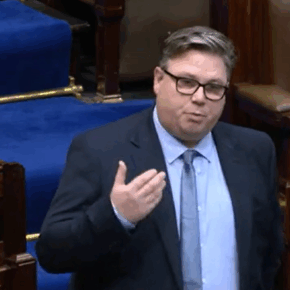
Local Social Democrat TDs Cian O’Callaghan and Gary Gannon, Labour TD Marie Sherlock, and independent TD Barry Heneghan all pressed the government on what exactly the government are planning to do to address the crisis.
The Soc Dems called on members of the public to share their experiences with healthcare, and O’Callaghan read a testimonial of a 73-year-old woman into the Dáil record.
Per O’Callaghan, one respondent said they filled out the survey for their 73-year-old mother, who is suffering from chronic illness, such as heart failure and dementia.
Two weeks ago, the respondent said, they found her crawling out of her room on her hands and knees because she had fallen and could not get herself up.; when the respondent rang the mother’s GP to ask for an appointment, they were told the next available GP appointment wasn’t until March 18.
“The respondent’s mother was recently discharged from her heart failure unit to GP care. If she has a future heart failure episode, she is meant to wait for five weeks for GP assessment to refer her back in. The respondent said they will end up back in the accident and emergency department to wait on a trolley or bed for another 56 hours,” O’Callaghan noted.
The Dublin Bay North TD said the story was reflective of “the reality facing people in Ireland because of the chronic lack of investment to improve GP capacity and primary care.”
The motion, which wasn’t opposed by the government, calls for the creation of a DEIS-like system for GPs, as well as a salary model for GPs.
O’Callaghan’s Northside colleague, Dublin Central TD Gary Gannon, discussed how areas such as the North Inner City are being failed by the current healthcare system.
Gannon told the Dáil, “in the north inner city, we have known for years that people develop chronic illness earlier, sometimes more than a decade earlier, compared to more affluent parts of the city. This includes earlier cases of heart disease, respiratory illness and diabetes, as well as a lower life expectancy. This is not about genetics; it is about systemic inequality. What did the state do in response? It tried to close down the GP Care for All system in Summerhill.”
The Dublin Central TD said, “our current funding model recognises age, but it does not recognise deprivation. Capitation increases at the age of 70. In the north inner city, however, many patients present with the health profile of a 70-year-old at the age of 50 but the system is not funded in that way.”
“Equality is giving everyone the same; equity is recognising that some communities start further back,” he stated.
Fellow Dublin Central TD Marie Sherlock noted the inherent inequality within Ireland’s healthcare system; research carried out by Labour found that there is one GP per 1,390 of the population in Clontarf in Dublin 3, yet in Cabra in Dublin 7, the ratio is one GP to 3,060 of the population.
The Labour TD said that the previous Minister for Health, Stephen Donnelly, committed to legislation to provide free GP care for under-12s in the last Dáil; the legislation has been left to gather dust since Donnelly lost his seat in the 2024 general election.
She warned that if the government doesn’t get a grip on the GP crisis, “people will end up paying to leapfrog the GP system; we need to make sure we have more GPs on the ground.”
She said, “the Department of Health does not have a consistent overview of the first point of access to the healthcare system in this country, that is, the GPs; that is wrong. It is an anomaly we see in hardly any other country across the European Union, but we see it in Ireland because we have a public system of hospital care and an effectively private system of GP care.”
“The government has been promising a strategic review of GP care for a number of years now. It was supposed to be published last year, but we have yet to see it. Where is it? Will the government please publish it?”
Sherlock told the Dáil of a local man who should have presented with very worrying symptoms of prostate but, because he was being given appointments two weeks out, he kept on putting the appointment off because of work and other commitments.
“He should have been able to pick up the phone, say he had a problem and be seen in a timely manner,” she told the Dáil.
“This is a real issue in certain communities, although not in every community across the country. The key thing is that, if we have more people on the ground, we can begin to resolve all of the issues we have with regard to our acute hospital system, including the Mater being the GP service for many people in the inner city because they cannot access a GP.”
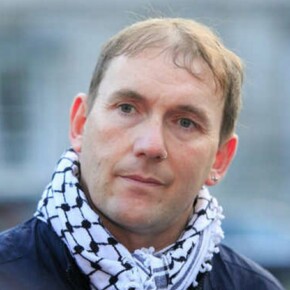
Independent Dublin Bay North TD Barry Heneghan said that a “Covid-style” response was needed in the context of the GP crisis.
“We need to listen to those who are on the ground; paatients are waiting way too long for appointments,” he said.
“People who cannot get to their GPs are forced to wait 14 hours in accident and emergency; it is really holding people back.”
Heneghan did welcome a new wave of investment for Beaumont Hospital, but his correspondence with a constituent had a more tragic tinge.
In Heneghan’s case, a local woman named Patricia Anderson lost her husband after a 14-hour wait in Beaumont; the experience deterred him from going back and he looked to get treated by a GP instead.
In the time it took for Anderson’s husband to receive treatment from a GP, he passed away.
“The deterrent for him was the fact that the wait in Beaumont’s accident and emergency was too long,” he said.
“The announcement (of funding) is welcome, but we need to make it a reality, deliver it, get in there and do, with a Covid-level response, what the government has done in the past.”
“I urge the government to have a Covid-level response and bring this in now because the people of North Dublin and Ireland as a whole need this now.”
Related News