Democracy grows stronger when citizens get involved
Jack Gleeson 02 Nov 2026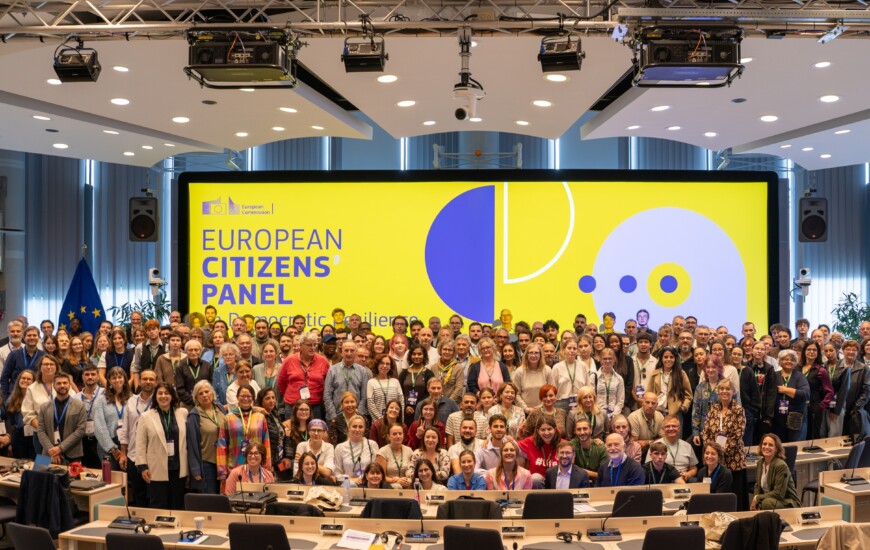
Later this month 150 randomly selected citizens from all 27 EU member states, including Ireland, will meet in Brussels for the closing session of a European Citizens’ Panel on Democratic Resilience.
There, they will draw conclusions from a series of debates that began in the Belgian capital last September and continued online in October.
They will then agree on common positions and make final recommendations to the European Commission.
The panel has been discussing its own members’ experiences of democracy, such as how they find and evaluate information, take part in public debate, feel heard by public bodies and have opportunities to shape important political decisions.
The panel’s final recommendations are not just suggestions on how democratic resilience can be improved.
The best part is that they will be used by the European Commission to inform policymaking on the topic.
It is an example of how ordinary citizens can get actively involved in democracy in a meaningful way beyond casting their vote in elections.
The Commission has been running a campaign called ‘Protect What Matters’ that invites citizens to take an active part in European democracy.
The campaign has been raising awareness of the opportunities citizens have to take part in decision-making at the highest levels.
Citizens’ panels, like the one on democratic resilience, are one of the ways to make a difference.
The panels were a central part of the 2021–2022 Conference on the Future of Europe and are now a regular feature of EU policymaking.
They are an example of deliberative democracy, in which citizens discuss different views and experiences before formulating collective recommendations.
Several panels have already taken place, and participants are recruited through a random selection process.
However, you don’t have to be selected for a citizens’ panel to contribute to the discussion.
The European Commission’s Citizens’ Engagement Platform hosts online debates alongside the panels when they are running.
That means every citizen can get involved by sharing ideas, reading contributions and commenting on proposals in any of the EU’s 24 official languages.
Contributions submitted through the Citizens’ Engagement Platform help inform the panel’s discussions, and recommendations and ideas raised online also feed into the Commission’s follow-up work when the panel wraps up.
Community groups, schools and other interested public organisations can also use the platform to promote local or online events connected to the topic of the debate.
Once an event has taken place, its conclusions can be shared with a wider audience.
From rebuilding trust and improving transparency to increasing civic participation and tackling disinformation, citizens from across Europe now have tangible ways of helping shape conversations that matter.
The Citizens’ Engagement Platform provides opportunities for everyone to have their voices heard on topics close to their hearts, even when there’s no active Panel working.
The platform offers access to online debates on issues such as what matters to young people, as well as links to opportunities to share views on new EU policies or existing laws.
The European Citizens’ Initiative is another unique way for you to help shape the EU by calling on the European Commission to propose new laws.
The Commission has to respond to any initiatives that reach one million signatures, making it a great way to have public voices heard.
All EU citizens and residents also have the right to petition the European Parliament on matters that affect them directly.
In fact, it is a democratic right enshrined in the Charter of Fundamental Rights. Petitions can be submitted by individuals or groups through an online Petitions Portal.
They are then sent to Parliament’s Committee on Petitions (PETI), which examines their admissibility and informs petitioners of the outcome and any follow-up action.
Democracy depends on participation, trust and transparency.
Citizens from across Europe are now helping shape conversations that will lead to better policies, and better futures for all of us.
- To find out more about the European Citizens’ Panel on Democratic Resilience visit the official webpage at https://citizens.ec.europa.eu/citizens-panel-democratic-resilience_en.
- Want to have your say on the future of democracy in Europe? Join the conversation on the European Citizens’ Engagement Platform, share your ideas, comment on proposals from others and help shape future European Citizens’ Panels. For more details see https://citizens.ec.europa.eu/index_en.
Related News