New book details history of Dublin’s Martello Towers
Dublin People 14 Jul 2012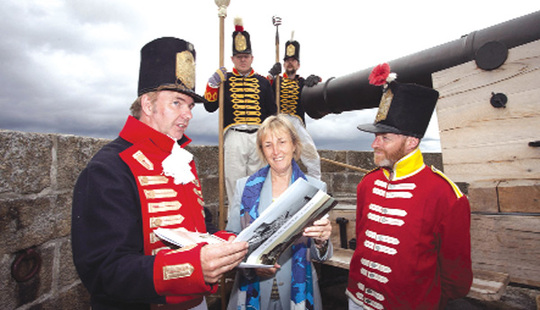
A NEW book that explores the history behind the most well known military defence fortifications along the east coast was launched on the Southside last week.
Produced jointly by Dún Laoghaire Rathdown County Council and Fingal County Council, with the support of the Heritage Council,
‘Martello Towers of Dublin’ tells their story for the first time.
Built between 1804 and 1805 the iconic buildings are dotted along Dublin’s coastline at 28 sites between Bray and Balbriggan.
Tim Carey, Heritage Officer at Dún Laoghaire Rathdown County Council, said the new book is full of new information about the Martello towers of Dublin and contains around 200 photographs.
“It is strange that many of us see or pass these buildings every day but we know very little about them,
? he said.
Mr Carey explained that the British built the towers in the early 19th century as a deterrent to attack from foreign navies. However, he pointed out that they were such a successful deterrent that they were never actually used to fight invasion forces.
He also explained that there is a higher density of towers along the Southside coast as there are more coastal inlets there such as Killiney Bay where geographical features were more favourable for landing invading troops from ships.
“These towers acted as a deterrent against attack,
? he added.
“You actually would have been mad to try it. These were very powerful fortifications. Killiney Bay was a weak point because there was deep water and a beach where you could very quickly land a lot of troops.
“The towers also provided overlapping fire. So the line of fire from the guns on one tower would overlap fire from the others, so you are always going to be under attack from three, if not four positions. The towers in North Dublin were more widely dispersed because there are fewer landing points there.
?
Mr Carey also explained that the British navy modelled the defensive structures on towers they captured from the French and Spanish in the Mediterranean.
“A tower in Corsica, which was built in the 16th century at a place called Cape Mortella, was later Anglicised to Martello. It was an unusual fortification for the time.
“In 1794 the British came to attack it. The first time the French garrison abandoned the tower and they took it very easily. However, they abandoned it and three months later when they came back the French didn’t retreat and they stayed in the tower. Two British war ships attacked it for two days but one of them had to retreat because it had been so badly damaged.
“The British were amazed when they found out there were only 33 troops defending the tower, so after they eventually took it they made drawings and copied it.
“The Corsica tower was the prototype. In Menorca they found similar towers that acted then as the model for the Dublin ones.
?
‘The Martello Towers of Dublin’ is available in most bookshops for
?¬25.99.
Related News