Community effort sees increase in school attendance
Dublin People 31 Mar 2012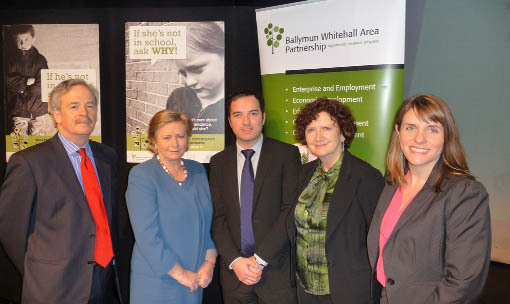
MORE children in Ballymun are attending school more
often thanks to the success of a community school attendance initiative.
The gap between the national school attendance average
and Ballymun’s average has halved in the two years since the Ballymun School
Attendance Community Action Initiative began.
During that time the attendance of every child, in
every class, in Ballymun’s 12 schools was recorded using software funded by
Ballymun Whitehall Area Partnership.
And according to an independent report published last
week measures introduced under the initiative have resulted in 14,000 less
school days missed in the area since
2010.
Children in Ballymun are now attending school more
often than their counterparts in other disadvantaged areas, and the upward
trend is expected to continue for years to come.
Overall school attendance in the area has increased by
1.6 percentage points, from 90.3 per cent to 91.5 per cent. The figure is still
below the national average of 93.7 per cent but it’s now higher than the 90.4
per cent rate for other disadvantaged areas after previously being significantly
lower.
According to the report the figures reflect
“very
positively
? on the achievements of the initiative over a two year timeframe.
“It is our view that the success of the initiative can
be attributed to the combination of daily tracking, reinforcement and follow up
activities of the attendance promoters and the wider school care teams’
tracking and case conferencing approaches which have been embraced by all,
? the
report reads.
“This is in addition to the wider community
mobilisation efforts and the support of all stakeholders, which have all been
integral parts of the initiative.
?
The initiative targeted local children, parents and
teachers and introduced procedures aimed at changing attitudes to school
attendance. The measures focussed on encouraging positive attitudes to the
problem, such as praising attendance rather than being overly critical of days
missed.
Parents of children who missed school were educated
through information booklets and given assistance, if needed, while pupils were
encouraged to attend through individual and class rewards for attendance that
fostered a sense of school pride and loyalty.
Colma Nic Lughadha of the Ballymun Whitehall
Partnership said the initiative’s success was a testament to all those
involved.
“What’s unique about the Ballymun School Attendance
Initiative is the work to get children, parents and the local community all
agreed and taking action to support their schools and to improve school
attendance,
? he added.
“It is really powerful to hear local children and
parents speaking about the initiative.
?
Last week Minister for Children and Youth Affairs,
Frances Fitzgerald, was at the Axis Centre in Ballymun to hear the results of
the independent report and Dublin Lord Mayor Andrew Montague, who lives in
Ballymun and is a director of the Partnership, gave a video address at the
event.
“This initiative is exactly what we need to see,
? the
Lord Mayor said.
“A whole town working together – local people,
children and families, schools and community and state agencies all playing
their part.
“I would like to commend the Ballymun Whitehall Area
Partnership and the Principals Network for their success. It could not have
happened without them.
?
According to the report the most frequently missed
school day was Monday and the least was Thursday. December, June and November
have the lowest attendance rates.
The report also found that children in support classes
and junior infants classes had the highest levels of poor school attendance and
that attendance levels were higher amongst girls than boys.
It was also discovered that ethnic groupings had a
strong impact on attendance, with Traveller children missing more school than
settled Irish children and those from overseas backgrounds.
However, there’s been significant improvement in the
attendance rates for Traveller girls over the course of the initiative. There
was also success in terms of reductions in the number of children falling into
a pattern of chronic non-attendance of 51 days absent or more.
Related News