Climate reality gives way to climate politics
Mike Finnerty 05 Aug 2026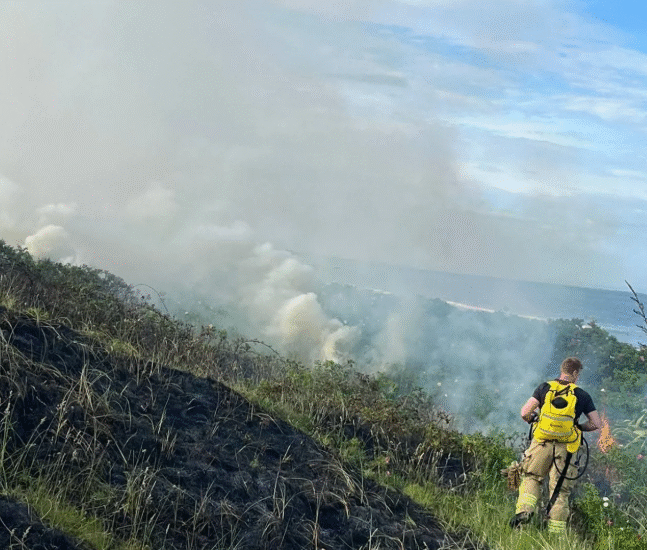
Wildfires threatening major French and Spanish cities, record-high temperatures in the United Kingdom, and forest fires raging across Ireland; this is summer 2026 in Europe.
The Long Hot Summer isn’t just the name of the movie where Paul Newman shared the screen with Orson Welles – it is the name of every summer in Europe.
And for once, we can’t say that we weren’t warned.
20 years ago, former American vice-president Al Gore became an unlikely movie star with his documentary An Inconvenient Truth.
Towards the end of the film, Gore states that “we have everything that we need to reduce carbon emissions, everything but political will.”
In a December 2006 article, The Guardian ran an article with the headline “The Year The World Woke Up,” with the article noting that 2006 was the sixth warmest year that the world has ever known.
In the 20 years that followed, the record for the hottest year on record has been broken on numerous occasions since then.
The 2006 episode of Reeling In The Years noted that “global warming dominates the international agenda in 2006” and showed a clip of RTÉ journalist Paul Cunningham reporting from an ice cap in Greenland.
Cunningham explained that higher temperatures would have an impact on Ireland, and spoke of warmer summers, less rain, and “far more drought.”
Grim predictions that sounded like science fiction 20 years ago are now science fact.
The sight of wildfires on Dublin’s mountains or Munster’s forests does raise Al Gore’s prediction about political will – now that climate change is a feature of Ireland’s summers, what does the government plan to do about it?
The Dáil is adjourned until mid-September, which means that the opposition won’t be able to hold the government to account on their management (or lack thereof) of climate issues for another few weeks.
However, the opposition has managed to get some digs in on the government not taking climate change seriously since the Fianna Fáil/Fine Gael/independents coalition took office in January 2025.
In January, Minister for the Environment Darragh O’Brien conceded that Ireland was likely to miss its legally binding climate targets, which called for Ireland to reach 50% of EU-mandated climate targets by 2030.
Ireland could face substantial compliance costs or penalties if it misses legally binding targets, potentially running into the billions.
From the government side, there was a sense that the Greens were rejected at the ballot box in the November 2024 election, and thus, they had a mandate to put climate change measures on the backburner.
The government parties chose to interpret the Green wipeout of 2024 (which saw them lose both MEPs and totally wiped off the map on South Dublin County Council) as proof that the last government was too focused on climate issues, and not focused enough on economics.
The coalition agreement drawn up in January 2025 states that “time is of the essence as global warming continues.”
“The government is committed to taking decisive action to radically reduce our reliance on fossil fuels and to achieve a 51% reduction in emissions from 2018 to 2030, and to achieving net-zero emissions no later than 2050.”
18 months into the government’s term, and the government’s promise to be “radical” in reducing fossil fuel reliance is less Che Guevara and more Rik Mayall on The Young Ones.
Minister Jack Chambers stated that the Climate Act has become “weaponised” in the context of infrastructure projects in Ireland.
Minister Chambers stated, “it’s not for NGOs to dictate that to the government or to use our court system to fundamentally delay projects.”
Fianna Fáil had no qualms with giving the Climate Act more powers in 2021, improving upon the initial legislation which was drawn up in 2015 by the Fine Gael/Labour government of the day.
Welcoming the passage of the legislation in 2021, Fianna Fáil TD Christopher O’Sullivan stated “this bill is a commitment that we are serious about tackling climate change and decreasing greenhouse gases.”
The Cork TD stated “if you look at it, half the planet is on fire and the other half is under water. You don’t have to go too far afield to see what’s happening before our eyes.”
Five years later, with the Greens out of the picture and an electorate demanding faster progress on infrastructure delivery, the West Wing-style idealism of O’Sullivan’s statement has been replaced by cold, hard politics.
Which brings us to a burning question; can the summer of 2026 serve as a revival for climate politics?
Climate change is no longer just an abstract theory taught in Junior Cert geography classes; it is now climate reality.
France reported nearly 6,000 excess deaths during the June heatwave alone, and heatwaves have cost the UK economy over £1 billion in lost revenue owing to lost working hours.
Ciáran Cuffe on his new European job, progressive co-operation and breathing space
Data centres have become an easy and identifiable target for the opposition – Sinn Féin MEP Lynn Boylan, Labour TD Ciáran Ahern and People Before Profit TD Paul Murphy are the loudest voices against what they perceive as a rolling out of the red carpet for Big Tech.
The optics of the government introducing a water hosepipe ban for Dublin and surrounding counties while data centres are allowed to continue uninterrupted is precisely the kind of issue that can put climate change politics back on the agenda.
Ahern has accused the government of “utter cognitive dissonance,” saying that the government is unaware of the true impact data centres have on Ireland’s water supplies.
“We know that the average household water usage is approximately 133 litres of water per person per day, yet now we learn that just 51 data centres across the country are managing to guzzle almost five million litres of water per day.”
“So for households, there’s a hosepipe ban, but for data centres? Nothing – no assessment of their impact on our climate goals, no calls to preserve water.”
Boylan, who spoke at length on the issue in a recent sit-down interview with this publication, noted “the sheer volume of water being used by data centres is staggering, and even more so when you consider that they’re not facing any restriction or conditions around the use in the current hot weather spell.”
“While these companies burn through thousands of litres per day, people who are trying to grow vegetables and tend to a garden, or fill a paddling pool for children are being threatened with fines.”
Murphy discussed what he perceived as a “rollback” of climate ambitions at a European level.
The People Before Profit TD claimed that environmentalists in Europe “fear” the Irish EU Presidency, owing to the government’s desire to “simplify” regulation.
“In reality, the ‘simplification’ label is designed to hide a huge push to weaken and remove EU climate and environmental protections,” Murphy noted.
“Environmentalists in Europe fear the Irish EU Presidency because they know the Irish government’s environment and climate agenda is heavily influenced by the likes of the IFA and agri-food corporations,” the Dublin South-West TD said.
From the government side, Fianna Fáil TD and Minister of State Catherine Ardagh argued that data centres are a crucial part of the modern Irish economy.
It isn’t a secret that Ireland’s economic growth is reliant on tech companies, and the Dublin South Central TD said as such during a Dáil debate on data centres in June.
“Data centres are central to Ireland’s modern economy and play a critical enabling role across a wide range of digitally intensive sectors, enhancing the competitiveness of the Irish economy.”
She explained, “they strengthen Ireland’s position as a strategic knowledge-intensive regional hub for the ICT sector and also support existing investment that supports billions in annual economic value for Ireland via high-wage employment and tax receipts.”
She also stated, “Ireland is at the forefront of transitioning to an electricity system dominated by variable renewable energy sources, such as wind and solar, and we have achieved record-breaking levels of renewable electricity generation, reducing our reliance on imported fossil fuels.”
Ardagh’s statements are totally fair from an economic standpoint, but the government telling people they can’t water their plants and there is a snitch hotline for people to avail of is exactly the kind of messaging that drives people back into the arms of climate politics.
Cynics have argued that the good weather that Ireland has been having recently is just that – good weather.
The statistic about the British economy losing a billion pounds due to lost working hours is, cynically, what will force governments into action.
Climate action isn’t exactly cheap to implement, but the indifference we are seeing from the government could be a lot more expensive.
Related News