McDowell proposes referendum to cap number of elected TDs
Mike Finnerty 24 Mar 2026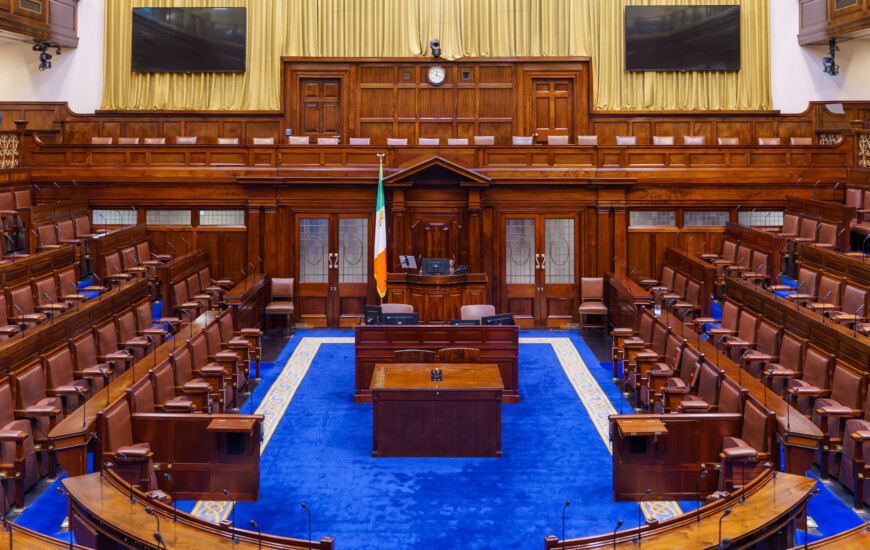
A proposal by Senator Michael McDowell to cap the number of TDs in a referendum was not opposed by the government in the Seanad last week.
McDowell, who briefly served as Tánaiste towards the end of the 29th Dáil, has argued that Ireland could have as many as 250 TDs by 2050 and that a referendum to cap the number of TDs is needed.
The independent Senator argued that the number of TDs should be capped as a matter of public finances, saying that the current Leinster House premises would need to be refurbished or a new government building would need to be found to accommodate the increased number of TDs.
At the height of the Covid-19 pandemic, Dáil proceedings were held in the Convention Centre in Dublin’s Docklands in order to comply with social distancing-related health measures.
McDowell’s motion was allowed to pass in the Seanad by members of the government parties.
Speaking in the Dáil on Wednesday (March 25), Senator McDowell said, “one of the problems with English democracy has been the complete imbalance between the executive and the membership of parliament, and I think we are going towards that because we’ve limited the number of Ministers, but there’s no limit on the number of TDs.”
McDowell said he is “concerned” about the health of Irish democracy, and that the current Dáil chamber would have to be rebuilt if it were to accommodate 200 members.
He remarked that “you’d have to possibly do a major extension (of Leinster House) and it would cost many multiples of the bicycle shed.”
Under the Constitution, there must be one TD for a maximum of 30,000 people, and McDowell proposed a referendum to fix what he perceives as a loophole that is not fit for modern standards.
While political scientists and certain political parties argue that 5-seater constituencies under Ireland’s proportional representation system make it among the fairest electoral systems in the world, McDowell said that not increasing the size of the Dáil and capping the numbers, similar to what is done in the United States, is the way forward.
In the 2023 set of Dáil constituency redraws, the Electoral Commission increased the number of Dáil seats from 160 to 174 to account for population changes since the 2020 general election, with more 5-seater constituencies being added.
The next seat of constituency redraws, expected sometime in 2029 or 2030, is likely to increase the number of Dáil seats even further, to over the 180 mark.
The Electoral Commission, which serves as an independent, non-partisan body, has recommended the creation of more 5-seat constituencies, or even 6 or 7-seaters in the case of some Dublin constituencies, while doing away with 3-seaters wherever possible.
European nations such as Germany and Italy have reduced the number of seats in their parliaments, which political scientists argue leads to weaker political representation for citizens.
As part of austerity measures in the 2010s, the Italian government cut the number of elected representatives from 630 to 400, which political scientists noted decreased the level of representation for voters and increased the chance of a single party being able to win a majority instead of a coalition government.
Last year’s German election saw 630 seats up for grabs in the German parliament, down from the 735 in 2021, which critics argue was not a true representation of the German electorate and left people without proper political representation.
McDowell argued that if the UK increased the size of Westminster to accommodate population growth like Ireland did, there would now be 2,300 MPs in the UK.
Fianna Fáil Cork TD Christopher O’Sullivan acknowledged McDowell’s concerns about an “explosion of TDs,” but remarked, “I don’t think there’s any fear that anytime soon we’re going to be sitting on each other’s laps in the Dáil.”
The Junior Minister noted that Ireland had 166 TDs in the 1981 general election, so in relative terms, the number of Dáil seats has not increased exponentially compared to Ireland’s population growth since the 1980s.
Related News