Celebrate the Ulysses Centenary with the unique Joyce’s Dublin App
Padraig Conlon 02 Feb 2022
Today marks the centenary of the publication of what is regarded by many as the greatest novel ever written in the English Language, James Joyce’s Ulysses.
A novel T.S. Eliott said no writer could escape, George Orwell said he wished he’d never read because it gave him an inferiority complex, and Jorge Luis Borges said he never finished.
To celebrate this, the Joyce’s Dublin App, which launched two years ago to thousands of users, has added a new feature to allow users to trace the footsteps of his characters through the streets of Edwardian Dublin, with self-guided tours ranging from a whistle stop tour of the key locations to step by step routes of selected chapters from Ulysses.
Joyce’s Dublin is the only app dedicated to exploring the connection between James Joyce and Dublin, the principal subject of all his writing.
Users can filter locations by chapter or theme to follow along when reading his work or to use when out and about exploring Dublin through his imagination.
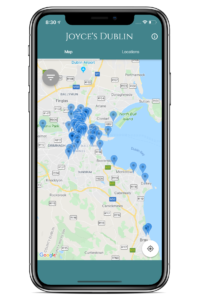
Some of the Selected Locations featured on the app:
While Joyce left Ireland in 1912 never to return, Dublin continued to live in his imagination, and almost the whole city and its suburbs are referenced in his books.
Here are 6 of over 100 locations featured in the app which is available now free on Android and iOS.
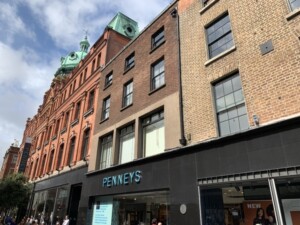
A – Volta Electric Theatre (demolished)
Joyce founded the first dedicated cinema in Ireland on 20 December 1909.
He had seen cinemas in Trieste, and secured financial backing of Italian friends. Joyce remained involved with the cinema for seven months before becoming disillusioned with this venture and withdrawing.
The cinema was then sold to the British Provincial Cinema Company; it closed in 1919, but later reopened in 1921 as the Lyceum Picture Theatre.
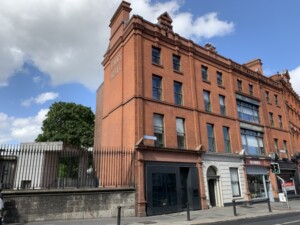
B – 1 Leinster St South
Nora Barnacle, Joyce’s future wife and muse was working at Finn’s hotel when he first met her.
They met nearby on Nassau Street on 10 June 1904.
Their first date was six days later on 16 June, a date commemorated in ‘Ulysses’ as the day of Leopold’s walk through Dublin.
In 1909, on a return visit to Dublin to set up the Volta Cinema, he booked his Triestine business partners into the Hotel.
He took the opportunity to visit Nora’s old room:
“… My God, my eyes are full of tears! Why do I cry? I cry because it is so sad to think of her moving about that room, eating little, simply dressed, simple-mannered and watchful, and carrying always with her in her secret heart the little flame which burns up the souls and bodies of men…”
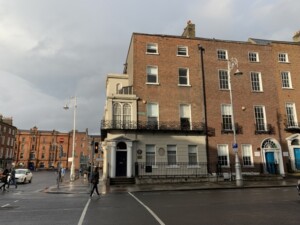
C – 1 Merrion Square
Joyce waited outside this house on 14 June 1904 for his first date with his future wife Nora Barnacle. However, she stood him up. He wrote to her to re-arrange for the 16th of June. This was to be the date he commemorated in Ulysses. The house is also coincidentally the childhood home of Oscar Wilde.
Joyce greatly respected Wilde; he wrote essays on his work and mentioned him several times in his works.
Bram Stoker, author of Dracula, was a friend of the Wilde family, and would frequently visit here.
Related News