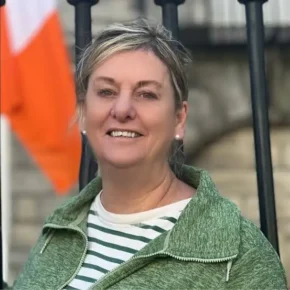
Woman given suspended sentence for careless driving that left victim an amputee
Padraig Conlon 13 Oct 2026
By Fiona Ferguson
A woman who admitted her careless driving caused a motorcyclist to suffer life-altering injuries has been disqualified from driving for 16 months and handed a suspended prison sentence.
Dorothy Stewart (61) failed to see the on-coming motorcyclist, Matthew Shaw-Cotterill, as she was preparing to turn right on Kinsealy Lane, Malahide into a nursing home to visit her mother.
Dublin Circuit Criminal Court heard that Mr Shaw-Cotterill was thrown over the bonnet and onto a grass verge, narrowly missing a pole. His injuries required the amputation of his leg.
Stewart, of Castle Heath, Swords Road, Malahide, pleaded guilty to careless driving causing serious harm on August 21, 2023. She has no previous convictions.
The maximum sentence for this offence is two years imprisonment or a €10,000 fine.
Passing sentence yesterday, Judge Martin Nolan noted that Mr Shaw-Cotterill sustained “very serious” injuries in the collision and it has had severe consequences for him.
He said Ms Stewart’s driving on the day was “certainly careless” and that the injured party was “there to be seen”.
The judge said the court could not identify an aggravating factor such as excessive speed or reckless behaviour.
“In this case, for whatever reason, she didn’t see him. She should have seen him,” Judge Nolan said, noting that this was an “error of judgement” and a “lack of concentration”.
The judge said the court considered it “moderately aggravating” that an engineer’s report was sought. The court viewed this as “unfortunate” and it also “delayed the matter coming before court”.
Judge Nolan said there was “good mitigation” in the case and the court had concluded an immediate custodial sentence was not required.
He imposed a 10-month sentence, suspended on strict conditions for 10 months and disqualified the defendant from driving for 16 months.
Judge Nolan said the court was “deeply sorry” for the injured man, who was “a very active man and participated fully in life”.
The investigating garda told Pieter Le Vert BL, prosecuting, that Mr Shaw-Cotterill was travelling home from work on his motorcycle along a road he used daily. Conditions were dry and visibility was clear.
Mr Shaw-Cotterill was wearing protective clothing and high-vis. He saw Stewart’s oncoming car and recognised that it was going to turn. The car slowed as he approached which he believed was to allow him to pass. He assumed the driver was aware of him and did not notice any indicators.
Instead, he said the woman turned in front of him and he was sent cartwheeling down the lane.
He was still conscious after landing and became aware of a smell of petrol and feared there would be an explosion. Another motorist came to his aid and an ambulance was called.
Stewart, who has multiple sclerosis, was driving a car fitted with a push pull lever for acceleration instead of using her right leg, and a steering ball on the steering wheel. She had begun driving the modified car the previous July. Both vehicles were found to be in good mechanical condition.
Stewart prepared a statement with her account of the accident outlining she only saw the motorcycle at the last second, that she had indicated and not crossed the median of the road.
In a victim impact statement, Mr Shaw-Cotterill described lying in a pool of blood after the collision, fearing a petrol explosion and realising his injuries were life-threatening. Passing motorists came to his aid.
He said he was “driven by pure adrenaline” as he instructed them to stay clear of the motorbike, call an ambulance, take photographs and apply a tourniquet to his leg. He said a medic later told him that the person who applied a tourniquet had saved his life.
He said he realised his ability to think clearly despite his injuries was the reason he survived.
He also he suffered permanent loss of part of the vision in his right eye and other “severe and painful life altering secondary injuries.” He said his rehabilitation was “gruelling and agonising.”
He described severe phantom limb pain as a “torturous part” of his recovery and said he had been diagnosed with post-traumatic stress disorder, anxiety and depression. He said the crash had “hijacked my mind”, with flashbacks and nightmares replaying events in vivid detail.
He spent 10 weeks in the National Rehabilitation Hospital learning to walk again.
Although he returned to work immediately after his discharge, he was forced to scale back his IT recruitment business which had employed four people. He said he had to pivot the business and is now the sole employee, working from a spare bedroom in his home.
He said his income and his family’s financial security had been severely affected.
Mr Shaw-Cotterill said he had been forced to face the depressing reality his best career days were “in the rear-view mirror.” He said he had taken significant risks to set up the business and now will never know how far he could have taken it.
“There is not one single aspect of my life that has not been completely altered by the collision,” he told the court. He also outlined to the court the effects on his family life.
Mr Shaw-Cotterill also described the trauma caused by delays in the court process and said Stewart had “dragged out accountability for three years.” He said he felt forced to recall every detail of the crash to be ready for court but was ultimately profoundly relieved there was no trial.
He said the defendant would serve her sentence but the consequences for him will be permanent.
At the earlier hearing, Judge Nolan said Stewart should have pleaded much earlier. He questioned the need for an engineer’s report when it was obvious she did not see him and had turned into the motorcyclist’s path. He said this was “a straightforward but devastating incident.”
Defence counsel said Stewart was devastated by what had occurred and still cannot explain why she had not seen the motorcycle. She said Stewart is genuinely emotional at the consequences for Mr Shaw-Cotterill and there is not a day she does not think about it.
Counsel described the incident as a momentary lapse in concentration and said Stewart had an otherwise unblemished driving record of 40 years.
She said the fact this “split second lapse” has had devastating and life changing consequences for Mr Shaw-Cotterill is not lost on Stewart and will never be forgotten by her.
The court heard that Stewart lives alone, uses a rollator and relies on her car for independence. Counsel said she had been assessed as safe to drive and asked the court to allow her to remain on the road.
Related News