Overambition holds La Bola Negra back from greatness
Mike Finnerty 11 Nov 2026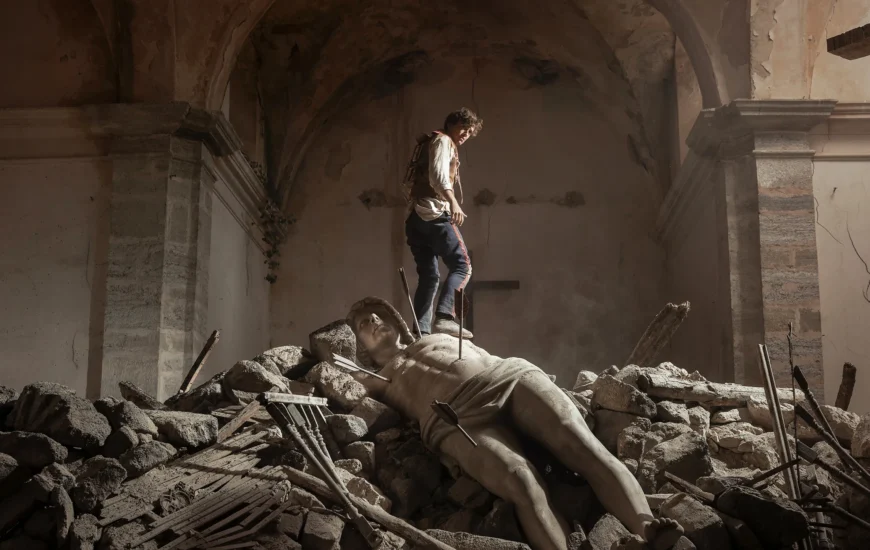
Spain won the World Cup this summer – but can they take on Christopher Nolan at the Oscars?
La Bola Negra is widely tipped as the only film that can take on The Odyssey at next March’s ceremony, and it is not hard to see why.
It ticks all the boxes for awards season success: a big, sweeping epic that touches on themes such as gay identity, fascism versus communism, riveting musical sequences, and a maximalist streak that voters love.
We are decidedly more cool on this movie than other critics; this is a film we respect more than we like; it bites off more than it can chew.
Readers with a longer memory may recall us lavishing The Secret Agent with praise back in February, and that may well end up being our number one film of the year.
In that review, we noted how The Secret Agent effortlessly cut between three different time periods, and it trusted the audience to keep up with the ambitious narrative.
La Bola Negra tries the same thing, asking viewers to keep track of characters and plotlines in 1932, 1937 and 2017, and to keep the Spanish Civil War in mind.
There was an emotional catharsis to The Secret Agent that made it a rewarding watch; La Bola Negra is more of an endurance test that requires the patience of a saint.
The Secret Agent and La Bola Negra would make for an interesting double bill; two countries that are still grappling with their authoritarian past attempt to make art out of the societal trauma that came with it.
While The Secret Agent dealt with the Brazilian state cracking down on left-wing beliefs in the 1970s and the scars of that trauma still lingering in the modern day, La Bola Negra draws a line from the Spanish Civil War to the modern day.
The Spanish Civil War has inspired everyone from The Clash to the Manic Street Preachers to Ernest Hemingway, and directors Javier Calvo and Javier Ambrossi, who were born after the fall of Franco, are the latest to have their say on the topic.
Known as “The Javis”, the directors have been tipped as the successors to Pedro Almodóvar; they certainly display the same expressionistic flourishes as their mentor and his tendency to not know when to end a scene.
On a technical level, La Bola Negra is a stunning achievement and puts English-language cinema to shame.
It is hard to believe a film of this scope and technical ambition cost just under €20 million; we have reviewed Hollywood films with budgets of over €200 million that look like video games.
The film’s high points are paradoxical; The Javis stage musical sequences have the technical rigour of a Bob Fosse number, but sequences could also be cut from the film with no bearing on the plot.
The musical sequences are filmed with such a sense of bravado and confidence that it makes you wish the entire film could have been made in that style.
It isn’t the job of a film critic to act as Captain Hindsight and tell the directors what the film should have been, but it is clear that the film should have leaned more into the musical elements.
If we could sum this film up in one word, it would be “indulgent.”
The final act, in particular, is when patience will be tested, and you just want the film to get to the point already.
Cutting between three different time periods – 1932, 1937 and 2017 – allows The Javis to explore how societal attitudes to homosexuality have changed over the years.
In the modern day, Spain is regarded as one of the most tolerant and progressive countries for LGBTQ+ rights; the most interesting idea the movie has is a soldier named Sebastián, fighting on behalf of the Franco regime, hiding the fact that he is a closeted gay man.
The soldier is played by Spanish musician Guitarricadelafuente; there is a striking, almost David Niven-like quality to him despite being 29 years old.
There is a gentleness to his performance that makes the 1937 segment of the film the strongest; we watch his relationship with a soldier named Rafael (who is fighting for the Republican side) blossom.
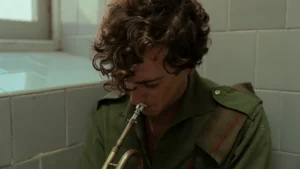
Guitarricadelafuente is the standout performer of La Bola Negra
In real life, there was a real man named Rafael Rodríguez Rapún, a footballer who briefly played for Atlético Madrid and was involved with the burgeoning Spanish theatre scene of the early 1930s.
After this film, you will be inclined to spend hours on Wikipedia trying to fit all the pieces together.
The strong points of the film recall The English Patient or Stalag 17, how relationships (romantic and platonic alike) can blossom in the most dire of circumstances.
If the entire film just focused on the 1937 stretch of the film, it would be worthy of the hype and adulation.
Bringing it back to Bob Fosse, hiding one’s queerness during a time of fascism is why Cabaret has endured for well over 50 years and has gained a resonance with a modern audience.
The Javis pull a similar trick here, and ask the audience to square the idea of rooting for someone fighting for Franco while also remembering Spain’s modern reputation as a progressive beacon of LGBTQ+ values.
Their argument is that the contradiction and clash of values is the point, and the film is stronger for it; that makes it a shame it doesn’t have that level of confidence and control with the other segments.
The 1932 segment of the film, focusing on a younger man attempting to gain membership of a local casino despite being a closeted gay man, is where the film feels most Almodóvar and classical (and arguably, it’s most ponderous and pretentious).
The 2017 segment, focusing on a younger man attempting to connect the two 1930s plotlines to the modern day, is less successful; this is where the film will start to lose you.
In the final 30-minute stretch, where all the plotlines end up intersecting, is fine as a conceit, but it can’t decide on how and when it wants to end.
The 1932 segment of the film has to be there, as it is deeply tied to the works of Spanish playwright Federico García Lorca, who wrote the original La Bola Negra, but the 2017 segment is the weak link.
A film being overambitious isn’t a fault, but when a film tells you it is important, it becomes tedious when it can’t figure out how to end the plot.
At nearly 3 hours, there is certainly value for money, and there is plenty of movie to chew on after the fact.
With that said, La Bola Negra isn’t necessarily worth a trip to the cinema; there is nothing about this movie that screams “you need to see this on the biggest screen you can find.”
We recommend La Bola Negra from a filmmaking point of view – as we said, this is assured of a Best Picture and Best Director nomination at the Oscars – but the overambition hobbles the movie when it should soar.
Related News