The Secret Agent pulls off a wildly ambitious heist
Mike Finnerty 20 Feb 2026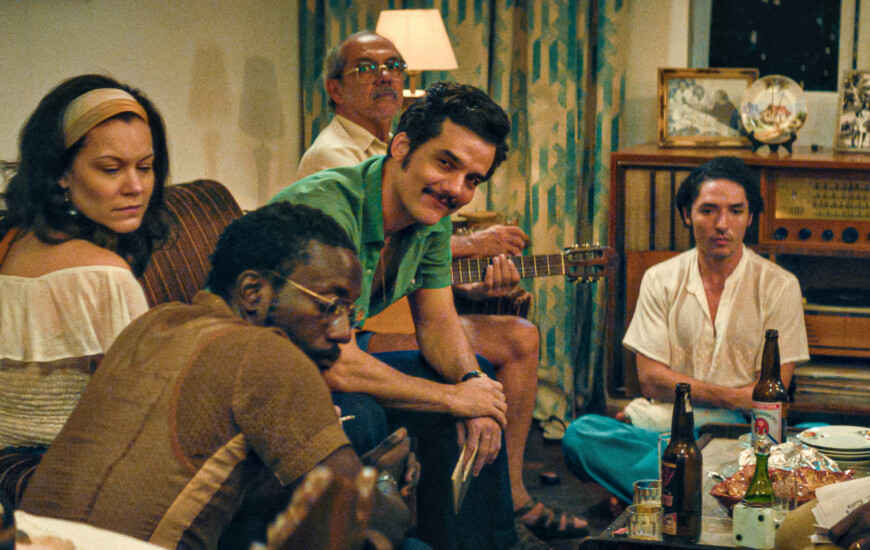
Brazil’s cinema scene may soon overtake its exploits on the football pitch.
With no Ronaldinho, Ronaldo, or Roberto Carlos among the current crop of Brazil’s stars, it is Brazil’s cinema that now best represents the nation internationally.
Last year, the incredible I’m Still Here took home the Oscar for Best International Feature and secured a Best Picture nomination alongside a nomination for leading lady Fernanda Torres.
I’m Still Here made it all the way to number four in our list of best films of 2025; The Secret Agent is likely to enjoy a similar fate as an Oscar-winning hit that is beloved by critics and audiences alike.
The odds-on favourite to win Best International Feature at next month’s Oscars, The Secret Agent is the latest in Brazil’s reckoning with its authoritarian past.
In the 1990s, a wave of Irish films, such as The Crying Game and In The Name Of The Father, wrestled with Ireland’s then-recent violent past and announced that Ireland was a nation that had big, heady ideas about national identity.
It took Brazil’s filmmakers a while to figure out what kind of films best represented their nation on the international stage (crime thrillers City Of God and the Elite Squad films were crossover hits with international audiences), but the one-two punch of I’m Still Here and The Secret Agent hints at a new wave of deeply political, quietly radical and ultimately empathetic cinema.
Narcos star Wagner Moura is an academic who is on the run and hiding out with fellow travellers; Moura is tasked with playing two other roles, but we will let the film reveal the exact nature of those roles.
Moura’s performance as Pablo Escobar made him a global star (after the Elite Squad movies made him a name to know among film fans), but one gets the sense that Moura has been waiting for a film like The Secret Agent to flex his muscles.
There is a Paul Newman quality to Moura’s performance here; the audience is in good hands when he is on screen.
Newman always commanded the screen with gravitas and demanded respect; Moura establishes himself as the modern equivalent with this performance.
Director Kleber Mendonça Filho is known in Brazil for his clashes with the political establishment; he is an outspoken critic of the Bolsonaro regime, and his 2016 film, Aquarius, was the subject of a political row as he spoke out in favour of then-President Dilma Rousseff.
As a result of his speaking out in favour of the impeached President, the film was not put forward as Brazil’s Oscar entry in 2016; a decade later, it appears that Mendonça Filho has got the last laugh and is surely on his way to Oscar glory.
Mendonça Filho’s past as a film critic informs his work and imbues it with a sense of righteous anger; the French had Jean-Luc Godard, South Korea has Park Chan-Wook, and Brazil has Kleber Mendonça Filho as former critics turned political firebrand film directors.
Knowing that the director isn’t one to back down or shy away from a political fight informs why The Secret Agent is so brilliant; it’s a political thriller at its core and recalls the works of Alan J. Pakula, namely Klute and All The President’s Men, or Francis Ford Coppola’s masterwork, The Conversation.
The paranoid 1970s thriller tone meshes beautifully with what the film calls “a time of mischief.”
Whenever a character has to use a payphone, the film deploys a De Palma-style split screen; on a technical level, the film wears its 70s influence on its sleeve, but it also drills down into the soul of the characters, too.
A character, who reveals she was a communist or an anarchist in fascist Italy (she can’t remember the order), says she wishes for a small child to live in a world without as much “mischief”, and that sense of hope is what powers the film, even in its darker moments.
The Secret Agent would pair well with fellow Oscar nominee It Was Just An Accident; two surprisingly funny films that take place within authoritarian regimes and have received major international attention.
This year’s Oscars added a Best Casting category for the first time, finally recognising the craft that goes into picking the right actors, and The Secret Agent earned the nomination with flying colours.
For a nearly three-hour-long film that jumps around different time periods and has a large ensemble cast, the work of casting director Gabriel Domingues is the film’s secret weapon.
The Secret Agent is many things, but above all else, it is ambitious and confident.
The audience is trusted to pick up on oblique references to the Angolan Civil War, keep track of two college students in our present day and trust they will factor into the film later, and have the political climate of 1970s Brazil in mind when watching the film; seeing the film in a cinema, a distraction-free environment, is crucial here.
While this isn’t the fault of the film, per se, the subtitles can occasionally be hard to read in this film; the film’s sunny locales mean that the white subtitles often blend in with the bright backgrounds, making them difficult to read.
For a film that is so dialogue-heavy and is reliant on the audience knowing specific information, this can occasionally be an issue.
One minor nitpick aside, The Secret Agent is absolutely worth seeking out, and ideally, with a crowd.
This is the rare film where you wish there was more of it, and the worst part of the film is when it ended (although the ending we got is a knock-out).
Brazil will likely not have much to celebrate at this year’s World Cup, but it can take consolation in having a brilliant, Oscar-winning film to its name.
Related News