


When Daniel Ennis was formally declared the winner of the Dublin Central by-election at 12:27am in the early hours of May 24th, it seemed more like an inevitability than a shock.
In the 1992 British general election, The Sun famously ran a front page of Labour leader Neil Kinnock with the headline “If Kinnock wins today, will the last person to leave Britain please turn out the lights.”
In the aftermath of the election, where John Major secured an unlikely majority, The Sun crowed “It Was The Sun Wot Won It” on their front page.
The accurate headline for Dublin Central could be “It Was Woke Wot Won It.”
The performance by the Greens showed that the party aren’t dead yet, they were just sick, and much to the dismay of Facebook and Twitter populists, it was Green transfers that got Ennis over the line.
Since the 2019 local elections, the Greens and Sinn Féin have had an uneasy relationship.
To the Greens, Sinn Féin’s sudden embrace of progressive values smacked of opportunism, and their sincerity towards climate change action was dubious at best.
To Sinn Féin, the Greens reduced climate change measures to a middle-class hobby horse and propped up Fianna Fáil and Fine Gael in return for incremental change.
The two parties were said to be “miles apart” in prospective coalition talks in early 2020, and the two parties have enjoyed a bitter back-and-forth ever since the Greens made the decision to prop up Fianna Fáil and Fine Gael on Dublin City Council in 2024.
Janet Horner’s transfers mean that Daniel Ennis is now a TD, and not Janice Boylan, and it proved that Sinn Féin’s decision to court the Facebook vote is as disastrous as it was in the 2024 general election.
It is in this context that the Greens, who still enjoy good support on Dublin City Council despite their nightmare year in 2024, were able to serve as kingmakers in this by-election.

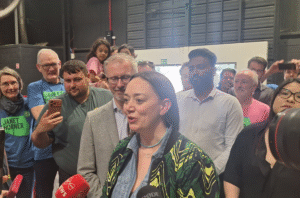
Transfers from Green councillor Janet Horner proved to be key
As the Northside People accurately predicted in the edition that went to press on the afternoon of May 1, Sinn Féin’s inability to make friends on the left came back to haunt them.
In 1978, British post-punk band Magazine released the album Real Life, best known for its single Shot By Both Sides.
That song, known for its distinct guitar riff, could best describe Sinn Féin’s fate in the recent by-elections.
On their left flank, parties that unapologetically embrace social progressive values such as trans rights, ending the mandatory three-day wait for an abortion, and accepting refugees from Ukraine were richly rewarded in Dublin Central.
Sinn Féin’s decision to abstain on a Social Democrats motion on ending the three-day wait for an abortion was dubbed a “drift to the right” by Solidarity TD Ruth Coppinger in May, and Social Democrats sources told the Northside People that particular decision came up “time and time again” on the doors.
The combined Gerard Hutch/Malachy Steenson vote reached 20.7%, enough for a seat if it were a general election.
A by-election is a wholly different set of circumstances than a general election (for one thing, the turnout would be higher), but two anti-establishment candidates scooping that much of the vote should concern both government and opposition alike.
While it would be generous to describe Hutch as having policies, Steenson’s brand of anti-immigration policies and hardcore social conservatism has clearly taken votes from Sinn Féin.
When Sinn Féin started taking Dáil elections seriously, the party, for better or for worse, enjoyed an anti-establishment vote that contained people who hold hostile views on immigration or anything that could be perceived as “politically correct.”
Sinn Féin’s brand for large parts of the 2000s and 2010s was being a party that was anti-whatever the government of the day was.
Since 2020, and amid Sinn Féin’s attempt to look like they were ready to govern, the party took positions that alienated parts of the base who didn’t want the party to co-operate with the establishment.
This has led to the current situation in 2026, where Sinn Féin are trying to appeal to both middle-class progressives and people who get their news from Facebook, and the approach has left neither side happy.
Results indicate that the Soc Dems ate into what should be a Sinn Féin stronghold in Cabra, but analysts have also noted that Cabra, historically considered a working-class area, has become home to middle-class urban professionals in recent years, much like Stoneybatter.
Indeed, in an Irish Times article published on May 26, a Sinn Féin politician told the outlet that the Social Democrats were “divorced from working-class communities,” with another politican quoted as saying “I’m not going to take a lecture on left-wing politics from the Social Democrats, with all due respect.”

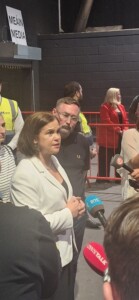
Under Pressure: Sinn Féin leader Mary Lou McDonald’s position is in question after losing a by-election in her own backyard
Thus, the by-election results reveal two different sides to Dublin; the 74.3% of Dublin Central voters who went for Catherine Connolly in last October’s presidential election turned out once again and made life a nightmare for the government parties.
By the same token, the 14.9% that spoiled the vote last October rallied behind either Hutch or Steenson, their way of sending a middle finger to the establishment.
The remaining 3-or-so years of this Dáil are plenty of time for both government and opposition to figure out what kind of voter is worth inviting into their big tents.
Gary Gannon is now in a unique position for a Social Democrat TD; he now has an extra party TD in his constituency.
Prior to his election to the Dáil, Gannon served as a councillor for the Cabra-Glasnevin area, and prior to his election to the Dáil, Ennis was a councillor for the North Inner City area; it could be a case that Gannon works the west side of Dublin Central, and Ennis takes the east.
As for the government parties, Sean Kyne’s victory in Galway West will compensate for what was a disappointing day in Dublin Central.
Lord Mayor Ray McAdam can take consolation that there is enough of a vote there for him in a general election and that the Paschal Donohoe seat isn’t lost forever.
For Fianna Fáil, the result was nothing short of shambolic, and the party putting John Stephens forward had the air of desperation to it.
Stephens was elected to Dublin City Council on the same day as Daniel Ennis in 2024, but his performance is a case of the singer not suiting the song.
Fianna Fáil’s wipeout in Dublin Central is more worthy of a graduate thesis than a newspaper column, but the short version is that Bertie Ahern still looms large over the local Fianna Fáil branch, much like Roy Keane does at Manchester United.
Even in 2011, at the height of the economic crash and when Fianna Fáil suffered a generational wipeout, Fianna Fáil secured 15.4% of the vote in Dublin Central.
15 years later, the party can’t even get their deposit back.
Not even Armando Iannucci can write political comedy as funny as that.

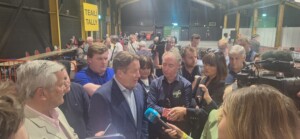
Fall Guy: Fianna Fáil Director of Elections Darragh O’Brien faces the media at the RDS after a shambolic result