


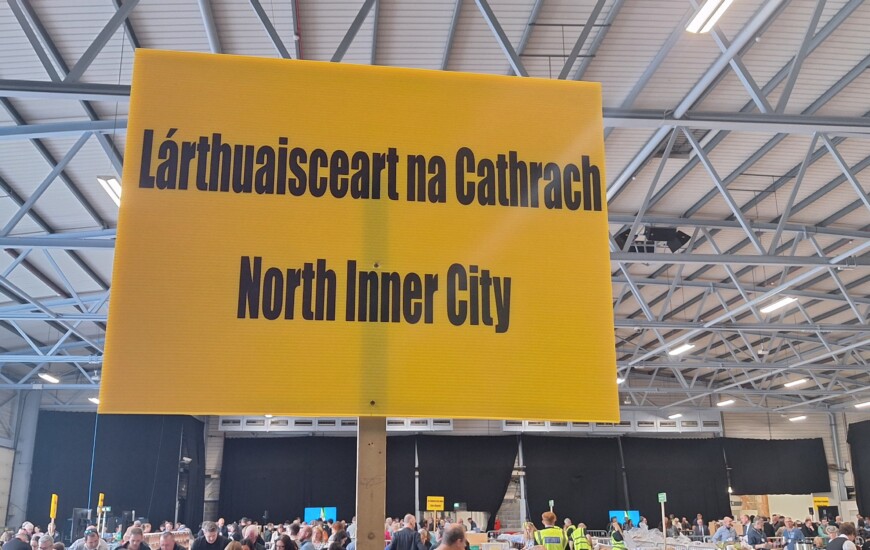
May 22 has all the makings of a potential blockbuster in Dublin Central.
All good blockbusters have a good, strong hook to lure audiences in, and Dublin Central has it all.
There’s the prospect of the opposition working together to shut the government out in the heart of Dublin, government parties struggling to regain public trust amid economic turmoil and unrest and to top it off, the prospect of the area’s historic anti-establishment streak rearing its head.
With so many candidates in the field and more twists than a box set, we are here to establish the main plot threads to look out for on May 22.
The by-election was triggered by Fine Gael veteran Pachal Donohoe vacating his seat last November to take a job in Washington DC.
Lord Mayor of Dublin Ray McAdam has been entrusted with helping Fine Gael hold onto Donohoe’s seat, which was first won in the 2011 general election.
Now in 2026, the seat is up for defence at a time when the government parties have their backs against the wall.
April’s fuel protests saw O’Connell Street shut down in this very constituency amid anger at the government parties.
By any metric, McAdam is the strongest possible candidate Fine Gael could have run – a councillor since 2009, incumbent Lord Mayor, close ties to Paschal Donohoe – but he faces a battle to retain Donohoe’s seat.
A former parliamentary assistant to Donohoe and a poll-topper in the marathon North Inner City race of 2024, McAdam’s chops are not in doubt, but even the best politician could struggle when tied to a party overseeing economic stagnation.
Dublin Central went for Catherine Connolly by 74.3% of the vote last October (15,848 votes), while Fine Gael’s Heather Humphreys received 19.6% (or 4,176 votes).
The odds are certainly stacked against McAdam, but Fine Gael, to their credit, has given themselves the strongest possible chance of holding onto the seat in terms of candidate selection.
Fianna Fáil’s hopes of winning back a seat that they haven’t won since 2007 fall to Cabra-Glasnevin councillor John Stephens.
Stephens, first elected to Dublin City Council in 2024, has the unenviable task of trying to win back a seat that Mary Fitzpatrick has failed to win on five separate occasions.
As far as Stephens is concerned, the question becomes how high his ceiling is and how much of a boost he will give McAdam on transfers.
Stephens currently serves as Deputy Lord Mayor to McAdam, and Stephens is keen to avoid a repeat of the last time Fianna Fáil stood in a by-election.
July will mark five years since the Dublin Bay South by-election, which saw Deirdre Conroy score less than 5% of first preferences.
On that occasion, Director of Elections Jim O’Callaghan saw his leadership credentials thrown into doubt after that disastrous performance, and Darragh O’Brien, occupying the same role now for Fianna Fáil, will want to avoid a similar fate.
On a local level, Fianna Fáil saw a pretty miserable set of results in 2024; Stephens was the only candidate elected out of a five-strong suite of candidates, with the party infamously going zero from three in the North Inner City.
Micheál Martin will be more concerned about proceedings in Galway West, and the Dublin Central result will only reach his inbox in the event that Stephens performs worse than Conroy did in 2021.

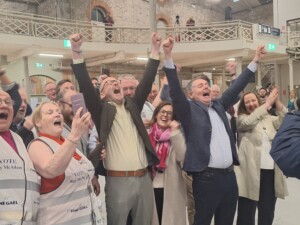
Ray McAdam and Paschal Donohoe celebrate victory in North Inner City at the June 2024 local elections
The million-dollar question is which version of the left will emerge strongest in Dublin Central.
2024 saw Sinn Féin, an improved Social Democrats vote and a comeback for Labour round out the quartet.
Question marks have begun to emerge around Mary Lou McDonald’s leadership of Sinn Féin; should the party fail to win a seat in her own backyard and fail to win in Galway West, a heave may emerge.
Sinn Féin didn’t select Janice Boylan as their candidate until the last week of February, after a high-profile row about McDonald’s preferred candidate not getting selected, whereas the Social Democrats selected Ennis as their candidate before Christmas.
In a by-election, every week counts, and the Soc Dems having an 8-week advantage on the doors will pay dividends in the end.
Dublin Central has always been characterised as a constituency that fires from the hip and wants to land a blow on the government of the day; at the present moment in time, the Social Democrats of 2026 occupy the same position Sinn Féin did in 2020, they are the party of change in voters’ eyes.
The Red C Poll for March 2024 had Sinn Féin polling at 26% in Dublin, and the April 2026 one had the party polling at 19% in Dublin.
By contrast, the Soc Dems have jumped from 4% to 9% in that time (and Labour has gone from 4% to 6%).
In the 2020 general election, Mary Lou McDonald’s performance in Dublin Central recalled the high points of Bertie Ahern as Taoiseach; the party did not see the overperformance coming and did not bring in a running mate for her.
When Boylan was brought in as running mate in 2024, the bloom was off the rose (not least because the rose bloomed again in the form of Labour’s comeback).
Labour’s presence in the race is more straightforward; they want to stress test how popular the Labour brand really is in the area.
Running someone without a council seat is a gamble for Labour, but the party also has no elected representatives in the area apart from Marie Sherlock.
Ruth O’Dea’s long history of standing for abortion rights and her involvement with local education issues – she founded Drumcondra For All – is likely to appeal to progressive voters, but our tip to budding analysts out there is watching where Labour’s transfers go.
The by-election is pretty high stakes for the Greens; the party is on the long road to recovery under Roderic O’Gorman, and May 22 will reveal just how well the recovery is going.
In 2024, Neasa Hourigan lost her seat after her share of first preferences dropped by 6% compared to 2020; it was telling that Gary Gannon saw an increase of 4% and Marie Sherlock saw an increase of 2% compared to Labour’s 2020 performance.
The Greens are fairly strong locally; Feljin Jose topped the poll in Cabra-Glasnevin in the 2024 locals, while Janet Horner finished third in the seven-seater North Inner City.

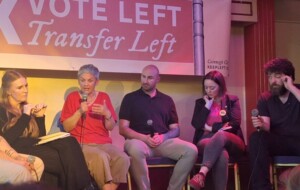
The left are attempting to work together in Dublin Central
The third and final plot to watch out for is how well the anti-establishment candidates perform.
Malachy Steenson has proven horseshoe theorists right by his move from Workers’ Party candidate in 2009 to an anti-immigrant independent councillor in 2026.
Dublin Central has a strong history of going for anti-establishment parties or candidates outside the traditional party system, and Gerard Hutch’s 5th-place finish in 2024 was a sign of that.
More recently, 14.9% of voters spoiled their vote in Dublin Central last October (or 3,754 people), enough to win a seat in a 4-seater context.
Clare Daly’s attempted Dáil comeback in 2024 flatlined; indeed, the same people who would have voted for her a decade ago are now interested in what right-wing populists have to offer.
The same issue presented itself in the 2024 European elections; a decade ago, people voted for left-wing anti-establishment candidates if they wanted to give the government a kicking, now right-wing anti-establishment candidates are the flavour of the month.
Between Daly and People Before Profit candidate Eoghan Ó Ceannabháin, nearly 10% of the Dublin Central electorate went for far-left candidates in the 2024 general election, indicating that there is an appetite for that kind of politics in the area, but left-wing politics is facing a difficult cultural moment in 2026.
In the 2024 local elections, Ó Ceannabháin came within 60 votes of winning a seat in North Inner City, and received 4.5% of first preferences in the 2024 general election.
People Before Profit’s impact on the race will be their unofficial transfer pact with the Social Democrats; the 2024 local and general election showed that the Social Democrats were the main beneficiaries of transfers from People Before Profit.
On the other side of the fence, a transfer pact is likely to emerge between Aontú’s Ian Noel Smyth, independent anti-immigration councillor Malachy Steenson and independent candidate Gerard Hutch.
Aontú are polling relatively well and have been the major beneficiary of the recent fuel protests anger; however, the party only has three elected representatives in Dublin (two in Dublin 15 and one in Swords) with the party mainly seen as a party for former Sinn Féin voters who are staunch social conservatives.
There is little evidence to show if that message will resonate with voters in the North Inner City (when Smyth ran in 2024, he received just 2.2% of first preferences), but their impact on the race will be fairly substantial.

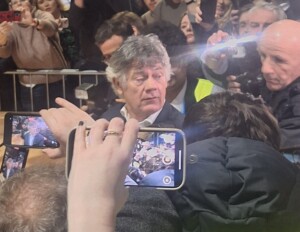
Gerard Hutch at the count centre in 2024 – has the media novelty worn off?
Despite tabloid media’s best attempts to get Hutch elected in 2024 by offering him breathless, limitless airtime, he still failed to get elected.
If Hutch failed to get elected in a four-seater context, it is difficult to see him win in a by-election where just one candidate wins.
This time around, Hutch has made an effort to encourage turnout among would-be voters
When Steenson went out on round six in the 2024 general election, 1262 of his 2195 transfers went to Hutch; expect roughly the same to transpire again on May 22.
Sequels are rarely as good as the original, and now that the media has gotten its Hutch fixation out of its system, the novelty appears to have worn off.
By the same token, it would be unwise to rule either candidate out; if the protests of April have proven anything, a not insignificant number of people believe that the Irish political system does not work for them, and will make their voices heard at the ballot box.
As for the day itself, we expect to see three candidates quickly emerge, like what happened in Dublin Bay South in 2021; on this occasion, we expect them to be Ennis, McAdam and Boylan, with transfers working their magic to resolve the race.
If we had to pick a winner? We predict Ennis to edge out McAdam on transfers simply because Ennis has a deeper well of transfers to tap into.