


From the Teacher’s Club, the top of The Spire is visible, the Rotunda Hospital is next door, and there are cranes dotting the skyline nearby.
By any other metric, this would be an indicator of Dublin’s economic prowess.
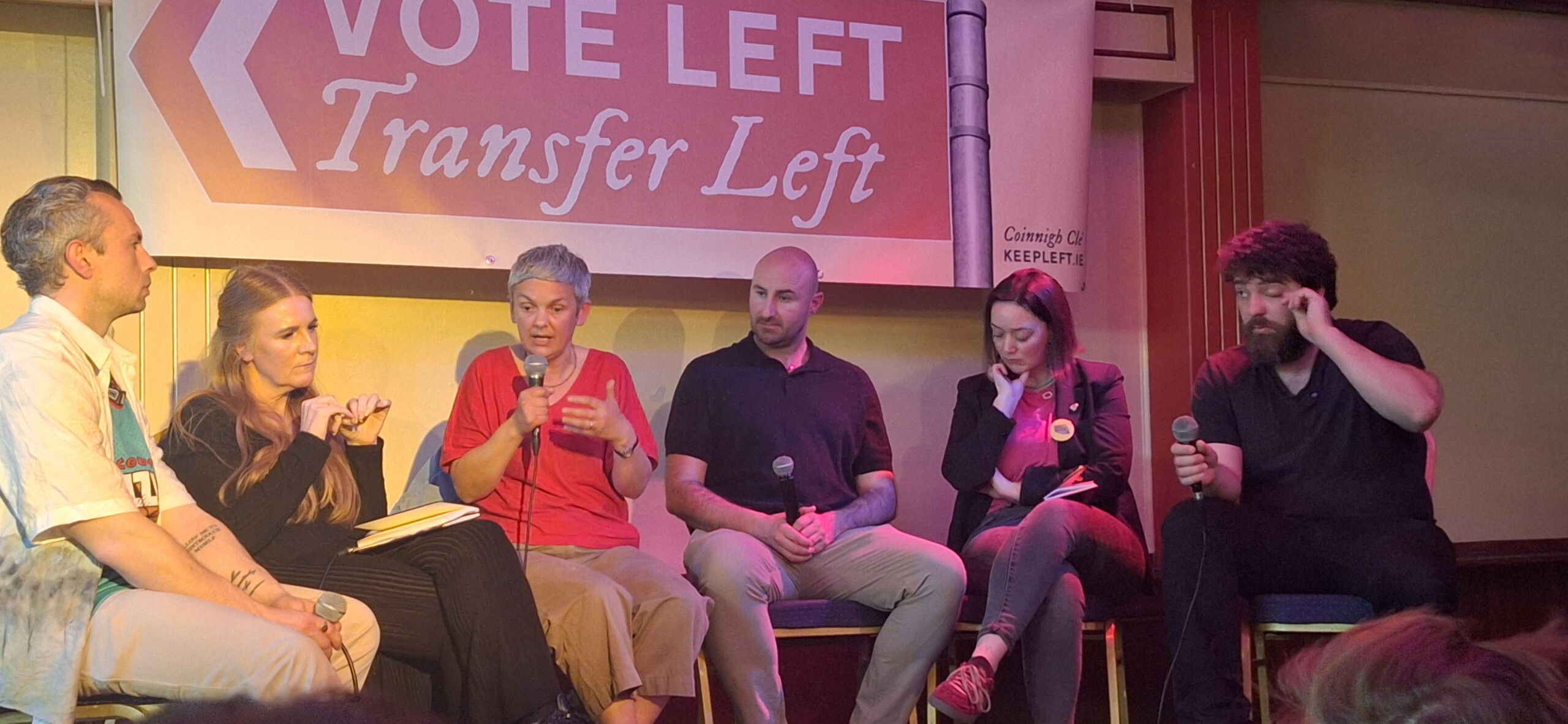
However, on a cloudless Thursday evening, and with the by-election writs presented to the Dáil, politicians from Ireland’s scattered left gathered on stage in an attempt to carry on the momentum from Catherine Connolly’s successful campaign.
A woman in a Che Guevara t-shirt was selling various leftist-themed badges, and payment was accepted on Revolut.
A man in his 20s travelled up from Perrystown on the Southside to attend the event; Liam said he voted for the Social Democrats in the 2024 general election, but said that Catherine Connolly’s win last October was an inspiration to him.
A young woman named Aoife moved to Dublin from Mayo two years ago, telling us she pays over half of her income on rent in Phibsborough; in 2024, she voted for People Before Profit’s Eoghan Ó Ceannabháin and gave her second preference to Mary Lou McDonald and third preference to Gary Gannon.
This would-be coalition of the left is now trying to carry on the momentum from last October’s presidential election, where Catherine Connolly carried Dublin Central with 74.3% of the vote.
With Paschal Donohoe out of the picture, Dublin Central now has the chance to be the only constituency in Ireland to be represented entirely by TDs from the opposition.
Just one slight problem: the attempt to unite the left in Dublin Central was, at times, more akin to Curb Your Enthusiasm than the Warsaw Pact.
In a week where Labour leader Ivana Bacik rubbed shoulders with Spanish progressive darling Pedro Sanchez and Brazilian political titan Lula Da Silva in Madrid, Ireland’s left showed vague signs of that kind of harmony.
Reporting back from Madrid, Bacik said that progressives “need to learn lessons” from Spain’s successful left-wing government, which has seen Spain’s analogue to the Labour Party go into coalition with various left-wing parties with roots in communism, the anti-austerity movement and the environmentalist movement.
So, all eyes are on whether Ireland’s famously fractious left can follow in Spain’s footsteps.
Sinn Féin councillor and candidate Janice Boylan set the tone by telling the audience, “I’d rather be out canvassing, I have to be honest,” in a statement that isn’t likely to be put in the pantheon alongside Nelson Mandela.
Similarly, Labour candidate Ruth O’Dea, the most unknown quantity on the stage (this being the first election she ever stood in), did impress in terms of talking about her decades-long history of fighting for abortion rights, but proceeded to nearly derail the evening by saying that water charge protesters “worked within the parameters of how you protest.”
The irony of a Labour candidate saying that on the same stage as a People Before Profit candidate was not lost on the crowd, which greeted the statement with peals of laughter and more than a fair share of groans.
O’Dea, however, did note her long, storied history with fighting for reproductive rights; she says she campaigned in the 1992 and 2002 referendums on abortion rights, an issue that Sinn Féin had a complicated relationship with up until Repeal.
Green councillor Janet Horner told the audience she is the “best value for money” candidate, alluding to the Greens being reduced to just one Dáil seat following the 2024 general election, and her election would result in a doubling of their current Dáil delegation.
Horner noted that she and O’Dea “have, more often than not, been on the same side,” referencing how they worked together on the likes of Repeal, the 2015 same-sex marriage referendum and, of course, last October’s presidential election.
The Green councillor said that should she be elected, she would work to loosen Ireland’s laws surrounding drug possession, a similar policy pushed by Germany’s Green Party during their recent stint in government.
More pertinent was People Before Profit’s Eoghan Ó Ceannabháin calling for a formal “Vote Left, Transfer Left” pact; candidates in the Galway West by-election have agreed to a similar pact.
Ó Ceannabháin said a condition of the pact was ruling out a coalition with Fianna Fáil and Fine Gael as the main key principle, but also focusing on key issues such as the cost of living crisis and the crisis in special education.
Ó Ceannabháin, who came within 60 votes of winning a seat in the North Inner City in 2024, said that a “people’s movement” was needed, saying that Repeal and the water charges movement are templates to follow.
A good chunk of the evening was dedicated to discussing how working-class voters can be wooed back into the left tent, after their flirtations with anti-immigrant or outright far-right politicians.
Malachy Steenson’s 2024 win in North Inner City (winning the 4th out of 7 seats on that occasion), along with Gavin Pepper’s victory in Ballymun-Finglas, Patrick Quinlivan’s win in Blanchardstown-Mulhuddart and Glen Moore’s victory in Palmerstown-Fonthill on the Southside, point to how a certain cohort of working-class voters feel attracted to candidates who prey on immigration concerns.
In Dublin Central, nearly 15% of people spoiled their vote in last October’s presidential election, while the nearby Dublin North-West saw over 20% of people spoil their vote.
A discussion of how to win back those voters who used to vote for anti-establishment, opposition parties, was the most enlightening part of the evening.
Social Democrats candidate Daniel Ennis, who pundits predict will be the most successful of the left bloc and will be in the running alongside Lord Mayor Ray McAdam for the seat, said he was inspired to run for Dublin City Council in the wake of the East Wall protests in late 2022 and early 2023.
Ennis, born and raised in the area, works as a football coach for the East Wall Bessborough Football Club; at the height of the protests, his young team had to walk by protesters.
The team consisted of younger players from immigrant backgrounds, and Ennis recounted the abuse the players received; he said the encounter was “frightening,” and that was the spark for him to run for office.
He was promptly elected to Dublin City Council in 2024.
Ennis, who works as a parliamentary assistant to Gary Gannon in the Dáil, told the audience, in a moment of vulnerability, that “not many people in Leinster House have my accent” and has considered masking it.
He then decided that his accent and his North Inner City roots were his calling card, and has decided to make no apologies for it; he said he wanted to have more voices like his in the Dáil chamber itself.
Boylan captured a similar tone, telling the audience that people in Dublin Central were “salt of the earth”.
The recent co-option of the Irish tricolour by anti-immigrant and far-right types (a tactic from their counterparts in the United Kingdom) was discussed by Boylan, and she said “don’t give them the space to use our flags; we cannot be afraid to call them out.”
The candidates stressed that “listening” was the best quality that a candidate could have, and that was the best way to appeal to voters who might feel tempted to vote for Malachy Steenson or Gerard Hutch.
O’Dea noted that there is a “disconnect” between some voters and establishment politics, and noted that “people went out of their way” to spoil their ballot last October.
Ó Ceannabháin said that he has noticed there is an overlap between people who attended his meetings on fighting rent increases, but are also turning up to Steenson meetings.
Horner relayed that there were some instances of Steenson receiving a first preference, and Horner receiving a second preference; the Green councillor said, “to be honest, I probably know those people. It might seem weird from the outside, we have very little in common, but chances are me and Steenson sat down with those people, listened to them, heard their stories, and told them we would solve their problems.”
With the campaign now officially underway, May 22 will serve as a day of reckoning for Ireland’s burgeoning left movement; will it go all the way to the government benches, or will it face a roadblock in the form of Ray McAdam’s well-resourced, government-backed campaign?