


In the 30 years since Jurassic Park ushered in a new era of cinema, very few films have been able to match it.
Not even the Jurassic Park movies themselves can grasp what made the 1993 film so fantastic to begin with, with more modern instalments in the franchise forgetting the key element: humans are going to freak out when they see a T-Rex wandering around.
The End Of Oak Street has a great premise for a movie; what if a 1980s domestic family drama suddenly got interrupted by dinosaurs?
It is a fantastic idea for a movie, and it’s one that more movies should copy. Movies like Hamnet and Sentimental Value are great, but what if they dropped a Stegosaurus into a heart-wrenching monologue?
Director David Robert Mitchell makes his return to the big screen after 2018’s Under The Silver Lake, a shaggy, messy noir about a detective trying to solve crimes in Los Angeles (we think? The movie wasn’t really clear), but his big calling card movie, It Follows, is what audiences will know him best for.
The End Of Oak Street feels like it could have been an episode of The Twilight Zone or an obscure science fiction novel from the 1950s, but that’s part of why it’s so great; it feels both old and new at the same time.
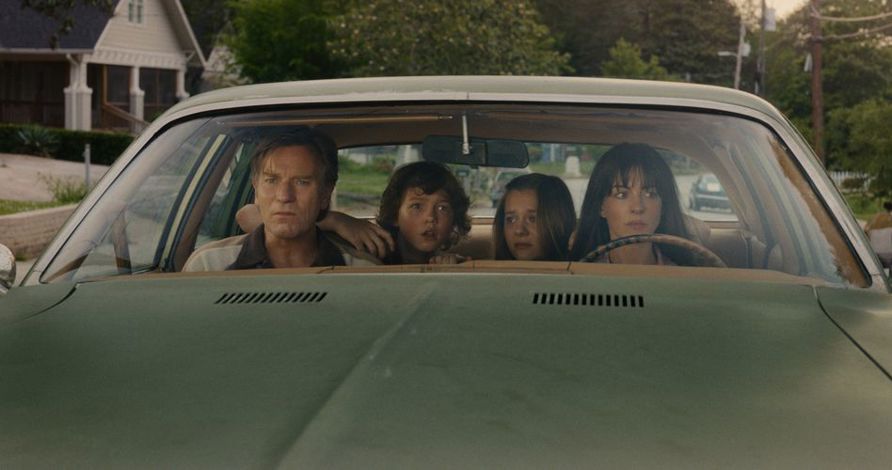
The movie, a crisp 100 minutes, spends the first 20 minutes setting up that Ewan McGregor and Anne Hathaway’s marriage is on the rocks, while the kids are worried about neighbourhood bullies and getting into college. So far, so standard.
We are told that the marriage is falling apart, and we get the classic trope of the dad drinking too much because he is working extra jobs to pay the bills. The teenagers start to pick up on this, and before the dinosaurs show up, we already know that the family unit is falling apart at the seams.
Then, at the 20-minute mark, with the characters set up, Mitchell proceeds to wreak havoc in suburbia.
All the familiar tropes we associate with American suburbia, such as the white picket fences, the semi-detached house and the backyard BBQ, are gleefully played with.
The film has a nasty streak to it; humans and animals alike are squashed or picked off by dinosaurs with an almost slasher movie-like abandon.
Right on the edge of a 12A and a 15A, we would say the film is slightly too intense for younger audiences.
With that said, the film is playing in the same camp as films like Gremlins, where it’s broadly suitable for larger audiences and has one or two moments that blindside them in terms of shock value.
Mitchell’s most famous film, It Follows, gained a lot of power from making you think you saw something out of the corner of your eye, leaving you on edge and waiting for the next thing to jump out.
Mitchell uses similar tricks here; the gradual build-up of the family thinking something weird is going on before the big reveal is masterfully executed.
One of the film’s best bits could have been lifted straight from It Follows; our heroes are in a garden trying to figure out their next move, oblivious to a T-Rex running towards them.
You want to shout at the characters to get out of the way or to look out; it sucks you in as all great movies do.
As we pointed out in our review of Masters Of The Universe in May, there is no decade more over-represented in pop culture than the 1980s.
The Stranger Things effect has started to crop up in other forms of media now, and The End Of Oak Street uses the 1980s setting as texture as opposed to building the film around it.
Whereas Stranger Things’ approach to 1980s culture was simply stopping the action to point out a famous thing from that decade, The End Of Oak Street has no time for that; it plays a song from 1981 and trusts the audience is smart enough to figure it out.
Spielberg proves he is still the king of popcorn cinema with Disclosure Day
Mitchell does use another trick from classic cinema: weaponising the idea of suburbia as a concept.
The homes depicted in the movie are supposed to be something that a viewer in Dublin or Davao can recognise as shorthand for the average suburban family home.
Those homes are shorthand for being safe, cosy and warm; when the rug is pulled out from under the audience and an element we don’t expect is introduced — in this case, dinosaurs — it is mighty effective.
In the original Halloween or A Nightmare On Elm Street, John Carpenter and Wes Craven use the average suburban house as the battleground as terror plays out.
They flip the idea of a safe suburban home on its head, and Mitchell builds upon that innovation.
Mitchell also borrows a trick from Brian De Palma; for fans of split diopter shots, this is your next favourite movie.
The finest directing moment of the movie comes when a snake-like dinosaur crawls in through the window, but the characters have their backs turned to it.
The creature crawls through the house, eventually cornering Anne Hathaway in the kitchen.
The build-up and suspense in the sequence is second to none, and the film has about five or six brilliant sequences like that.
A note on Hathaway; with 2026 shaping up to be the Year Of Hathaway (The Devil Wears Prada 2 and The Odyssey have put her back on top), the movie is a great showcase of her talents.
As written, her and McGregor’s well-meaning but dim dad character aren’t the most fleshed-out characters ever committed to page, but the two actors manage to wring a lot out of very little.
The writing is very crude and simple, but some corners have to be cut to give the film its lean runtime; Hathaway and McGregor help paper over the cracks in that regard.
McGregor’s performance is just as strong as Hathaway’s: his usual cool, charming guy persona is sanded off for a well-meaning doormat that has more in common with Ned Flanders than his character in Trainspotting.
We are unsure how this film will perform; Spider-Man and The Odyssey are continuing to sell out weeks into their run and keeping the lights on for cinemas. A film like this might seem a bit too “small” when audiences want big spectacle.
But there is a pleasing throwback sensibility to this film, and it wouldn’t have felt out of place alongside the likes of Jumanji circa 1995.
Populism isn’t a dirty word when it comes to film reviews; sometimes all an audience wants is some well-executed chase scenes involving dinosaurs.
It is more likely that this film will find its audience on streaming, but if you want a 100-minute, no-frills time at the cinema, you could do a lot worse than this.