


Nearly 60 years into his career, Steven Spielberg’s career continues to rewrite the rulebook.
Last year, we reminisced on the lasting legacy of Jaws for its 50-year anniversary, but Spielberg’s recent work is nothing to sniff at.
2015’s Bridge Of Spies was the perfect distillation of a “dad movie,” where Tom Hanks is involved in some Cold War politics, and 2021’s West Side Story did the impossible by being on a par with the 1961 original.
2022’s The Fabelmans revealed that Spielberg still had plenty of tricks up his sleeve; the semi-autobiographical movie about a young filmmaker cast his filmography in a new light as we figured out the reason for his daddy issues.
In the run-up to Disclosure Day, Spielberg has been singing the praises of the wunderkids Curry Barker (the 26-year-old behind runaway horror hit Obsession) and the 20-year-old Kane Parsons (the prodigy behind Backrooms), and one gets the impression that Hollywood is getting ready for a new changing of the guard.
In the 1970s, Spielberg and his pals George Lucas, Francis Ford Coppola, Martin Scorsese and Brian De Palma took over from the old guard of Billy Wilder, Howard Hawks and John Huston.
Now, Spielberg is the old guard that is on the verge of being replaced by the self-taught YouTube generation; if Disclosure Day is anything to go by, Spielberg isn’t going down without a fight.
Disclosure Day sees Spielberg in very familiar territory, telling a story about aliens, but he proves he still has a head swimming with ideas.
1977’s Close Encounters Of The Third Kind was Spielberg’s direct follow-up to Jaws, and still ranks among the greatest science fiction films of all time.
Whereas Spielberg was approaching UFOs in that movie with a sense of wide-eyed wonder and gee-whiz awe, an older Spielberg is in a more reflective mood with his new alien movie.
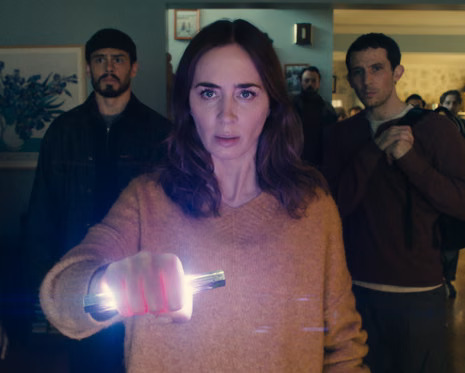
Disclosure Day follows a cast of Emily Blunt, Josh O’Connor, Dublin’s own Eve Hewson, Colin Firth, and Colman Domingo as the truth about aliens is the subject of a government cover-up.
Hewson is the soul of the film; a former nun who has a wavering relationship with faith, her performance helps drive home the film’s most interesting train of thought.
The film asks, if we found out that aliens existed in the morning, how would society react? Would it challenge our pre-conceived notions of faith and our place in the universe? In an era already wrestling with fear and anxiety, how would a profound secret being revealed change things?
There is an interesting trend in Hollywood movies recently; Conclave and last year’s Knives Out film (which also starred O’Connor) explore crises of faith in the face of adversity.
In the background of the film, we are told that the world is on the brink of war, and people are scared; after the events of the last few years, it would appear that Hollywood’s filmmakers are wrestling with their own faith being tested and asking the audience to do the same.
Disclosure Day goes for a more ecclesial approach, inviting the viewer to explore their relationship with faith – or lack thereof – in the face of a profound sociological shift.
Disclosure Day has top-notch action, as expected for Spielberg, and the performances are universally excellent (O’Connor continues his streak as one of the brightest acting talents of his generation), but the film’s headier elements are what you will remember.
When the film slows down and asks you to think about the bigger picture, it serves as a reminder that no one can mix highbrow and popcorn action quite like Spielberg.
As mentioned, Hewson is the main conduit for the film to communicate its big ideas about faith; her character is a former nun in training who left it behind, but still believes in something.
Hewson’s career has gone from strength to strength (her role in Bad Sisters has propelled her to international fame), and her performance here marks a level-up for the Dubliner.
The film’s message about faith needs an actor with weight and gravitas to sell it, and Hewson makes it look effortless.
When O’Connor’s whistleblower character confides in her that he needs to share the information he knows with the world, Hewson pushes back and reacts the same way an average person would in an impossible situation like that.
O’Connor is a favourite actor of these film pages, with his performances in Challengers, The Mastermind and last year’s Knives Out all coming in for high praise from us.
O’Connor is still best known for his Emmy-winning performance as a young King Charles on the Diana seasons of The Crown, but his move into Hollywood leading man status has been fascinating to watch; there is a gentleness to him that makes him arresting to watch.
An underseen but great O’Connor performance is La Chimera, where he plays a shady British graverobber who gets into hijinks; the performance is reminiscent of 1970s-era Elliott Gould, and that 1970s aura is a big secret to why Disclosure Day feels timeless.
In a sense, Spielberg could have just as easily made Disclosure Day in the 1970s; the only reason he waited until 2026 to make it is so that technology can catch up to his imagination.
At its core, however, is a classical story about a secret waiting to get out, and the forces that be fighting to keep it quiet.
Special mention goes to Spielberg’s long-time collaborators John Williams and Janusz Kaminski.
Williams needs no introduction; the man can produce a timeless score in his sleep, but his work here, at the grand old age of 94, is majestic.
The 1970s feel of the movie bleeds into the score; the score, at times, sounds more like Klute or All The President’s Men and recalls Williams’ own score for The Long Goodbye (speaking of Elliott Gould).
Kaminski’s work as Spielberg’s cinematographer has been a vital part of Spielberg’s evolution as a director; the Polish lensman has worked with Spielberg since Schindler’s List, and they still get the best out of each other.
Kaminski’s tricks in Disclosure Day involve using natural light to shoot a scene, or having interactions play out through reflections in windows; there are some shots in this movie that will leave you wondering how they pulled it off, as is the standard for Spielberg.
It is difficult to tell how general audiences will react to Disclosure Day; Spielberg can still direct an action sequence like no one else, but critics who find his films too treacly and sentimental might scoff that he’s still playing arrested development at the age of 79.
The counterpoint, Spielberg argues, is that humanism is the approach to the woes facing our world, and that cynicism does no one any good.
Relative to his West Side Story and Fabelmans (two of his finest films), Disclosure Day is a minor step down, but a 4-star Spielberg film still runs circles around most films in a given year.
The summer blockbuster season is likely to be dominated by Christopher Nolan’s take on The Odyssey, which also looks set to offer brains and action in the grand Spielberg tradition, but Spielberg is here to remind people that he’s not done yet.