


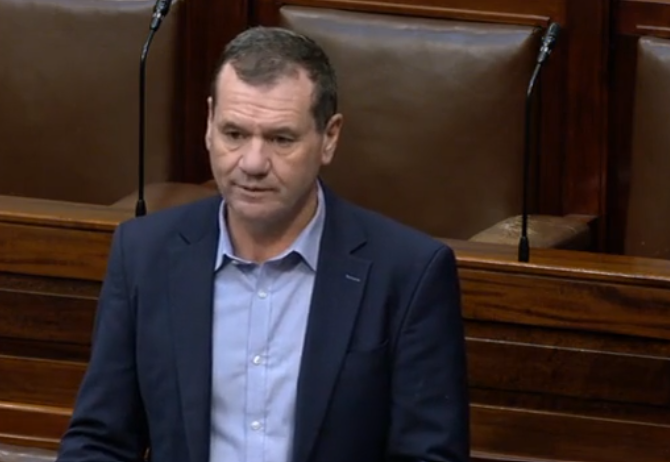
Sinn Féin TD Paul Donnelly has criticised social media giants for failing to take action against misinformation being spread against him.
The Dublin West TD was the target of misinformation on TikTok, which accused him of giving preferential treatment to a Somalian family on a housing issue.
The TikTok video alleged that an older man, recovering from a medical procedure, was issued with an eviction notice, and told to vacate the house.
The video further alleges that they got in contact with Fingal County Council about the situation and were told it was not a matter for them.
Donnelly’s umbrage with the video stems from the video, without proof, alleging that Donnelly moved for a closure of the house and that a Somalian family would be “more suitable.”
Owing to the shoot-from-the-hip nature of social media, where the truth is negotiable, the news spread and put a target on Donnelly’s back.
Donnelly said he was hesitant to even share the misinformation being spread about him, but he said “unfortunately, I have to respond.”
Donnelly said of the video “this is completely made up and fake; it comes from a cowardly anonymous account.”
“I’m quite astounded that some people believe this stuff. I thought about posting this, but some people have been letting me know it’s up there, so unfortunately I have to respond.”
He said that the page has been reported and “hopefully” will be taken down but remarked he would be “surprised” it would be taken down as social media giants such as TikTok, Facebook and Twitter have gutted moderation staff in order to curry favour with Donald Trump.
Donnelly stated, “they (social media companies) are happy to have lies being told about anyone so they can make money.”
By the same token, were the Northside People to report on a similar issue without verifying it and spreading unsubstantiated rumours about Deputy Donnelly, the publication would face serious legal action and be subject to reputational damage.
As reported in last week’s issue, despite TikTok having their European HQ in Dublin, there is hesitation on the part of the government to tackle companies that spread misinformation and sow social division.
Donnelly said of social media companies, “it is all about driving traffic and making money; they couldn’t care less about people.”
Blanchardstown–Mulhuddart councillor Breda Hanaphy said that the situation was “absolutely scandalous,” calling it “defamation of character and blatant lies regarding Fingal County Council and Paul Donnelly.”
As reported in last week’s edition, a dummy account was set up by the Northside People newsroom in June, and told the Facebook algorithm to recommend political content.
The account was fed content from Donald Trump’s administration, posts from the far-right Restore Britain, as well as posts from the far-right National Party, despite not liking, sharing, or posting anything which indicates an interest in right-wing, anti-immigrant, anti-LGBTQ+ politics.
At the start of 2025, and in a blatantly transparent bid to appease Donald Trump, Mark Zuckerberg announced sweeping changes to moderation standards on Facebook, made fact-checkers redundant (and allowing a rise in misinformation in the process), and changed the algorithm to show users more socially conservative content.
Similar changes happened to the Elon Musk-owned Twitter, which also has headquarters in Dublin, and at TikTok.
Moderation staff at Dublin’s TikTok HQ have been told they might be made redundant; in recent weeks, 300 staff in the trust and safety departments were informed their positions are at risk, according to reporting in The Journal.
For politicians like Donnelly, who use Facebook as a means to communicate with constituents (as well as politicians from government parties), the collapse in moderation standards on social media websites poses a headache to them.
Responding to a commenter who suggested that he take out legal action against TikTok, Donnelly remarked it was “pointless.”
He said because the claim came from an anonymous account, there was little point in pursuing legal action.
“It is also pointless if they have no money or assets to enable you to get back your solicitors and barristers fees for taking a cases,” noting “it be cost tens of thousands to take a case to the High Court for defamation.”
MEPS for government parties, potentially sensing public anger around social media, have said that social media giants need to be reined in and Ireland should use EU presidency to put smacht on the tech giants.
Fianna Fáil MEP Barry Andrews said that TikTok being based in Dublin is not an excuse for the government to be scared of taking action.
TikTok refused to appear before an Oireachtas committee on media after being summoned by committee chair Alan Kelly.
The Labour TD called TikTok’s snub “outrageous,” but conceded that under Irish law, an individual or organisation called before an Oireachtas committee is not legally obliged to do so.
Despite this, Andrews said that TikTok’s snub was “unacceptable.”
Andrews said, “TikTok is clearly being used to fuel the latest crime spree of joyriding on our roads which has led to several deaths.
“Ireland is the main regulator of TikTok on behalf of Europe, enforcing EU law, working with the European Commission. They clearly could appear before the Media Committee, discuss their policies in general without commenting on the relevant ongoing investigations,” he said.
Andrews’ Fianna Fáil colleague, Michael McGrath, serves as Ireland’s EU Commissioner and has consumer protection as part of his brief.
“Maybe as a Chinese company, TikTok do not fully understand our democratic system. The Oireachtas is our main national oversight body, and their refusal shows a great lack of respect to Ireland as host country,” Andrews remarked.
“What is quite ironic is that China itself bans the international version of TikTok at home. The EU institutions in Brussels and many EU governments, including Ireland, have also banned TikTok from official devices due to security and privacy fears, and yet we still allow it full access to millions of young people in Europe,” he noted.
This week, Facebook faced what tech journalists are dubbing social media’s “Big Tobacco Moment” after it agreed to pay billions in damages to various American states and restrict access to Facebook and Instagram to youths.
An American court found that Facebook deliberately engineered its algorithm to make itself addictive.
Under the court ruling, Facebook and Instagram will introduce daily time limits for teenagers, restrict night-time usage, and increase parental controls.
Carberry said that Ireland and the European Union must follow suit in introducing similar measures for children.
The Fine Gael MEP said that Facebook and Instagram were designed to get children addicted, and this has now been proven in a court of law.
“The new protections – including daily time limits and stronger parental controls – are very welcome,” she said.
“But so far, Facebook has only agreed to introduce them in America; these safeguards cannot stop at the US border. Children and families here deserve the same protection,” she said.