


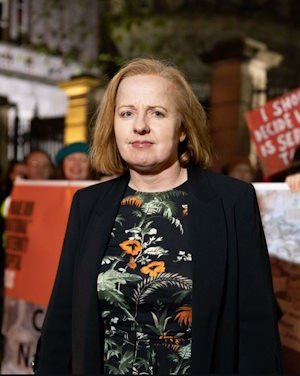
Solidarity TD Ruth Coppinger has said that Sinn Féin are “out of touch” with its own base.
The Dublin West TD was speaking in the Dáil on Thursday evening after People Before Profit TD Paul Murphy proposed a ban on hare coursing.
Coppinger, who has criticised a “drift to the right” on social issues by Sinn Féin under the leadership of Mary Lou McDonald, reaffirmed her stance during the Dáil debate.
Despite the Dublin Central by-election being decided on Green transfers, resulting in Daniel Ennis and the Social Democrats winning over Janice Boylan and Sinn Féin, the main opposition party appears to have not heard concerns from voters that the party are too conservative on social issues.
The most recent Sunday Business Post poll has shown little change in Sinn Féin’s polling since the 2024 general election, and has put the Social Democrats within the margin of error range with Fianna Fáil, as the Soc Dems continue to scoop up socially progressive voters who voted for Sinn Féin in 2020.
While the government parties announced they will not be supporting the People Before Profit bill, Sinn Féin’s decision to vote alongside the government parties recalls the party’s stance on fox hunting.
In late 2025, People Before Profit introduced a similar piece of legislation that would ban fox hunting.
On that occasion, Sinn Féin voted alongside the government parties.
In May, the party came in for fierce criticism from its socially progressive flank after the party abstained on a Soc Dems motion to lift the mandatory three-day wait on abortion.
Sinn Féin did pass a watered-down version of the legislation in June, but not before the May abstention on the abortion vote caused major damage in the Dublin Central by-election.
The decision to back the government parties on a proposed ban on hare coursing is the latest wedge between the largest opposition parties and their would-be coalition partners on the left.
Coppinger said, “Fianna Fáil and Fine Gael have for far too long stood over these really bad animal rights practices; I cannot believe Sinn Féin is coming back again with exactly the same arguments recycled from a few months ago in relation to fox hunting.”
She remarked, “they are probably word for word: regulated, set up a commission. This is completely out of touch with the population and its base.”
The Solidarity TD said that Sinn Féin “had a debate on fox hunting and this is exactly the same. It is a blood sport, and I do not understand how anyone would stand over it.”
“It does not augur well for what Sinn Féin would do in government if it is not willing to move on these issues in opposition,” she said.
The likely Sinn Féin explanation (or excuse, depending on your interpretation), is that the matter has not been voted on at the Sinn Féin Ard Fhéis, and under party rules, decisions made by party TDs cannot be acted on without a vote from members.
In any case, Coppinger said that hare coursing is a “blood sport” and said, “I do not understand how anyone would stand over it.”
Coppinger claimed there was little public support for hare coursing among the general public.
Fianna Fáil TD Niall Collins claimed, much like the fox-hunting debate, that regulating the practice would drive demand underground.
Coppinger questioned this, citing a study by The Journal which found that while there were 200 coursing events in Ireland between 2019 and 2024, there were just four inspectors.
“Hares can be held for 12 weeks before being released to be chased by dogs. They are not on their own but are in with many other animals, which is against their nature. The NSPCA is supporting this Bill and asking TDs to be allowed to vote for this Bill. It is asking for a free vote,” she said,
“The hare does not know that the greyhound is muzzled. It does not make any difference. They are running for their lives in terror. They can still have damage done to them, including injuries and so on. The fact that the hare is protected but licences are given to capture it and treat it in this way is beyond belief.”
She further noted that Britain banned hare coursing in 1914, while the practice is still legal in Ireland.
Fellow Dublin West TD Roderic O’Gorman backed the ban.
The Green Party leader and TD noted “unfortunately, for progress to be made and for laws to be changed, we need a majority across this House.”
O’Gorman recalled his time in government, saying he was “in the room” when animal welfare issues were raised, and said, “our party was not able to change the minds of the two other coalition parties at that time.”
He noted that the government are looking to push forward legislation on banning puppy farms, but he says that the government can and should be doing more on animal rights issues.
“The challenge here is that the larger parties in this House are not where the people are at; I welcome the recent decision of the membership of Sinn Féin to change party policy in respect of fox hunting,” he said.
O’Gorman noted that the muzzling of coursing greyhounds was introduced in 1993, with the legislation brought in for the coursing meets themselves.
“It is not done for training, of course – there is no law around that – but I do not believe the introduction of muzzling justifies this blood sport. I do not believe you can muzzle cruelty.”
“While the coursing itself may no longer result in a live hare being torn apart, we still have to consider the trauma a hare experiences in terms of its capture, a wild animal being held in captivity for a period of time, the trauma of release from captivity if it survives the coursing meet, but most significantly the trauma that comes from violent exposure to two far larger animals, even if they are muzzled, and all of the risks that creates.”
O’Gorman said, “we know the Irish hare faces a variety of threats. It faces threats from hunting, probably most significantly from the destruction of a large amount of its habitat, from infectious diseases such as rabbit haemorrhagic disease and European brown hare syndrome, and it faces competition from other species as well.”
“I and my party do not believe the trauma caused by this practice, even in the muzzled context, is justified. I think Ireland should adopt the change, the evolution in thinking on this matter, that has been seen in many other countries,” he said.
“The introduction of the muzzle in 1993 was a reflection of the fact that the Irish people no longer believed it was morally justifiable for a live hare to be torn apart at the end of a coursing. In terms of their opposition, the Irish people’s views on hare coursing have changed, evolved and have become more trenchant. The vote on this matter will demonstrate a House that is out of step with where the Irish people stand.”
People Before Profit TD Paul Murphy noted, “Sinn Féin needs to stand up and make the right decision, which is to ban hare coursing here, just as it is already banned in the North.”
“There should be no more partitionism on this. Hare coursing in this country is a legacy of British colonialism introduced here by the British Army.”
“The supporters of hare coursing may prove to be a majority in this House but they are a tiny minority of the population; it speaks to how out of touch this place is with public opinion,” he said.
“What is happening here is the same thing that has happened with fox hunting. A well-connected minority that wants bloodsports to continue, that enjoys making animals suffer and making money out of it, is the tail that is wagging the dog, and the result is all sorts of spurious arguments that we will hear.”
O’Gorman said that Murphy’s legislation has no chance of passing the Dáil, owing to the government majority as well as Sinn Féin voting alongside the government parties on the issue.
From the government side, Fianna Fáil TD Niall Collins said “the government fully recognises the strong views on both sides of this debate and policy area, which have been the subject of extensive debate over the years”
The Limerick TD made the economic argument, citing an independent 2022 report which estimated that coursing contributed approximately €70.7 million annually to the Irish economy, the vast majority of which directly benefited rural communities.
€37.9 million of the figure is attributable to the life cycle of the coursing greyhound itself.
“The sector receives no state funding and is entirely self-resourced through club fundraising, membership and voluntary effort,” he noted.
He said “coursing provides a strong social function for rural communities, particularly for older members during winter months. A ban would remove this voluntary activity and community infrastructure without replacing it.”
“We are opposing the Bill. We do not do government by referendum or opinion poll findings,” Collins stated.