


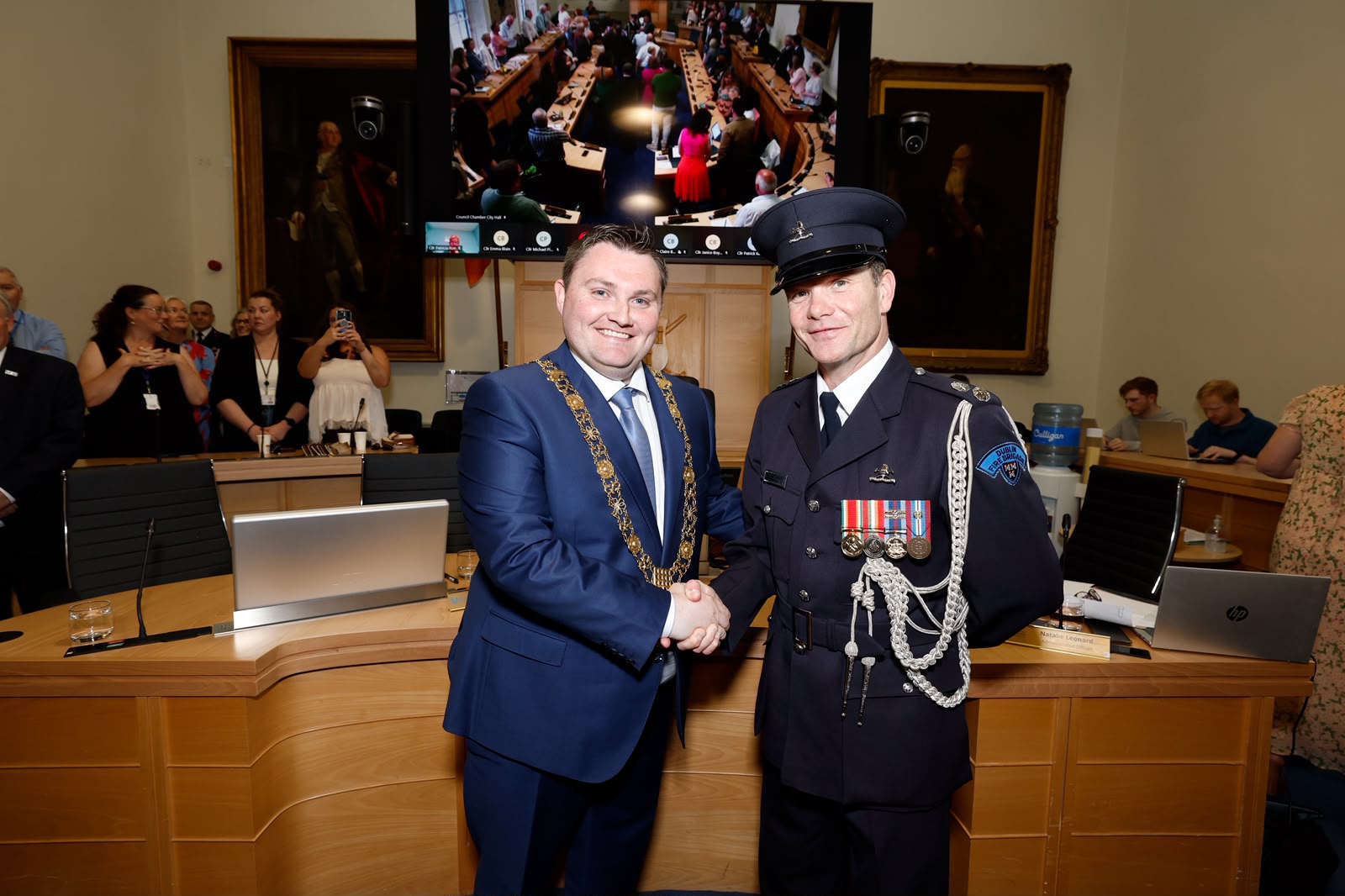
Fianna Fáil councillor Daryl Barron has been officially elected as the 359th Lord Mayor of Dublin.
The Lord Mayor has served as a councillor for Donaghmede since 2019, and will now serve as Lord Mayor of Dublin until June 2027.
Barron succeeds North Inner City Fine Gael councillor Ray McAdam in the role.
The Donaghmede councillor saw off competition from Artane-Whitehall councillor Jesslyn Henry, of the Social Democrats, for the position.
The Fianna Fáil councillor stated “a great capital city cannot survive on potential alone,” and that his term as Lord Mayor would not be one of “passive stewardship.”
He said if Dublin was to truly fulfil its potential as a leading European capital city, it needs to deliver.
“When foundational pillars like security, cleanliness, and housing fracture, civic trust fractures with them,” he told the meeting.
“This year, we restore that trust. By going back to the basics, which underpin our great city, we will put our vibrant communities back on the map.”
Barron said that under his watch, the Mansion House will be an “engine room” of executive action and that “Our Dublin” is his theme for his year as Lord Mayor.
“From the street corners to this council chamber, we will clear the litter, build the homes our people deserve, and ensure public security is treated as a basic essential, not a luxury,” he said.
Barron said that he would also look to introduce a tourist tax, an issue that has received support from local Fianna Fáil TDs and Senators (see page six for more details).
He said that the introduction of a tourist tax would help fund public realm infrastructure, without “overburdening” local businesses.
Since taking office as Minister for Housing in January 2025, Fianna Fáil TD James Browne has come in for criticism from Fianna Fáil and Fine Gael councillors alike for his autocratic tendencies and for not allowing Dublin City Council members to have input on major decisions.
Despite mood music from Micheál Martin and a commitment in the Programme for Government to possibly bring back municipal or town councils, Minister Browne’s actions have caused tension within the government parties.
Since the Local Government Act of 2014 gutted powers afforded to local democracies (meaning that Ireland now has the dubious distinction of being in the bottom five countries in Europe for local democracy), Ireland has become one of the most centralised forms of government in Europe.
Barron has been a critic of Minister Browne’s approach, telling a Council meeting in May that he has voiced his frustration with the Minister about his tendency to act unilaterally and not give councillors input on major decisions.
To that end, Barron called on the government to give Dublin City Council more funding in October’s Budget.
With a member of Fianna Fáil now serving as Lord Mayor of Ireland’s largest democracy, time will tell if Minister Browne will continue down the same path or raise tensions within his own party.
Government councillors “angry and annoyed” at Minister Browne’s one-man war on DCC
McAdam, just before handing over the chains to Barron, said that his year as Lord Mayor reminded him that “Dublin is not made great by stone, buildings, streets or ceremonies alone; Dublin is made great by Dubliners.”
The Fine Gael councillor said that “Dublin is made great by the people who volunteer quietly.”
He added, “it has been the honour of my life to serve this city and to champion and celebrate Dublin.”
McAdam said that Dublin City Council has made decent progress on tackling dereliction during his time as Lord Mayor, and Barron said he would pick up from where McAdam left off.
The new Lord Mayor said that a new Special Purpose Vehicle will be established in September, with the aim of “aggressively targeting, acquiring, and remediating vacant urban properties, while doubling down on the direct building of affordable housing on council sites.”
The Fianna Fáil councillor said he was committed to a “safer and cleaner capital,” tackling dereliction and the housing crisis, and “empowering youth and honouring communities.”
Barron said he would deploy an ambitious ‘Cleaner Dublin Initiative’ with expanded direct labour staff and dedicated community wardens, alongside a formal partnership with Gardaí to rapidly expand town-centre policing and establish a dedicated transport police unit.
The new Lord Mayor said he would also launch the “Lord Mayor’s Community Leader Awards” across every electoral area of Dublin City Council to recognise grassroots sports and volunteer organisations.
Barron was backed for the Lord Mayor role by Pembroke councillor Rory Hogan.
The Fianna Fáil councillor said that the role of Lord Mayor “helps bring people together at a time when that is easier said than done.”
“When we elect a Lord Mayor, we’re not simply choosing someone to occupy the position for a year, for the year, we are choosing someone to represent Dublin in all its complexion and diversity,” he said.
“For me, that’s why supporting Daryl Barron is an easy decision; I’ve known Daryl for close to 10 years, and in politics that’s long enough to see how someone reacts when things are difficult and when the spotlight isn’t on them,” and highlighted Barron’s “consistency” as a councillor.
“He shows up, he listens, and he does the work.”
Labour councillor Alison Field will serve as Deputy Lord Mayor, seeing off competition from Sinn Féin councillor Edel Moran.
Field was first elected to Dublin City Council in June 2024, and is a councillor for the Clontarf area.
The Clontarf councillor was nominated for Deputy Lord Mayor by Southside colleague Fiona Connelly.
“Politics is way better off because people like Ali choose to be part of it,” she said.
“When families are being failed by the system, she has stood by them and has taken petitions to the European Parliament, making sure their voices are heard.”
The Labour councillor said that Field “looks for common ground” and works across communities.
“Politics is about bringing people together, and she does that every single day.”
Prior to the vote, Labour and the Greens were invited by Sinn Féin and the Social Democrats to walk from their coalition with Fianna Fáil and Fine Gael, which was formed in the wake of the 2024 local elections.
Following Labour walking from a similar coalition on Fingal County Council and the Greens helping Daniel Ennis win the Dublin Central by-election in May, there were hopes that the much-mooted Progressive Alliance would be able to take control of Dublin City Council.
Social Democrats councillor Jesslyn Henry was backed by the left-wing alliance on Dublin City Council, which consists of Sinn Féin, the Social Democrats, People Before Profit, and various left-wing independents.
Henry’s nomination for Lord Mayor came on the same day that her Artane-Whitehall colleague Aishling Silke left the Soc Dems to sit as an independent.
Regardless, Ballymun-Finglas councillor Leslie Kane backed Henry for Lord Mayor, citing her work as a special needs assistant and consistent highlighting of the role that SNAs play in modern Irish society.
Kane said that Henry “works tirelessly” for her constituents, and her advocacy for autism awareness led to Dublin City Hall being designated as autism-friendly.
In the vote, Barron won by 31 votes to Henry’s 21, and Field beat Sinn Féin councillor Edel Moran to the position of Deputy Lord Mayor by 32 votes to 24, with four abstentions.
Sinn Féin’s leader on Dublin City Council, Daithí Doolan, said “it is hugely important that we challenge the ruling group in Dublin City Council led by Fianna Fáil and Fine Gael.”
“The Progressive Alliance has worked as a cohesive alternative to the politics of these governments’ apologists. They have absolutely failed to stand up for families and communities in Dublin. They continue to be the mudguard for failed government policies.
He said that the Progressive Alliance are “committed to standing up for Dublin and for reversing the increase in council rents.”
The controversial rent increases, which became an issue on the doorsteps in the recent Dublin Central by-election, continue to be a stick that the opposition parties are happy to beat the government parties with.
“These increases not only affect council tenants, but they also hit HAP, RAS and tenants in approved housing bodies as well. These rent increases are putting pressure on already struggling families.”
“Council tenants are in poorly insulated homes requiring urgent upgrades and maintenance. While HAP and RAS tenants remained trapped in the precarious private rental market, facing evictions at any time. Demanding extra rent is unfair and will continue to be opposed,” he said.