


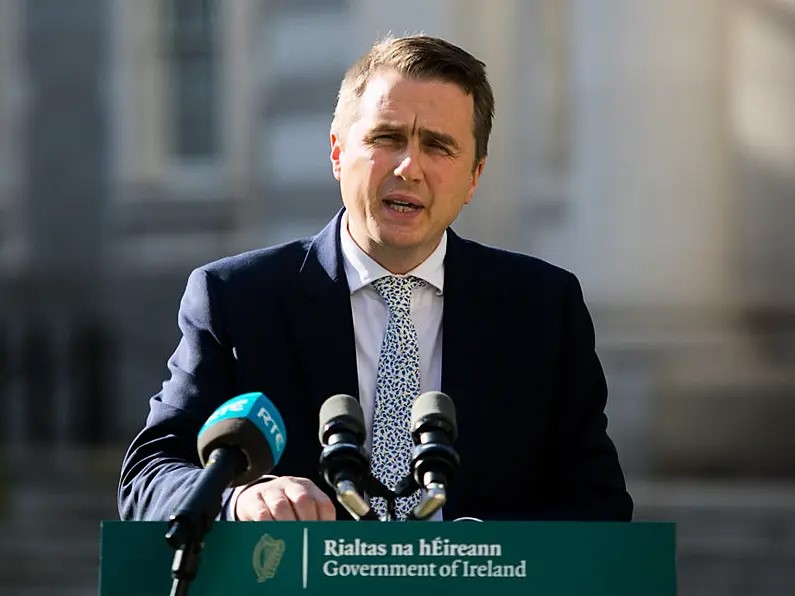
Dublin City Council members from both government and opposition parties have criticised the behaviour of Minister for Housing James Browne and how he is treating Ireland’s largest local democracy.
In a number of incidents since taking office in January 2025, the Fianna Fáil Minister has repeatedly acted in a unilateral fashion and has made decisions on housing without consulting Dublin City Council and its 63 members.
At this week’s meeting of Dublin City Council, held in the wake of the government pulling the plug on a long-promised regeneration project at the Oliver Bond complex, councillors from both government and opposition parties made their feelings known about the Minister’s lack of communication.
A motion, put forward by government and opposition councillors, criticised that Minister Browne, yet again, made a decision about a major housing project, that Dublin City Council usually had a say in, without councillors being consulted.
In May 2025, Minister Browne controversially pulled the plug on 250 social housing units in Ballymun; that action isn’t newsworthy in of itself, but councillors said they had to find out about the cancellation through the media as they were not consulted.
A year later, and the same issue has raised its head; a promised project for a dilapidated area of the city is promised by the previous government, a new Minister is appointed, and local residents are the ones left to pick up the pieces.
Fianna Fáil councillor Ammar Ali, a councillor for the South-West Inner City constituency, said the situation reflects badly on the party.
“I just cannot say sorry because I am in the government. The way people are being treated in the inner city is appalling. There are no community centres, and there are no pitches.”
Ali said he was going to “put his party politics aside,” and said he “cannot accept the decision” made by his party colleagues.
“These are people who are living in such difficult conditions. If I am going out to buy a house, I will never buy a house that has mould or overcrowding. Can any of you live in the houses that people in the inner city live in?”
Fianna Fáil’s leader on Dublin City Council, Donaghmede councillor Daryl Barron, was more critical about his party.
“When I heard the news last week, I made contact with the Department to air my grievances; you’ve heard the bona fides of the residents, and you can hear it across the chamber. They have been let down.”
The Donaghmede councillor said he was in contact with both Minister Browne and the Taoiseach about his “displeasure.”
“It’s not good enough and it’s not acceptable that parts of the city are being left behind. When I go into the Department, I go in wearing my Dublin City Council badge, regardless of party affiliation. It’s important that across the chamber, we 63 councillors go in to bat for this city.”
Fine Gael councillor Colm O’Rourke said the whole affair undermines people’s trust in local democracy.
The Cabra-Glasnevin councillor said Fine Gael councillors are “angry and annoyed,” about the issue, and that local residents have not been engaged with “in good faith.”
“It’s not good for local democracy if this kind of thing is happening too often, residents being engaged with, told one thing is going to happen, then it doesn’t happen. It will get to a stage where people won’t engage at all,” he warned.
Labour councillor Dermot Lacey was clearly furious in his contribution, with the Pembroke councillor saying “I’ve heard a lot of contributions in this chamber saying they are disappointed. I’m not disappointed, I am angry and I am furious.”
Lacey criticised what he called the “sheer arrogance” of civil servants in the Department of Housing for “depriving people in these areas of a future.”
“The reality in this country is that the Secretary General of the Department is the boss and who calls the boss, and we have a lame duck Minister who is afraid to stand up to the officials in his Department,” he said.
The Pembroke councillor said that the Department of Housing is “dysfunctional” and “anti-democratic,” saying it is “actively destroying the lives of people in this city.”
Sinn Féin councillor Micheál Mac Donncha said that in his 15 years as a councillor, he had “never seen a situation like it.”
He said that his time as a councillor has seen Dublin City Council hand down a number of decisions from central government, but the backtracking on the Oliver Bond project is the most “disgraceful” of them all.
The Donaghmede councillor said that “the buck stops” with the Minister for Housing, calling it a “scandal and a disgrace,” that residents of the Oliver Bond complex were “given hope” that improvements would be made, with Michéal Martin visiting the complex in September 2020, only for the government to make a u-turn.
“We boast about being a great European capital, and we have people living in these conditions. I don’t want to hear about a report saying ‘oh, we will look at Plan B or Plan C,’ this must be reversed. We must stand united as a council and a community to get this reversed,” he said.
Social Democrats councillor Lesley Byrne, who is a councillor for the South-West Inner City constituency, noted that the Department’s cold language was of major annoyance to local residents.
“We keep hearing about units, numbers on a page, targets to be met, but the people in Oliver Bond are not units. We are not going home from this meeting tonight and saying we are going home to our units. These are people who live in houses.”
She said that residents were living in the area with the hope and promise from the government that the conditions in the complex would be fixed, only to have the rug pulled out from under them.
“The regeneration plans offered hope that long-standing communities could remain together while finally receiving the standard of housing they deserve. It’s the hope that kills you, feels very appropriate now,” she remarked.
Green councillor Michael Pidgeon recalled former Sinn Féin councillor Críona Ní Dhálaigh, who served on the council from 2006 to 2020, and Pidgeon said “one of the reasons she gave for standing down was that she was sick of saying no to people.”
“When the Oliver Bond decision came in, you really feel it; you are putting in time and effort that isn’t going anywhere, and I felt the most for people who put in the regeneration form.”
The South-West Inner City councillor said “the problem is no one making this decision has any knowledge of inner city flat complexes; I say that as someone from one of the posher suburbs. No one in the decision-making process has any experience representing those areas, so they don’t get it.”