


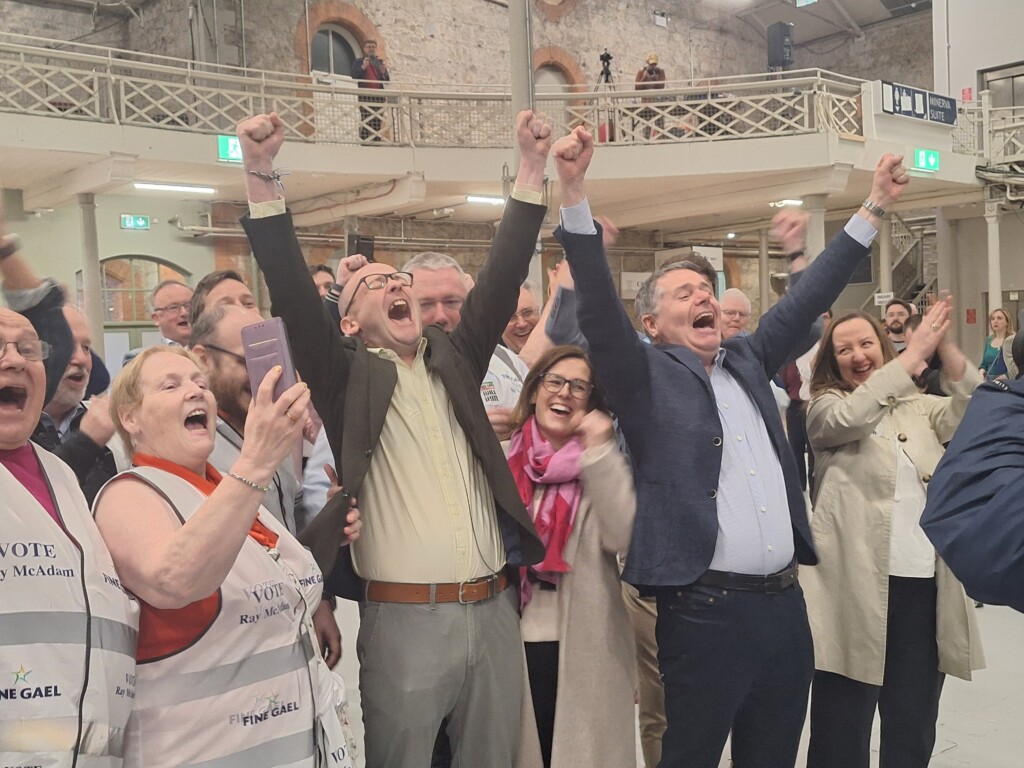
The resignation of Paschal Donohoe has triggered a by-election in Dublin Central.
Donohoe has vacated the Dáil seat he has held since 2011, and the race to replace him is already underway in some quarters.
By-elections are usually high stakes, but the stakes are especially pronounced for both government and opposition alike.
In the case of Fine Gael, they have lost a proven vote-winner who has demonstrated a clear ability to win votes not just from his own party, but from parties across the spectrum.
For Fianna Fáil, they are itching to win a seat they haven’t won since 2011.
For the opposition, the stakes are potentially make-or-break; the dream of a unified left will face its first test in the backyard of the would-be Taoiseach.
As soon as Donohoe announced his resignation, the rumour mill quickly identified incumbent Lord Mayor Ray McAdam as his potential replacement.
McAdam, a councillor for the North Inner City constituency (which has 1:1 overlap with Dublin Central at a local level), has served the area since 2009.
McAdam, notably, worked as a staff member for Donohoe following his election to the Seanad in 2007, and continued his work with Donohoe following his election to the Dáil in 2011.
Paying tribute to the Phibsborough man, who has taken up a position with the World Bank, McAdam spoke of the “genuine partnership” he had with Donohoe; it would be foolish to bet against McAdam being the name on the ballot for Fine Gael whenever the election comes.
McAdam has been serving as the Lord Mayor of Dublin since June, and like Donohoe, reflects the more centrist wing of the party.
McAdam is only too aware of the prestige that comes with being the Lord Mayor of Dublin; Dublin Bay South TD James Geoghegan went from the Mansion House to the Dáil last November, getting elected to the Dáil while still serving as Lord Mayor.
The Dublin Central by-election will likely take place on the same day as the by-election in Galway West, to replace Catherine Connolly’s now-vacant Dáil seat, meaning that the eyes of political geeks won’t just be focused on Dublin like the 2021 by-election in Dublin Bay South.
At a local level, Fine Gael are in a healthy spot; in the two constituencies that make up Dublin Central, North Inner City and Cabra-Glasnevin, the party is in good health, with McAdam topping the poll in June’s 2024 dogfight in North Inner City, and the party winning two seats in Cabra-Glasnevin in the form of Colm O’Rourke and Gayle Ralph.
In last November’s general election, Donohoe himself notably picked up the most votes, securing 8069 overall, more than Mary Lou McDonald’s 7388 (that’s with the caveat that her running mate, Janice Boylan, picked up 1295 votes before being eliminated on the second count).
Fianna Fáil has run Senator Mary Fitzpatrick in five general elections, stretching all the way back to 2007; a sixth tilt at the Dáil can’t be ruled out, as she’s the most high-profile Fianna Fáiler in the area (Cabra-Glasnevin councillor John Stephens only won his seat in the June 2024 locals, with the party flatlining in North Inner City).
Sinn Féin will have the first bite of the apple and position themselves as the leader of a theoretical combined opposition, and will claim the right to field a candidate that the left will, in theory, rally behind.
Dublin Central was the sight of a landslide victory for Catherine Connolly in October’s presidential election, with the Galwegian securing 74.3% of the vote.
The four-seater has three TDs from the opposition (McDonald, Social Democrats TD Gary Gannon and Labour TD Marie Sherlock), so securing an extra seat here would be a death blow to the government.
Candidates and parties to the left of Sinn Féin, the Soc Dems and Labour fared relatively well in the seat last year.
Former TD and MEP Clare Daly’s unsuccessful independent bid last year, along with People Before Profit, still managed to secure 8.5% of the vote between them.
With that said, it would be unheard of for a constituency, on the Northside, to be represented by all TDs from the left of centre.
Dublin South Central did pull off that trick in the 2011 and 2020 general elections, but replicating the feat in Dublin Central would be tricky.
In the run-up and aftermath of the Presidential election, talk of a combined left-wing opposition fighting the next election led to feverish speculation among party supporters and, indeed, the press.
The Irish Independent played some fantasy football and imagined what a hypothetical cabinet of the left would look like; if that article is to come to fruition, it needs to pass the crucial test of co-operation in Mary Lou McDonald’s stomping ground.
Councillor Janice Boylan was brought in as McDonald’s running mate last year, after McDonald’s 2020 vote revealed she could have gotten a running mate elected.
That did not transpire last year.
However, Boylan is a councillor for the North Inner City constituency, and much like McAdam, has been a long-term servant to the community; she was first elected to Dublin City Council in 2014.
If Sinn Féin wanted pazzazz and wanted to bring star power to the race, however, they could draft in another Boylan; namely, MEP Lynn.
Boylan was Sinn Féin’s candidate in the 2021 by-election in Dublin Bay South, which, of course, was won by future Labour leader Ivana Bacik.
Boylan’s re-election to Europe in 2024 was one of the rare bright spots on a torrid day for Sinn Féin at the last local and European elections, and having a serving MEP go up against the incumbent Lord Mayor is the kind of title fight that would capture the public imagination.
The 2024 locals were a debacle for Sinn Féin; three candidates in North Inner City and four in Cabra-Glasnevin saw just two councillors elected.
In fact, the Social Democrats had a better set of locals than Sinn Féin; the party ran just three candidates, compared to Sinn Féin’s seven, and got two elected (Cat O’Driscoll and Daniel Ennis, and narrowly missing out on a second seat in the North Inner City).
The path to victory in Dublin Central will come in the form of the progressive block: Social Democrats, Labour, and the Greens.
Their combined vote in November 2024 came to 26.8%, compared to Sinn Féin’s 23.3%; Sinn Féin needs the progressive vote more than the progressive vote needs Sinn Féin.
Green TD Neasa Hourigan, widely seen as being on the party’s left, lost her seat last November, which was a clear sign that the party saw wholesale rejection by the electorate.
Despite her and fellow rebel Patrick Costello being suspended and having the party whip taken away from them during the last Green stint in government, her leftist chops weren’t enough to keep her seat, with her vote dropping by 6.3%.
Hourigan’s slump in polling saw Gary Gannon pick up 4% more than what he got in 2020, while Marie Sherlock did well enough in terms of first preferences (a 2% improvement from Labour’s 2020 performance) that she was able to benefit from Fine Gael and Green transfers to get over the line.
The Northside is the one area where the Greens are still relatively healthy; Feljin Jose topped the poll in Cabra-Glasnevin in June 2024, while Janet Horner put in a strong performance in North Inner City, building on Ciaran Cuffe’s poll-topping performance in 2019.
Hourigan herself has ruled herself out of the running for the by-election, and Labour have no elected representatives in either Cabra-Glasnevin or North Inner City.
That means a hypothetical left candidate is likely to come from either Sinn Féin or the Social Democrats.
There is a potential wildcard in the form of independent councillor Cieran Perry; the left just showed relative harmony in backing a leftist independent, perhaps it can happen again?
A councillor’s councillor, Perry has served on Dublin City Council since 2009, as an independent for Cabra-Glasnevin.
While Jose topped the poll in Cabra-Glasnevin, it was Perry who received the most votes last June.
Perry has been a consistent left-wing voice on Dublin City Council since 2009, and was willing to be one of the independent councillors to work with Sinn Féin, Soc Dems, Green, Labour and PBP’s failed Progressive Alliance in the aftermath of the June 2024 elections.
Perry has appeared on the Dáil ballot three times before (2007, 2011 and 2016), with his best result coming in 2016 with 5.2% of the vote.
Dublin Central has a strong history of voting for independents, from the Tony Gregory and Maureen O’Sullivan eras and the long-serving Nial Ring and Christy Burke representing the North Inner City.
The performance of Gerry Hutch in the 2024 general election – and the media furore it caused – showed that Ireland isn’t as immune to populism as it claims to be.
Indeed, the media giving Hutch breathless, free coverage demonstrated that for all the chest-bumping that a Trump-style populist could never gain traction in Ireland, last November proved that the media is more than happy to facilitate a populist if it means it’s good for clicks and sales.
Hutch’s performance – 9.5% of first preferences – and the presence of Malacahy Steenson as a councillor at a local level show a not-insignificant presence for anti-establishment and anti-government (and anti-opposition) vote in the constituency.
Whether those same people turn out to vote in a by-election would merely be a guessing game at this stage.
There is no set date for the by-elections just yet, but they must be held within the next six months under Irish electoral law.
The next few weeks will be crucial in determining if the government will be able to hold onto a relative stronghold in the city centre and if the opposition can finally move forward as one.