
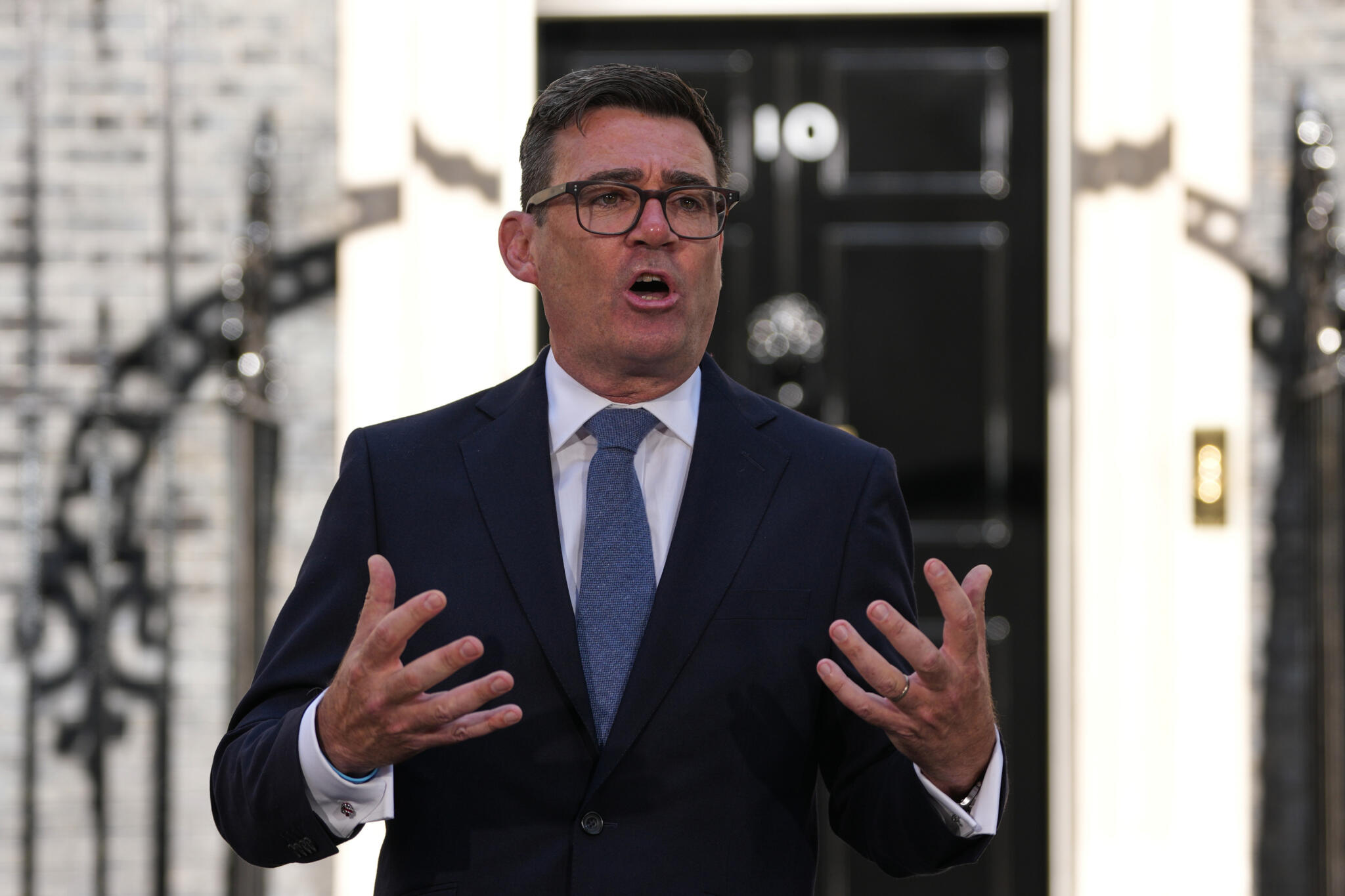
Our neighbours across the sea are now living under their 7th Prime Minister in a decade.
Andy Burnham is the latest person to occupy 10 Downing Street, and his big gamble is his patented brand of “Manchesterism.”
Burnham has any number of issues to deal with, but he is staking it all on his brand of politics known as Manchesterism.
Burnham was elected as Mayor of Greater Manchester in 2017, and was afforded a wide range of powers such as control over housing, waste management, policing, and most notably, transport.
Under Burnham’s tenure, Manchester’s public transport (buses, trams and active travel) was all merged into a system called the Bee Network, which offered cheap, frequent, well-maintained public transport.
The ace in the hole is a £5 ticket for 1-day unlimited bus travel anywhere within the Manchester region, and in the city centre itself, buses are free of charge.
The powers afforded to Burnham came about as a result of George Osborne, regarded by some as the second coming of Thatcherite economics, deciding to delegate more power away from London and putting it into the hands of a directly elected mayor of Manchester.
George Osborne’s legacy is complicated; economists argue that his “starve the beast” economic mantra worsened the recession and Britain’s economic output for a decade, but his reforms in affording more powers to local authorities across the UK can’t be overlooked.
At the same time George Osborne gave Manchester greater control over its political destiny in 2013, Ireland was gearing up to cut its local government to shreds.
As part of austerity measures, then-Minister Phil Hogan came to the government with the Local Government Act of 2014, legislation which abolished town and urban councils, and resulted in more powers being centralised within central government.
As a result of the measure, Ireland found itself alongside the likes of Moldova, Hungary and Russia in the bottom five countries in Europe for least
In late 2023 and 2024, this publication carried out a number of interviews with prominent Dublin politicians on how they can fix local democracy.
From the government side, Fianna Fáil TD Paul McAuliffe noted that Fianna Fáil were actually against the Local Government Act, and that Ireland as a whole is “poorer for it” as a result of local democracy being weakened.
Speaking to this publication in 2023, the Dublin North-West TD stated “I think it’s somewhat absurd that part-time councillors are expected to run cities.”
McAuliffe proposed that the size of Dublin City Council be reduced, but in exchange, elected representatives are granted more power, in line with council members in the United Kingdom.
As part of the coalition agreement drawn up between Fianna Fáil and Fine Gael (and independents) in January 2025, the coalition agreed to look into potentially bringing back municipal or town councils, with Taoiseach Micheál Martin going on the record, on numerous occasions, about his desire to restore local democracy in Ireland.
From the opposition benches, Social Democrats TD Cian O’Callaghan told this publication in January 2024, “when I speak to people on doorsteps, there is a genuine sense of frustration that local government is so weak here.”
“There is a real gap when it comes to transport or housing. When you compare us to other European countries, we have our hands tied behind our backs.”
O’Callaghan was the Social Democrats spokesperson on housing and local government at the time, and said that Ireland should be looking elsewhere across Europe for inspiration on how to restore local democracy.
The Dublin Bay North TD noted that restoring local democracy wasn’t like “flicking a switch,” but said that it could be a matter of “building it back up.”
Prior to the Dáil breaking up for the summer recess, Labour TD Marie Sherlock noted that there is “frustration and anger” among her constituents in Dublin Central about waste collection being in the hands of private operators and not local government, as used to be the case.
Just this week, a decision by the government, which gave the Land Development Agency more powers at the expense of local councils, was criticised by Sinn Féin councillor Daithí Doolan.
As part of the government changes, up to 30% of homes delivered by the Land Development Agency on state-owned land are to be sold on the private market.
The Sinn Féin leader on Dublin City Council said the plan “totally flies in the face of what is really needed in Dublin.”
“This clearly shows just how out of touch this government really is when it comes to meeting the needs of Dublin. This proves yet again we urgently need a government that works with us, not against us,” the Ballyfermot-Drimnagh councillor said.
Doolan’s comments about the government working against Dublin City Council is shared by many Dublin City Council members, government and opposition alike.
Government councillors “angry and annoyed” at Minister Browne’s one-man war on DCC
Since becoming Minister for Housing in January 2025, Fianna Fáil TD James Browne has taken advantage of Ireland’s planning and local government system being hyper-centralised.
Sinn Féin TD Eoin Ó’Broin has hit out at what he dubbed “bullyboy” tactics from Browne, and has criticised Browne on numerous occasions for not allowing Dublin City Council members the chance to vote on certain housing developments.
“These changes to the Land Development Agency need to be blocked. If the government are allowed to proceed, they will only serve to deepen the housing crisis in Dublin and other cities and towns.”
Which brings us back to Manchesterism.
Part of Burnham’s big pitch to fix the Not-So-United Kingdom is taking control out of London and delegating more powers to the cities.
Burnham’s plan to largely operate out of Manchester and create a “Number 10 Of The North” has caused a stir in the British media, but Burnham’s argument is that in the face of Nigel Farage, the government needs to be seen working for people and not hiding away in Victorian-era rooms in London.
For Burnham, he needs to be seen working outside the London bubble and working for communities that never quite recovered for Thatcherism, lest the populist forces of Nigel Farage exploit the vacuum.
On Tuesday, the Local Democracy Taskforce, which operates under the Department of Housing umbrella, published a report which recommended that “hyperlocal” forms of politics return to Ireland.
Chief among the recommendations were the partial re-establishment of town councils.
While the report noted that bringing back town councils wholesale would be a “retroregressive” step, it could go some way to restoring trust between the people and their government.
The report stated, “there needs to be a renewed focus on towns as key drivers of activity and service provision for the citizens in their municipal district areas.”
Municipal councils were suggested as a potential way of beefing up Ireland’s weak local government; crucially, municipal council members would not be directly elected, but instead existing councillors would be granted more powers (and more money) to solve hyper-local issues.
The report read “the structure ensures that councillors make decisions on local matters at municipal level, and continue to decide on wider strategic county-wide issues at plenary level.”
When the Local Government Act was introduced in 2014, the population of Balbriggan stood at 21,000, and the area had eight councillors representing them.
In 2026, the population of Balbriggan is estimated at over 26,000, yet just five councillors represent them.
That isn’t to say that Dublin having a directly elected mayor would suddenly make the deficiencies in local democracy go away; John Moran’s tenure as Mayor of Limerick can be best described as Kafka-esque as Fianna Fáil and Fine Gael councillors have done everything within their power to stop the independent mayor from getting any work done.
However, the current alternative isn’t representative of what should be a democracy.
Just like in art, nostalgia can be a potent force in politics.
There is a sense among older Dubliners (who still call Dublin City Council the “Corpo”) that politics used to work for them, but now it doesn’t.
In the absence of robust local democracy, cynicism creeps in, and cynicism breeds contempt.
Restoring Ireland’s local democracy to what it once was might run into the tens of millions of Euro, but you can’t put a price on happy citizens.
It remains to be seen what powers, if any, Burnham will delegate to the various councils in the North of Ireland, but it could prove to be important fieldwork for Ireland’s local democracies.
If Irish citizens see Belfast has a directly-elected mayor with the power to make decisions on housing, transport and health, they might want a piece of the action.