


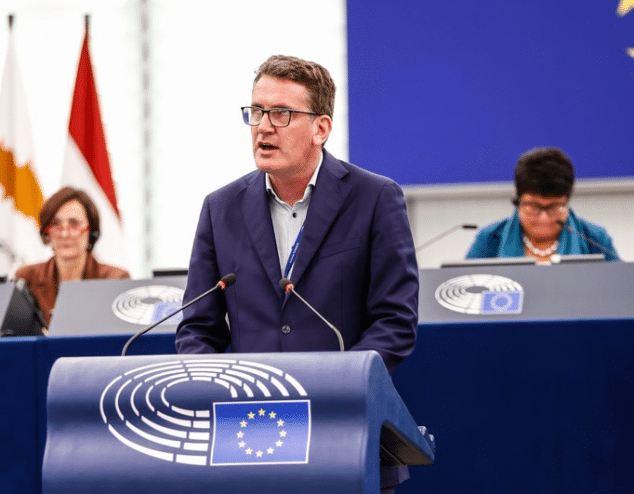
Halfway through an interview with Labour MEP Aodhán Ó Ríordáin, someone asks to borrow a chair at our table.
There are four chairs at the table, and only two are in use.
Ó Ríordáin is mid-flow on how and why Europe can deliver for housing, when he makes a hand gesture to the chair wanter that they can take the chair, but his focus is on answering our question.
Always good for a quote, the Northsider was in rare form as he sipped a coffee, and we nursed a fizzy drink.
We break the ice by remarking that Strasbourg itself has a mix of half-French and half-German influence.
“Jesus, don’t let them hear you say that,” he jokes.
Ireland’s MEPs are in town (and on their best behaviour), because Taoiseach Micheál Martin is paying a visit, setting out Ireland’s ambitions for the Presidency of the European Union.
Ó Ríordáin said that “housing, housing, housing” is his mission statement as an MEP, and that the government should avail of EU support to help end the homelessness crisis.
When Labour left government in May 2016, there were 2,767 adults in homeless accommodation in Dublin.
The most recent figure for Dublin stands at 12,370.
Prior to the EU Presidency beginning, a number of MEPs visited Dublin to get a sense of why a supposedly modern European capital has such a problem with homelessness.
Ó Ríordáin opted to bring Socialists and Democrats colleague Iratxe García to Gardiner Street so she could get a sense of how bad things really are.
It is estimated that 10% of Ireland’s overall homeless population is on that particular Dublin 1 street.
“When I was a TD, we would hear about children doing their homework on the floor; now they are doing their homework on fire escapes,” Ó Ríordáin said.
It would have been lazy from a journalistic perspective to get Ó Ríordáin to talk about why the Irish left can’t work together, and that is something we have been guilty of in the past.
Instead, the question became “what can Irish progressives learn from other progressive parties?”
The success of Zohran Mamdani as Mayor of New York City has given progressives a new ideological role model to look up to.
Mamdani has carried on with the American left tradition of “sewer socialism,” an early 20th-century tradition from the city of Milwaukee.
In the early 1900s, socialists controlled the city council in Milwaukee, and made a huge point of carrying out extensive works, repairs and upgrades to the city’s infrastructure, something that Mamdani has updated for the modern era.
Ó Ríordáin said that Ireland’s progressives can start winning if they “stop talking about the far-right” and start talking about “what we can do better.”
“We need to get better organised, and tell people about what we can do better,” he stated.
The government back in Dublin was a nice, juicy target for Ó Ríordáin to take aim at.
His analysis of the government was cutting; he stated that the Fianna Fáil/Fine Gael/independent government are “killing Dublin.”
He said that the passing of the controversial Mercosur deal and the €505 million payoff to end the fuel protests in April are examples of the government being captured by special interests.
“There is no vision and no mission from this government,” he stated.
This gap at the heart of government, Ó Ríordáin argues, should be something that progressive parties exploit.
As part of the Taoiseach’s visit to Strasbourg, Ó Ríordáin and his colleagues put on an exhibit in the European Parliament documenting how bad the housing crisis has become in the EU.
As part of the exhibit, a Dublin woman named Katherina had her story highlighted.
A single mother of three and diagnosed with cancer, Katherina has had to deal with three evictions in five years.
The exhibit noted that she was days away from forced eviction; when the no-fault ban on eviction was introduced by the Fianna Fáil/Fine Gael/Green government in the winter of 2022, homeless figures dropped, and stories such as Katherina became less prevalent.
Issues like this, Ó Ríordáin insists, are how Europe can become more tangible and more real to the average person.
Asked about the difference between being a TD and an MEP, he said the major difference was that the tone of the emails has changed.
“When I was a TD, I would get complaints from people sitting in their cars, complaining about the state of the local road; now, the tone is a lot different,” he mused.
The Labour MEP also welcomed the somewhat slower pace of life in Strasbourg and Brussels.
He said that as a TD, there is this expectation every April that a general election was going to be called.
“It would be April in Leinster House and you’d see the Fine Gael TDs have a new haircut. Your mind goes ‘oh, they must be getting done up for the posters, which means there’s an election around the corner” – on the European mainland, things are different.
The next European election won’t be held until May or June 2029, and an election cannot be called before that.
The certainty, he said, made for a nice change of pace, and he could really dig into the substance of political issues.
“Over here, I am dealing with politicians who were maybe the Prime Minister of their country or were ministers in their governments,” he noted.
Such is the nature of an MEP, after conducting an interview with this outlet, Ó Ríordáin was on his way to a media briefing with other Irish outlets (where he talked about the intersection of politics and his well-known passion for football), another sit-down interview, and then voting on sanctions targeting Russia.
The strong coffee, ordered at 9.45am, was his fuel for the rest of the day.