


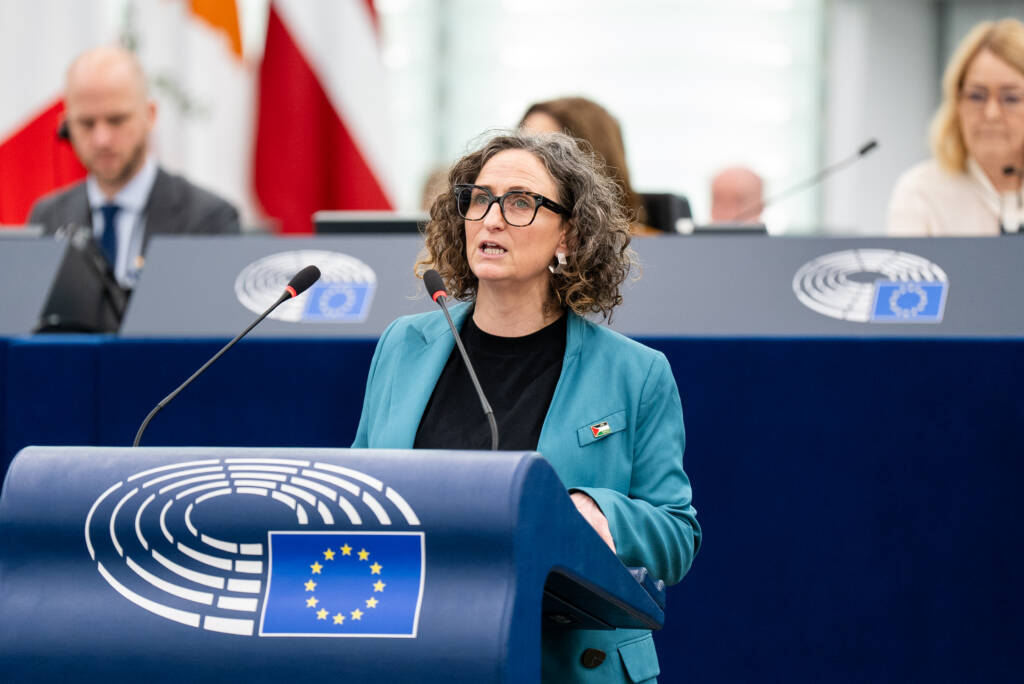
The River Rhine is the second-longest river in Europe, with a meandering path through six different countries.
At over 1,200 km long, the river serves as a backdrop to a sit-down interview with Sinn Féin MEP Lynn Boylan, whose path back to Europe was as twisty and turny as the river itself.
Elected to Europe in 2014 amid a bounce for Sinn Féin and rejection of Labour, Boylan lost her seat in the 2019 “Green Wave”, which saw the Green agenda briefly overtake Sinn Féin’s brand of left populism among the Irish electorate.
By the summer of 2024, the tide was out on the Green movement, and Boylan moved from the Seanad back into Europe.
Two years later, Boylan is back in the thick of it.
Prior to speaking to this publication, Boylan abstained on a vote to ban alumina exports to Russia.
Fianna Fáil MEP Billy Kelleher spoke of certain Irish political parties needing to “get real” in terms of foreign policy and the EU military agenda.
Fine Gael MEP Regina Doherty said, “Russia is not our ally; we should not be helping to strengthen its economy while it continues to inflict pain and suffering on the people of Ukraine.”
To Boylan, statements from government MEPs talking about military policy are red meat.
Boylan has long maintained that Sinn Féin are not Eurosceptical – she prefers to use the term “Euro-Critical.”
The recent ramping up of military spending by the European Union has become Boylan’s cause d’etre as an MEP.
Boylan subscribes to the theory that the European Union is too distant and removed from the everyday lives of normal people.
With Taoiseach Micheál Martin in town to address the European Parliament, Boylan had her doubts about the hubbub surrounding the EU Presidency.
“I think there is a tendency to overplay it,” she stated.
She agreed that Ireland having the Presidency is important “in a sense,” but inferred that the European Union project isn’t something Sinn Féin are jumping up and down about.
“The European Union works best as a peace project,” she explained, and said she was against what she called the “militarisation” of Europe.
“In the past, the EU has worked well to bring peace to areas such as the North,” she noted, and said that a focus of Ireland’s EU Presidency should be opening talks for Northern Ireland to have associate MEPs.
Budget talk was on the lips of many diplomats in the halls of Strasbourg during the week of our visit, and Boylan was concerned that money could be taken out of the EU Cohesion Fund to fund the military.
She said that in the past, the likes of Ballymun benefited from EU funding, with funding from the EU directly going towards social cohesion projects; now, she warns, that money is going towards military spending instead.
This, she explains, helps feed the rise of far-right parties right across Europe, and she criticised those parties for their “deeply disturbing” rhetoric.
During the final EU Parliament vote on the Asylum and Migration Pact in June, far-right MEPs chanted “send them back” as the bill passed with the support of the European People’s Party (Fine Gael’s European grouping) and various right-wing to far-right groupings.
“They are only interested in punching down”, she said of far-right parties.
This week in 2021 saw Boylan stand as Sinn Féin’s candidate in the Dublin Bay South by-election.
On that occasion, Boylan finished third behind eventual winner (and later Labour leader) Ivana Bacik and future Fine Gael TD James Geoghegan.
At that stage in 2021, Sinn Féin were seen as the government in waiting, with polls regularly putting Sinn Féin above the 30%, even 35% mark.
The heady days of 2020, when Sinn Féin ran too few candidates and talked itself out of being the largest party in the Dáil, quickly gave way to the relative stagnation the party now finds itself in.
The question was put to Boylan – have Sinn Féin become too professional, or God forbid, too moderate?
“Well, you can’t win,” she laughed.
Boylan noted that in the party’s more populist era, they had the “magic money tree” line thrown at them; then, when the party submitted fully costed proposals as they sought to govern in the Mary Lou McDonald era, the government implemented Sinn Féin’s policies “arseways.”
We queried which of Sinn Féin’s policies the government implemented “arseways?”
“Reducing childcare costs, for one,” she noted.
The no-fault eviction ban, long called for by Sinn Féin, was briefly implemented in the winter of 2022 and spring of 2023, causing homelessness levels to fall, only for homelessness figures to rise once the ban was lifted.
Boylan also noted that it was Sinn Féin policy in their 2020 manifesto to give renters a €1,500 tax credit and introduce a three-year freeze on rent increases; that was whittled down to a €1,000 tax credit, with nary a rent freeze in sight.
Talk then turned to a topic where Boylan was out ahead of the pack: data centres.
Data centres have become a hot political issue in both the United States and Europe in recent months, but when Boylan was a member of the Seanad, she was among the first Irish politicians to blow the whistle on data centres.
On the day we spoke to Boylan, a statistic from the Central Statistics Office found that 23% of electricity used in Ireland is being used by data centres.
Per Boylan, electricity consumption from data centres has grown every year without exception, doubling between 2015 and 2019 from 1,240 GWh to 2,490 GWh, and tripling between 2019 and 2025, reaching 7,663 GWh.
“They are cannibalising our energy supply,” she said, and said that small businesses were not being considered in the debate.
She questioned the government line that data centres were a key part of the Irish economy.
“Look at Germany; cars and pharmaceuticals are an integral part of their economy. They have been part of local communities for years, and towns have been built up around them. I don’t think the same thing is happening here,” she remarked.
Boylan stated, “the government has to be honest with people.”