


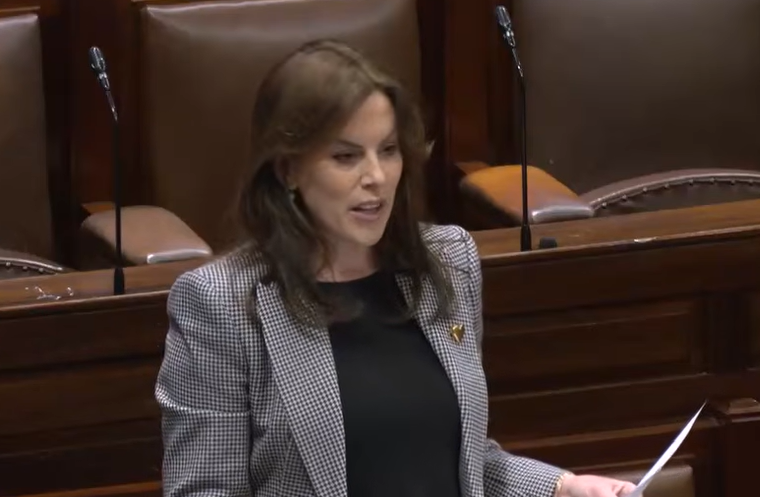
Minister For Health Jennifer Carroll MacNeill has said that Ireland’s healthcare system will face more problems as the country’s population grows.
In the Dáil this week, Sinn Féin brought forward a motion which criticised the government for overseeing chronically high levels of hospital overcrowding across Ireland.
During the debate, the Dáil heard that there has been a 7% increase in people reporting to emergency departments compared to 2025.
For people over 75, the same figure has risen by 9%.
Minister Carroll MacNeill insisted that increasing emergency department capacity was a priority for this government.
“The truth of all of this is that we are experiencing and will experience a much bigger challenge,” the Dún Laoghaire TD said.
“Our population will grow from 5.3 million people to potentially 7 million in 2057. More significantly, the number of people aged 65 will continue to grow rapidly. That is a good thing, but we will have to provide care in different ways.”
“We have to address our current pressures and plan our resources for the future. Yes, we need more resources, but we have to change how care is delivered,” the Minister said.
She further explained that healthcare policy by the previous Minister for Health, Stephen Donnelly, pushed for a “home first” approach to healthcare as opposed to people going to hospital for treatment.
Under the last government, GPs and pharmacies were given more powers to treat patients for minor ailments and injuries, which the government believes will free up spaces in Ireland’s emergency departments.
The Minister did acknowledge there are “very real pressures” facing emergency departments.
“We know what the demand growth means in practice; it means that we have to protect our patients’ dignity and we have to protect patient safety,” she said.
The Minister said that the recent opening of the South Dublin surgical hub at Mount Carmel Community has helped make a dent in local waiting lists.
She told the Dáil that since opening in February 2025 to the end of August 2026, the hub has delivered 8,006 procedures, including 4,275 procedures in 2026 alone.
As a result, it has reduced average waiting times in participating specialities from 8.5 months to 4 months, and reduced the number of long waiters by 63%.
Minister Carroll MacNeill said she is aware of the impact that overcrowding has on patients, families and staff.
“I know what good looks like and I know what bad looks like. Every patient in an overcrowded or red hospital is one hospital patient too many.”
“Comparisons matter because transparency matters. It matters as much to point out the good practice as the bad practice,” she said.
One day in October saw 824 patients waiting for a bed across the Irish hospital system.
INMO General Secretary Phil Ní Sheaghdha said, “given the level of overcrowding we have seen in our emergency departments throughout this year, the HSE must have a plan to ease the pressure across the acute hospital system.”
“The current situation is dangerous and requires immediate action,” she said.
“The HSE and Department of Health must be honest with the public about the dire situation facing the majority of our emergency departments. Patient safety must come first, and that means taking decisive action now to address overcrowding.”
Sinn Féin TD Seán Crowe said that the population of Tallaght has grown substantially over the last 20 years, but Tallaght Hospital has not received funding to reflect the growth.
“A new 72-bed unit was approved for funding in 2023; we were told that these additional beds would solve the problem in accident and emergency services in particular, but they have remained in limbo ever since because of the bureaucratic nightmare that is the HSE capital project system,” the Dublin South-West TD said.
“I do not understand a system where a hospital delivers additional services for patients and reduces waiting lists but is then expected to operate with the same resources; it does not make sense, but that is the system we are operating,” Crowe said.
“There is a lot wrong with our system and one of the issues is clearly that we are not planning for the future and for population growth”
Crowe stated, “it is patients and people living in areas where there is population growth who are suffering. “
“It makes sense that if there is population growth in an area, staff working in the local hospital cannot get accommodation and have to live farther out; we have a broken system, and it does not seem to be getting fixed any time soon,” Crowe told the Dáil.
Dublin South Central TD Jen Cummins has said that waiting times are high in her constituency’s hospitals.
St. James’s Hospital, the Coombe, Crumlin Children’s Hospital and Cherry Orchard Hospital are the hospitals within the Dublin South Central constituency.
Per Cummins, over 39,000 patients attended the emergency department to date in 2026.
Some 40.2% of those were seen within six hours. Some 17% did not wait over the 24 hours because they could not wait any longer. Some 4.5% were seen after waiting for more than 24 hours. The 1,764 people involved waited for more than 24 hours.
The Soc Dems TD further elaborated, “I was recently contacted by a woman who went to the Coombe hospital. She was 36 weeks pregnant and needed an MRI. She, a pregnant woman, waited on a trolley for 40 hours. That is absolutely ridiculous. It should not be the situation.”
Cummins stated, “the issues of overcrowding and understaffing in hospitals have nothing to do with the staff who are there. It is the responsibility of the Minister and the government to ensure that these issues do not arise.”
Fianna Fáil junior minister Mary Butler defended the coalition’s record on healthcare.
“The facts tell a different story; there are 4,000 more staff in our health service today than at the start of the year. That is a fact. There are 6,000 more staff today than 12 months ago. That is also a fact. There are 30,000 more staff now than at the start of 2020. That is another fact.”
“Within our acute hospitals, staffing has increased by one-third. Since 2019, health spending has increased by more than two-thirds, or €10.6 billion. The motion from the party opposite ignores these facts because they cannot accept the government is making sustained and substantial investment in our health services, in staffing and in patient care,” she said.
Butler, who also serves as minister for mental health, said that the coalition was committed to improving emergency departments for individuals who are suffering mental health crises.
“People experiencing mental health difficulties should be able to access timely support in their communities without having to attend already under pressure emergency departments,” she said.
“As we continue this major expansion of community-based supports, we know some people in distress may need to present to a hospital where they have both a physical and mental health need.”
She added that the Department of Health were also investing in building the capacity of emergency departments to better respond through the development of new specialist crisis nursing teams.