


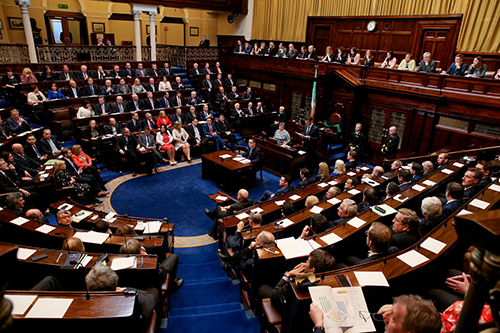
Opposition TDs have said that the government had no mandate to remove the Triple Lock.
On Wednesday (October 21st), the Dáil heard contributions from both government and opposition parties on the contentious issue.
Despite removing the Triple Lock not being featured in either Fianna Fáil’s or Fine Gael’s 2024 general election manifestos, the coalition voted 79 to 71 to remove the Triple Lock.
A stormy three-and-a-half-hour debate saw leader of the opposition Mary Lou McDonald state that Ireland was being “dragged into EU military structures, dangerous alliances and further alignment with NATO.”
The Dublin Central TD stated that the government not putting the issue to a referendum was a “profound betrayal.”
Addressing Taoiseach Micheál Martin, McDonald stated “it is not for you, for Fianna Fáil, for Fine Gael or your government to decide the future of Irish neutrality; that is for the people to decide.”
In 2013, when Martin was serving as leader of the opposition, Martin told the Dáil that removing the Triple Lock was an “out-of-touch ideological obsession on the part of Fine Gael which ignores the facts of Ireland’s international standing.”
Martin claimed in June 2013 that “there is no reason whatsoever to change it (Ireland’s relationship to neutrality”) and further stated, “such a change will impress no one in Europe, and it will contribute nothing to international peace.”
Martin’s change of heart on the issue has been spurred by Russia’s aggression since 2013.
Responding to McDonald’s charges, he claimed that the Sinn Féin leader “wants Russia, the United States and China to have the power of veto over whether Ireland ever again in the future participates in a peacekeeping mission.”
“That is the essential difference; she has created false narrative after false narrative, but the essential difference here is how we develop a capacity. We need to be honest with our military about this as well, including with soldiers and their families.
McDonald said that the Taoiseach’s approach to the debate was “to downplay, dismiss and trivialise your shameful manoeuvring; the dishonesty is staggering.”
Fine Gael TD James Geoghegan accused the opposition of “fundamental lies” during the debate.
The Dublin Bay South TD said, “there are two fundamental lies that have underpinned the opposition debate in respect of the issues that pertain to this bill.”
“The first is that this bill represents some form of attack on multilateralism and the United Nations. The second lie is that this somehow represents a transition from Ireland being peacemakers to being conflict makers,” he commented.
Geoghegan stated, “I do not think Sinn Féin has any credibility with the public when it comes to telling people where the Defence Forces are going to enter conflict or where any Irish man or woman is going to enter conflict versus the defence of peace.”
“For decades in this country, Sinn Féin and its predecessors sent men and women into conflict when others were looking for peace, so it has no credibility. Leaving aside the fact that Sinn Féin has no credibility, its claims are simply not true,” he remarked.
Social Democrats TD Sineád Gibney stated that the government has “no mandate” to abolish the Triple Lock.
Gibney reserved her strongest criticism for Fine Gael, stating “they do not support neutrality; they never have and never will, as long as they are in power.”
“The bill finally puts the nail in the coffin of Irish neutrality and allows Fine Gael to pursue its goals, namely, to drag us towards militarisation along with its EPP partners,” she said.
The Dublin Rathdown TD noted that there is a “schism” in Fianna Fáil on the issue.
She claimed that “some of its TDs are seeing through the Government spin and recognise that this is an absolute nail in the coffin of Irish neutrality.”
Gibney further stated, “the opposition is completely united and is working together to open the eyes of the public, who are with us on this, and those of the government TDs who are being hoodwinked by the Cabinet spin.”
Fianna Fáil TD John Lahart stated, “there is so much hysteria on the opposition benches” on the issue.
The Dublin South-West TD said, “this debate is not about ending Irish neutrality, it is not about joining NATO, and it definitely is not about creating a European army.”
Lahart said, “the opposition cannot credibly claim to defend Irish sovereignty. Sinn Féin, the party whose very name means ‘ourselves alone ‘”, would leave Ireland dependent on a system where Russia or China can determine where Ireland sends its peacekeepers.”
“Sinn Féin, ironically, would allow Britain more say than our parliament over where we deploy our peacekeepers,” he claimed.
Lahart further charged the the oppostiion does not “trust the elected representatives of the people.”
“If you believe in Irish democracy, you should have the confidence to allow democratic decisions to be made here in this house by members sent here by the people,” he said.
People Before Profit leader Richard Boyd Barrett called the government’s stance a “historic betrayal” of Ireland’s long-standing neutrality stance.
The Dún Laoghaire TD said “anybody can claim them and indeed Donald Trump, if pushed, would probably claim his actions are in line with international law and the Charter of the United Nations.”
“What the government is actually doing is removing the block on the Irish government being able to deploy troops in those situations. Would the government send young people to die in wars in which they did not want to die,” he asked.
Boyd Barrett stated “the UN is far from perfect. It is very far from perfect but the one thing the veto does is prevent us from being involved in military conflict where the big powers are at loggerheads with each othe; that is the whole point and that goes right back to Wolfe Tone and Connolly and that we do not side with empires.”
Independent TD Paul Gogarty said the debate about Ireland’s neutrality was one worth having.
The Dublin Mid-West TD said, “like others, I value our neutrality, and insofar as it is reflected in our Constitution, we have a number of checks and balances.”
“Article 29 commits Ireland to peace, international justice and the peaceful settlement of disputes. Following the Lisbon Treaty, it also explicitly provides that Ireland shall not adopt any decision relating to a common defence of the European Union.”
Gogarty said “I am comfortable with these arrangements remaining as they are, although some argue that Ireland should be prepared to demonstrate greater military solidarity with other European states, particularly the smaller Baltic nations and others like Poland, if they are faced with real and serious aggression, and that aggression is becoming a higher risk. It is a legitimate debate to have, even within our own European affairs committee.”
He said that scrapping the Triple Lock would represent a “profound change” in Irish policy, and “that sort of thing should only occur after a proper discussion.”
“That type of debate should ultimately go to a vote of the Irish people,” he said.