


The names of 570 people who died in the Irish Sea’s greatest maritime disaster have been inscribed on a new memorial in Dún Laoghaire, ensuring their lives are remembered 108 years after the sinking of the RMS Leinster.
Unveiled beside the ship’s recovered anchor on Saturday, October 10, the memorial commemorates those lost when the Holyhead-bound mailboat was torpedoed shortly after leaving the town on October 10, 1918.
Civilians, postal workers, nurses, crew members and military personnel were aboard the Irish-owned vessel when it was attacked in the final weeks of the First World War.
The sinking brought devastation to families across Ireland and far beyond.
For Dún Laoghaire, then known as Kingstown, it became a disaster closely bound to the town’s history, as survivors were brought back to the harbour from which they had departed.

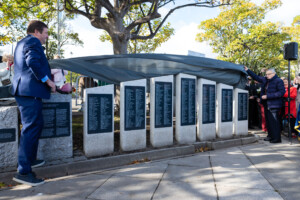
Unveiling Memorial to the RMS Leinster.
Picture by Shane O’Neill, Coalesce.
Cathaoirleach of Dún Laoghaire-Rathdown County Council, Cllr Barry Saul (pictured above), unveiled the memorial on the anniversary of the attack.
He paid tribute to the sustained efforts of those who have researched the sinking, preserved the stories of passengers and crew, and worked to secure a permanent record of the victims’ names.
“This memorial is the result of many people’s efforts over the years to ensure that the tragedy of the RMS Leinster is not forgotten,” he said.
“It is the latest step in a collaboration of remembrance – following on from the recovery of the anchor in 1991, the major events to mark the centenary in 2018, the films, books and digital resources now available and most importantly, the memories of the descendants and relatives of the people who lost their lives on that terrible day.”
Those commemorated came from Ireland, Wales, Scotland, England, the Channel Islands, New Zealand, Australia, Canada, the United States and Lithuania.
The breadth of those connections reflects the mix of passengers travelling aboard the Leinster, which carried both civilian travellers and personnel serving during the war.

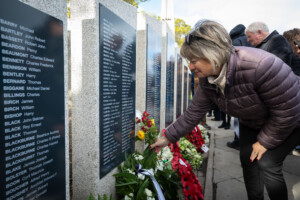
Unveiling Memorial to the RMS Leinster.
Eileen Creedon.
Picture by Shane O’Neill, Coalesce.
Operated by the City of Dublin Steam Packet Company, the vessel served the Kingstown-Holyhead mail route, connecting Ireland with Wales and carrying postal workers who sorted mail during the crossing.
The Leinster was one of four steamers ordered by the company in 1895 for Royal Mail service. Named after Ireland’s provinces, the ships were the Leinster, Connaught, Munster and Ulster.
Built at Laird’s shipyard in Birkenhead, England, the Leinster was a 3,069-ton steamship. During the war, it was armed with a 12-pounder gun and two signal guns.
The ship had previously escaped a torpedo attack in the Irish Sea. On October 10, 1918, however, it was struck by the German submarine UB-123 outside Dublin Bay, east of the Kish light.
Just before 10am, as the vessel travelled through a heavy swell, passengers saw a torpedo approaching from the port side. It passed ahead of the bow.
Another followed shortly afterwards, striking the forward part of the ship near the mail room, where postal sorters were working.
As the vessel began to settle by the bow, it turned in an attempt to make its way back to Kingstown.
A further torpedo struck, causing a huge explosion, and the ship sank rapidly.
Despite the conditions, crew members managed to launch several lifeboats. Some passengers clung to life-rafts as they waited for help.
Rescue vessels brought survivors back to Kingstown harbour, but hundreds of those who had set out that morning never returned.
Among the civilians who died was Rev John Bartley, the Presbyterian minister of Tralee.
He had been travelling to visit his mortally wounded son in hospital.
Others included Lady Phyllis Hamilton, daughter of the Duke of Abercorn, and Robert Jocelyn Alexander, son of the poet and hymn writer Cecil Frances Alexander.
Thomas Foley and his wife Charlotte also died. Foley was a brother-in-law of the Irish tenor John McCormack, who subsequently adopted the couple’s eldest son.
Josephine Carr, the first member of the Women’s Royal Naval Service to die on active duty, was among the victims, as were Irish Transport and General Workers’ Union officials James McCarron and Patrick Lynch.
Several of the military personnel who died are buried in Grangegorman Military Cemetery, providing another Dublin connection to the tragedy.
Those rescued included Michael Joyce, the Irish Parliamentary Party MP for Limerick City, and Captain Hutchinson Ingham Cone of the United States Navy, who headed US Naval Aviation Forces in Europe.
For survivors, escaping the sinking did not end its impact. The trauma of their experience remained with them in the years that followed.
The new memorial places the names of those lost alongside the ship’s anchor, linking the individual lives commemorated with a physical reminder of the vessel.
Council chief executive Frank Curran said it formed part of a wider landscape of remembrance along the town’s waterfront.
“This listing of the names of those who died when the RMS Leinster sank joins a number of memorials along Dún Laoghaire’s waterfront remembering those who died at sea,” he said.
“These form an important part of the public realm of Dún Laoghaire and ensure that we make space in the modern world to remember the people and events of the past.”
The project was supported by the council’s Civic Memorials Committee, the RMS Leinster Memorial Committee, RMSLeinster.com and the Maritime Institute of Ireland.
Funding was provided by the Heritage Council of Ireland and the Department of Culture, Community and Sport.
The unveiling adds a permanent roll of names to the work of remembrance described by Cllr Saul, preserving a place on Dún Laoghaire’s waterfront for those who made their final journey aboard the Leinster.