


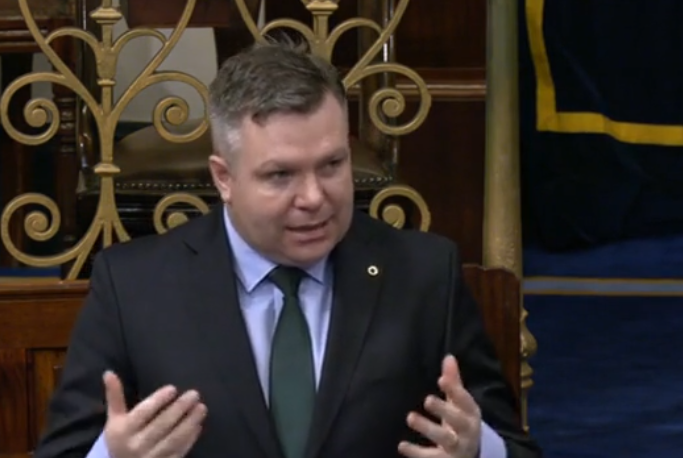
Fianna Fáil TD Shane Moynihan has said that more needs to be done to improve supports for students with dyslexia and speech and language needs.
The Dublin Mid-West TD acknowledged that while improvements have been made for students on the autism spectrum, the same could not be said for other neurodivergent students.
Moynihan said that “concerns have been raised with me that this progress has not necessarily been reflected in the provision of dyslexia and speech and language needs.”
“Associated with that are needs around dyspraxia and apraxia of speech as well, especially where there is a co-occurrence of autism,” he explained.
Moynihan said there were no reading classes or specialist reading schools in his constituency of Dublin Mid-West, and the same could be said of Dublin as a whole; he noted that there are only a few in all of Dublin and indeed, across Ireland.
He noted “the early signs of dyslexia are not always recognised or acted upon in a timely way,” and for that reason, better support systems were needed.
Moynhian said that there are capacity constraints in the National Educational Psychological Service, which he acknowledged has an impact on psychological assessments.
The current practice of using standardised test scores to inform decisions on additional support, per Moynihan, is not an effective tool in detecting students with underlying learning difficulties.
He said that standardised test scores “primarily measure attainment rather than the underlying learning difficulties and may only highlight the issues once a child has already begun to fall behind.”
“International best practice suggests that early screening of key indicators, such as phonological awareness and letter sound knowledge, are the sorts of things that we should be zeroing in on.”
He said that structured literacy instruction or targeted small group or individual intervention delivered by trained staff would be a better solution to the current education model.
Moynihan then questioned if the same model used for students on the autism spectrum could be used for students with dyslexia, and whether the Department of Education is developing a national framework on the issue.
The Fianna Fáil TD also said that the expansion of the National Educational Psychological Service was needed to tackle the issue.
The elephant in the room, as far as Fianna Fáil are concerned, is that they held the Education brief in the last government (and have worked with Fine Gael in some capacity since 2016), yet they failed to expand resources for students with additional educational needs.
Fine Gael TD Neale Richmond took the question on behalf of Minister Hildegarde Naughton, and he agreed that the issue was “pertinent.”
The Dublin Rathdown TD stated that it was the Department of Education’s policy to support students with additional learning needs in mainstream classes, with additional supports provided “as necessary.”
Fine Gael, which now controls the Education brief (and has held it for three of the last five governments), has reiterated that funding has increased under their watch, but critics argue that funding alone is not a silver bullet to tackle the crisis in special needs education.
Richmond said in the Dáil “the Department has invested considerably in ensuring that all recognised mainstream schools have been allocated additional special education teaching resources to support children with special educational needs, including students with literacy difficulties.”
He explained, “there are 15,000 special education teachers allocated to primary and post-primary schools to enable them to support children with special educational needs; I know that, as my wife is one.”
Richmond said that the National Council for Special Education has ultimate responsibility for planning co-ordinating school supports for children with special educational needs, and iterated that the Department of Education does not have a role in making individual school determinations.
The NCSE was established in 2003 as an independent body that operates in the same orbit as the Department of Education, but is separate from the Department itself in terms of decision-making.
Richmond said it was “important to note” that the majority of students with literacy difficulties currently receive additional teaching support from a special education teacher in a mainstream class.
He explained that the support is provided on the basis of the individual student’s learning needs identified in schools, as opposed to being based on a requirement for a child to have a diagnosis or an assessment of a particular disability.
Richmond said there are 14 classes in Ireland that are dedicated to students with specific learning disabilities in mainstream schools, and conceded that none were in Dublin Mid-West.
He expressed hope that the classes could become more widespread across Ireland in the near future, as the classes have a student-teacher of 9:1, regarded as an ideal ratio by education experts.
Richmond said that Minister Naughton was working to expand “enhanced supports” in mainstream schools for students with literacy difficulties, and said that the Minister would provide an update on the plan “soon.”
In response, Moynihan said that the current practice of acquiring extra resources for students with educational needs is “extremely onerous,” and said that the government’s focus should be on “ensuring the resources and hours required are made available in a targeted and timely way.”
Moynihan said it was “important” that the development of a national framework for students with dyslexia was “evidence-based.”
“It is important that teacher training be made available on a consistent basis. While I welcome that some specialist supports are provided in schools, there is also a need for an expansion of the reading classes the Minister of State mentioned in his reply.
“They do not necessarily need to be in a school setting, but the provision of more reading classes in schools is an important step in addressing the medium level of difficulty some children might have,” he said.
Moynihan said there are cases in his constituency where children in an autism special class are not able to access speech and language supports because it is not seen in the overall suite of supports provided to children in an autism class.
“While I am not for a second suggesting we should stop our roll-out of autism classes, I am concerned that we need to give the same level of attention to speech and language difficulties that in many cases coincide with a diagnosis of autism,” he said.
“In many cases, a school may need proper specialist support that might be more than the SEN hours allocated to a school, and that might require the opening of a reading class or, in some instances, the expansion of the reading school. Those disabilities are as important as the ones we are rightly responding to at the moment,” he said.
Richmond said that “going to the nub” of special education runs the risk of “missing certain aspects” and that it was difficult to “put that into a straight column.”
Richmond said that the Department will “continue to engage intensively with the NCSE on forward planning for new special provision to ensure every child has a place in an educational setting, which, where possible, best fits their special needs.”
The Fine Gael TD said that there are 15,000 special education teachers and 12,500 SNAs already in the system at present.
“For children with more complex needs, special class or special school places are still important; that is in keeping with the policy.”
Richmond acknowledged that there is a need for “a degree of flexibility to allow children to adapt to settings to allow them to flourish to their best, particularly at the key ages of between eight and 12 when diagnoses are made.”
“It is about putting in a learning support plan that is appropriate to the child’s needs and the setting,” he said.
Richmond said there is no “perfect answer to any of the issues,” and acknowledged the width and breadth of issues that TDs deal with.
“However, the issues the Deputy raised provide me with great material, which I will put directly to the Minister and I will ask her to respond to the Deputy with additional information in due course,” he said.