


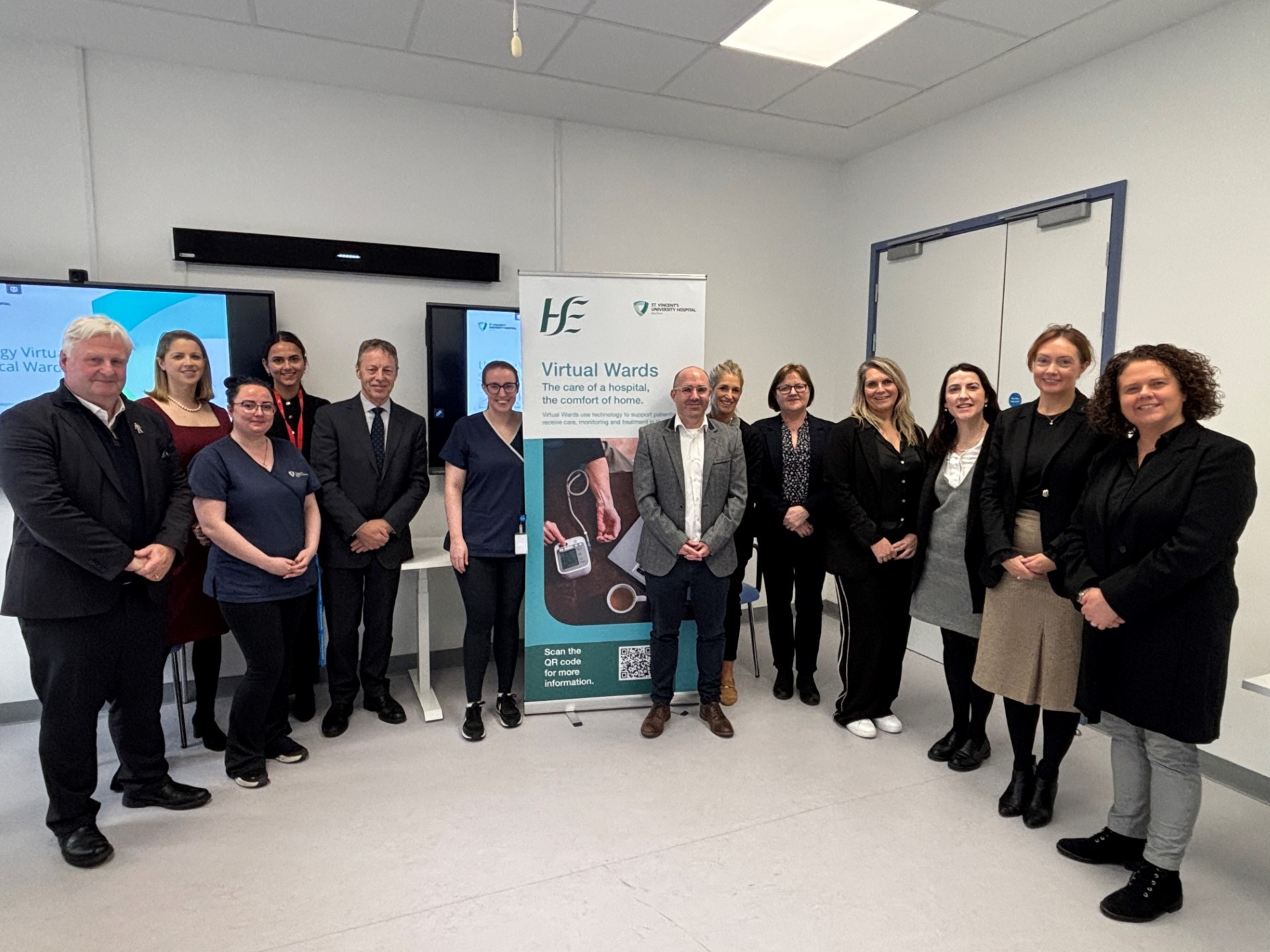
St Vincent’s University Hospital has launched Ireland’s first surgical pathway within its Virtual Ward, allowing suitable urology patients to recover at home while remaining under full hospital supervision.
The initiative marks a significant step in how surgical care is delivered and coincided with World Kidney Day.
It forms part of the HSE’s National Virtual Ward Programme, which began in July 2024 at St Vincent’s and University Hospital Limerick, but this is the first time a surgical specialty has moved into the model.
Under the new pathway, patients can receive hospital level monitoring at home, including daily consultant review, continuous remote oversight and rapid access back to the hospital if needed.
Patients can return directly through the Virtual Ward system without going through the Emergency Department.
Urology patients often require admission for observation, scans or early post operative care, which can lead to extended stays and added pressure on hospital beds.
During busy periods, some patients have traditionally been placed on non specialist wards.
The new pathway covers a wide range of conditions, including urinary infections, catheter and stent care, and recovery following procedures such as transurethral resection of bladder tumour, transurethral resection of the prostate and ureteroscopy.
The Virtual Urology pathway went live in September 2025 and early results point to clear benefits.
The hospital reports shorter inpatient recovery times, reduced lengths of stay and fewer attendances at Emergency Departments.
The initiative has freed up 162 urology bed days so far, helping to increase capacity and support earlier discharge.
These outcomes reflect wider progress within the Virtual Ward service, which has treated more than 1,300 patients across multiple specialties since its launch.
he programme has delivered the equivalent of over 12,400 bed days saved.
The pathway was developed in collaboration with the Office of the Chief Clinical Officer and the RCSI National Clinical Programme in Surgery, and is now being considered as a model for wider national rollout.
Mr David Mulvin, Clinical Director of Surgery at St Vincent’s, said the pathway represents a major shift in surgical care.
“This is a significant development in how we deliver surgery in Ireland. The Virtual Ward with a Surgical Urology Pathway allows patients to recover safely at home under continuous consultant oversight, while also freeing vital acute beds for emergencies and planned theatre activity.
“It improves patient experience and supports a more efficient surgical service.”
Brian Murray, peri operative Directorate Nurse Manager, said the model has improved patient experience while maintaining strong clinical support.
“The success of this pathway is built on close collaboration between peri operative staff and the Virtual Ward nursing team.
“For many patients, recovering at home means less stress and a smoother experience but with the reassurance of continuous hospital oversight.
“It’s a modern, responsive way of delivering surgical care.”
The launch was attended by Prof Eamonn Rogers, Co-lead of the National Clinical Programme in Surgery at the Royal College of Surgeons in Ireland (RCSI), who said the programme sets a new standard for innovation in surgical care and could be adopted nationally.
“What SVUH has achieved with this Surgical Urology Pathway is genuinely impressive.
“It sets a new benchmark for how digital innovation can enhance surgical care while maintaining the highest clinical standards.”
Patient feedback has also been strong, with 95.6 per cent rating their experience as good or very good, and some months achieving full satisfaction.
The Virtual Ward at St Vincent’s now supports a growing number of medical and surgical specialties and is expected to expand further as part of national plans to modernise healthcare delivery.