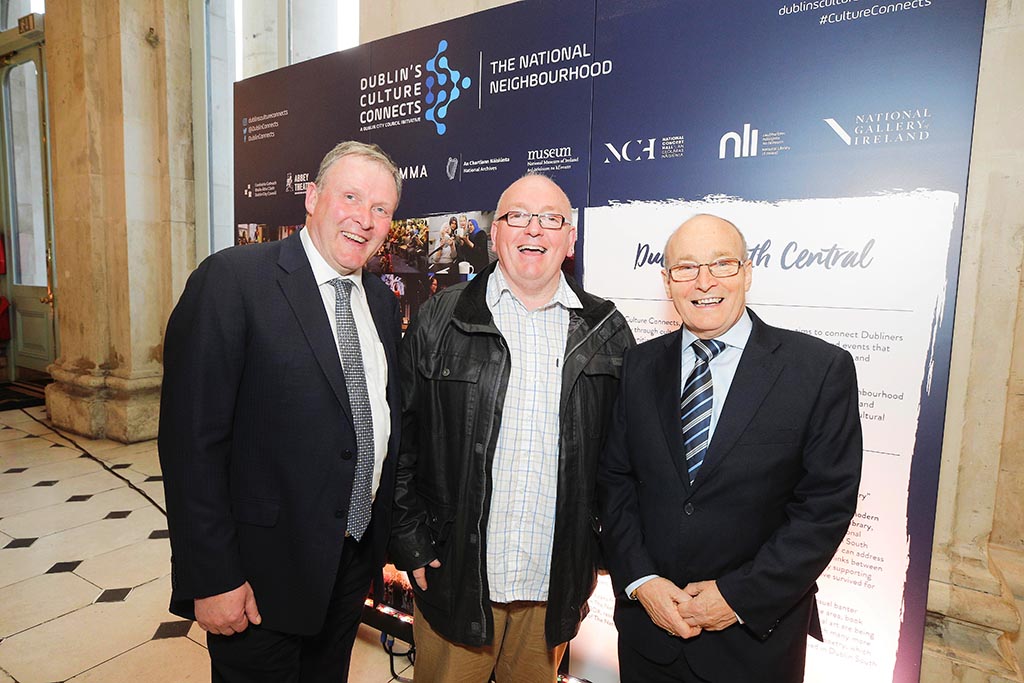
WOMEN in history, the links between health, poverty and housing and music and theatre performances were just some of the themes explored as part of Dublin’s Culture Connects: The National Neighbourhood.
The second wave of the highly successful culture in the community initiative was launched by Lord Mayor of Dublin Micheál Mac Donncha at City Hall recently.
Dublin’s Culture Connects aims to connect Dubliners to their city by working collaboratively with artists and the National Cultural Institutions on cultural projects that reflect the concerns and ambitions of their communities.
More than 1,000 residents from 29 neighbourhoods across the city made cultural projects as part of the initial The National Neighbourhood activities last year.
The project brings together the Dublin City Council arts, cultural and community resources in partnership with all eight National Cultural Institutions.
These are located in Dublin – The Abbey Theatre, The National Museum of Ireland, The National Library of Ireland, The National Gallery of Ireland, The National Concert Hall, The Chester Beatty Library, The National Archives and The Irish Museum of Modern Art.
The Lord Mayor Micheál Mac Donncha said: “The National Neighbourhood addresses a key aim of Dublin City Council. We want every neighbourhood to know and ‘own’ their city’s cultural resources.
“The National Neighbourhood is all about building projects in community settings – to connect villages and their communities and groups to libraries, museums, creative places and to artists.
“This programme enables people to make and take part in culture, working together to deepen their understanding of their city, their communities and themselves.”
As was the case in 2016/2017, each of the council’s five administrative areas has been partnered with national cultural institutions to deliver The National Neighbourhood projects in 2017/2018.
Working with the Irish Museum of Modern Art (IMMA), the Chester Beatty Library, and Dublin City Council, National Neighbourhood projects in Dublin South Central are considering how they can address complex challenges such as the links between health, poverty and housing, by supporting resilient communities that have survived for decades.
The National Neighbourhood in Dublin South East takes place mainly around Kevin Street, Bishop Street, Whitefriar Street, Patrick Street and Rathmines.
So far it has engaged with groups that are young and old, spanning schools, students, international residents and senior citizens, and the artforms being investigated include literature, visual arts and animation.
The Chief Executive of Dublin City Council, Owen Keegan, said: “I am delighted to see the National Cultural Institutions developing such a close working relationship with Dublin City Council – and to see us all working together with neighbourhoods on activities and projects that are really important to them.
“This is a key objective of the City Council. The National Neighbourhood programme involves our Area Offices, Arts Office, Public Libraries and Dublin City Gallery The Hugh Lane.
“These partnerships have covered 29 Dublin neighbourhoods, with 86 community groups and 103 artists.
“Over 1,000 citizens created performances and exhibitions, 3,000 took part in workshops and events and more than 10,000 engaged online."
Dublin’s Culture Connects project director, Iseult Byrne added: “All of our programmes are built on our five core values of participation, partnership, relevance, quality and capacity building.
“Through The National Neighbourhood we are working with communities to make cultural projects together.”