


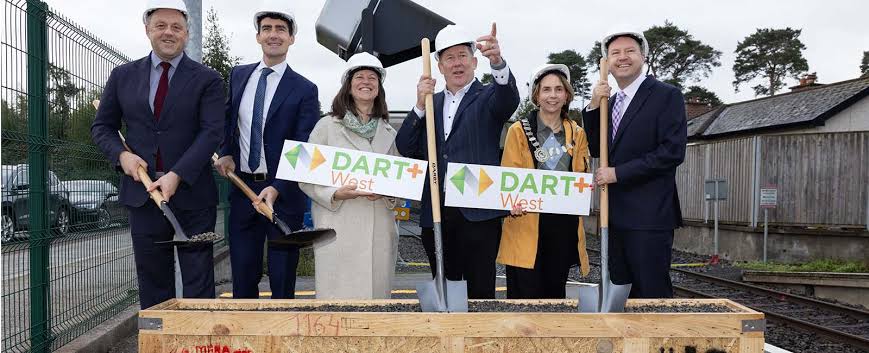
Work on the highly anticipated DART+ West project is underway.


Shovels are in the ground for the railway project, which will see DART-like frequency of railway services on the Maynooth and M3 Parkway lines.
The works will double the passenger capacity and treble the electrification of existing railway services in West Dublin.
The first major enabling works took place over Halloween weekend at two bridges between Hansfield and M3 Parkway.
Excavation works will take place to lower the track level, and overhead power lines (required to operate the DART+ Fleet) will then be installed later without the need to modify the height of the existing road bridges over the railway.
While fully expanded DART services are a few years away, the finished project will see over 50,000 passengers per hour going in each direction.
It is expected that commuter towns such as Dunboyne and Maynooth will be the major beneficiaries of the improved rail services, while the planned works at Dunsink (as reported in last week’s Northside People) are also set to benefit from the improved rail capacity.
DART+ West will expand DART services to include communities in Ashtown, Pelletstown, Broombridge, Castleknock, Coolmine, Clonsilla, Navan Road Parkway, Drumcondra, Leixlip, Maynooth and Hansfield, Dunboyne and M3 Parkway, providing a DART service at least every 10 minutes.
A new station at Spencer Dock is also part of the works, with plans to have an interlink with existing Luas services in the area.
Certain level crossings will be closed on the route as part of the works.
Minister for Transport, Darragh O’Brien, said that the works mark a “major milestone” as the project moves from the planning process to the building process.
“Dart+ West is the first major infrastructure element of the programme to enter construction, and it will provide additional rail capacity, a new depot and electrification works to support a much improved rail service on both the DART+ West line and for the wider DART+ programme as a whole,” the Fianna Fáil TD said.
Junior transport minister Sean Canney said that the government were progressing rail projects right across Ireland, and not just in the Dublin area.
“We are improving railway services in the West, through the reinstatement of the Western Rail Corridor from Claremorris to Athenry, in the South, through advancing Phase 2 of the Cork Area Commuter Rail Programme and in the Greater Dublin Area, through the DART+ Programme,” the Galwegian said.
Niall Butler, delivery director at Iarnród Éireann said the works are a “huge milestone” for the organisation.
“These enabling works signal the commencement of the most transformative public transport infrastructure investment programme that our rail network has ever seen. We are delighted to be progressing these works in collaboration with our colleagues in Iarnród Éireann, utilising our in-house resources to design and undertake these works.”
“We believe the commencement of these works represents a real statement of intent to deliver the scheme, a very positive message for our supply chain as we work toward the next stage of our tender process,” he said.
Eoin Gillard, assistant director with the National Transport Authority, said “the commencement of these enabling works marks an important milestone in the delivery of the DART+ West project.”
“This investment will expand the electrified rail network, increase capacity and deliver more frequent services for thousands of passengers travelling across the Greater Dublin Area. As a key part of the wider TFI network, DART+ West will improve connectivity, provide greater travel choices and support the continued development of the region. These works are the first visible steps in bringing the benefits of DART+ West to communities along the corridor.”
In September, Iarnród Éireann announced it was beginning compulsory purchase orders along the planned route, and it had begun the consultation process with affected homeowners.
Fine Gael TD Emer Currie has said that overcrowding is still an issue on Maynooth-bound trains and has asked what Iarnród Éireann is doing to alleviate capacity issues.
As part of the seeming gold rush to build in the West Dublin area (the aforementioned Dunsink project and the planned Broombridge-Hamilton project are testament to this), rail services have become busy on Dublin commuter routes.
This week, the Kildare Nationalist reported that passengers were fainting on Dublin-bound services as a result of overcapacity.
Labour TD Mark Wall said he has been contacted by “hundreds” of constituents about overcrowding, and said that “overcrowding serving commuters in the county is now presenting a serious health and safety risk.”
“These towns in Kildare seem to be the worst impacted, with many constituents highlighting that they are packed in like sardines on these trains. I have heard from hundreds of people from Kildare train stations, and they have highlighted a number of serious incidents such as people fainting because of how overcrowded these trains have become,” he told the publication.
Currie also raised the issue of overcrowding on local rail services.
During a Dáil committee, Currie noted that the number of weekday services to Maynooth has remained at 74 since September 2019.
“I acknowledge that there has been an increase in the number of longer trains, eight-carriage trains, since 2025, but there are still a lot of reports of overcrowding. How is overcrowding on trains measured during the morning and afternoon school commutes? Does Irish Rail measure the number of passengers unable to board as well as those already on the train, or is it the level of discomfort?”
Barry Kenny of Irish Rail explained, “at peak times, and this is not unique to Irish Rail but an international phenomenon, the trains are designed to accommodate full loading.”
“I appreciate that it is not comfortable at all times; we want to be able to carry everybody on every service. Effectively, if we are leaving people behind on a service, that is the problem. That is not physically counted as such, but obviously we have direct driver and station reports on that, and those help inform our planning.
He said that Irish Rail is “very limited” in terms of how it can tackle the issue until the new train carriages are put online.
Currie said there are “chronic capacity issues”, and it has become an issue among constituents in Dublin West.
With the Dart+ West project not expected to be finished by 2032 (and that may well slip, considering Ireland’s track record of delivering infrastructure projects), the discomfort may last a bit longer yet.