


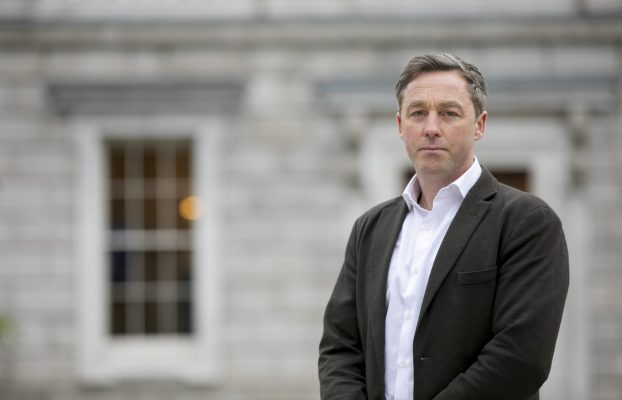
Social Democrats TD Rory Hearne has questioned how serious the government is about tackling the homeless crisis.
Dubbing the situation a “disaster,” Hearne said that a ban on evictions is needed and that vulture funds should not be allowed to buy up homes.
Minister for Housing James Browne said that implementing the likes of a no-fault eviction ban is “giving people false hope” and claimed that it would “kill supply.”
He asserted that what Hearne is proposing would merely “freeze” the crisis and prolong the housing crisis, now approaching its 10th year as a major political issue in Ireland.
Upon taking office in 2017, Taoiseach Leo Varadkar stated that the housing crisis and the homeless crisis would not be solved within the lifetime of his government.
In March 2018, homeless figures reached 10,000 for the first time, a figure that Varadkar dubbed “disturbing,” but based on current projections, the homeless population of Ireland will hit 20,000 by the time of the next general election.
The most recent round of figures revealed that 5,830 children are in emergency accommodation across Ireland; in the same month Varadkar called the figures “disturbing,” the figure relating to children in emergency accommodation stood at 3,755.
Responding to the figures, Hearne asked “what emergency action is the Minister taking to immediately stem the flow of families and children into homelessness and the length of time people are spending in homelessness?”
“I have not seen an emergency response from the Minister to this homelessness disaster. What will he do about it?”
In response, Minister Browne responded, “I do not want find any person in homelessness and one is one too many. In particular, it is not acceptable that young children and young people are ending up in emergency accommodation.”
“We want them to exit as quickly as possible when it does happen. We are determined that this situation is not normalised,” he said.
Since Browne took over as Minister for Housing in January 2025, homeless figures have jumped from 15,286 to 17,885.
Sociologists have noted that the true homeless population of Ireland is likely over 20,000, as the figures released by the government only take into account people in emergency accommodation; the government figures do not take “invisible homelessness” into account, which involves people sleeping in cars or sleeping on couches.
Minister Browne said, “I do not want it to be considered acceptable by any member of this state or any state agency, and we do not.”
Despite the rising numbers, Minister Browne claimed, “we are challenging this situation,” and pointed to the government’s record on preventing people from entering homelessness and leaving homeless services.
“When people are homeless, we provide emergency accommodation. It is important to understand that these people are not sleeping on the streets. We have people sleeping on the streets, and there is outreach. There is no need for anybody to be on the streets. People living on the streets are in very complex situations, but we provide accommodation for everybody who needs it through emergency accommodation,” he explained.
Minister Browne asserted, “we are working relentlessly to address this situation and to tackle homelessness through prevention but also speeding up exits as quickly as possible.”
He said that last year, the government provided the highest number of social houses in the history of the state.
The Fianna Fáil Minister said that the government’s aim was to get people out of emergency accommodation and into social housing, as well as reducing the number of people on HAP, as that involves the state paying private landlords.
“That is why we have seen the number of HAP properties fall very significantly because of people exiting into permanent social housing solutions,” he explained.
Hearne pointed the finger at the government’s controversial changes to rent laws for driving the recent wave of homeless figures going up.
“There are hundreds of thousands of tenants, including tens of thousands of families and children, who are as vulnerable to eviction as they were before the Minister brought in the new measures,” the Dublin North-West TD said.
“We can look at the scale of evictions. There were 20,000 households evicted last year and over 11,000 evicted this year. In the past two and a half years, 48,000 households have been issued eviction notices. That is why we are seeing a massive rise in homelessness,” he claimed.
The Social Democrats housing spokesperson said that the Minister has the power to introduce a no-fault eviction ban, but has decided not to.
In the last government, and as a result of the Green Party’s moderating influence on the Fianna Fáil/Fine Gael government of the day, a no-fault eviction ban was introduced from October 2022 until April 2023.
As a direct result of the ban being introduced, homeless figures dropped; in the final month before the eviction ban was lifted in April 2023, the figure stood at 11,988.
In the first month after the ban was lifted, the figure jumped to 12,259, and the following month saw a further rise to 12,441.
Hearne said, “what really frustrates me is the Minister has the power right now to implement an emergency ban on evictions that would at least stem the flow and stop the trauma of families and children being evicted.”
“He showed what he can do when he wants to, when he made the changes for vulture funds, but when it comes to stopping families from being made homeless, he should put in place a ban on evictions,” he stated.
Minister Browne refuted Hearne’s charges, saying that “the Deputy knows full well he is giving people false hope.”
“If you implement a ban on evictions, you kill supply straight away. The population is increasing. Where will you house everybody else who needs somewhere to live?”
The Minister said, “freezing the crisis into a permanent crisis is not the solution to solving the housing crisis; it gives some people short-term support, but when you end it, you do not have any solutions.”
“We are where we are, only even worse when a temporary eviction ban comes to an end. We have seen that. That was tried. We have seen exactly what happens in that – kill supply and the crisis is only worse when you come out the other side of it,” he said.
“Freezing the crisis into a permanent crisis, which is the Deputy’s proposal, will not solve this,” Minister Browne claimed.